
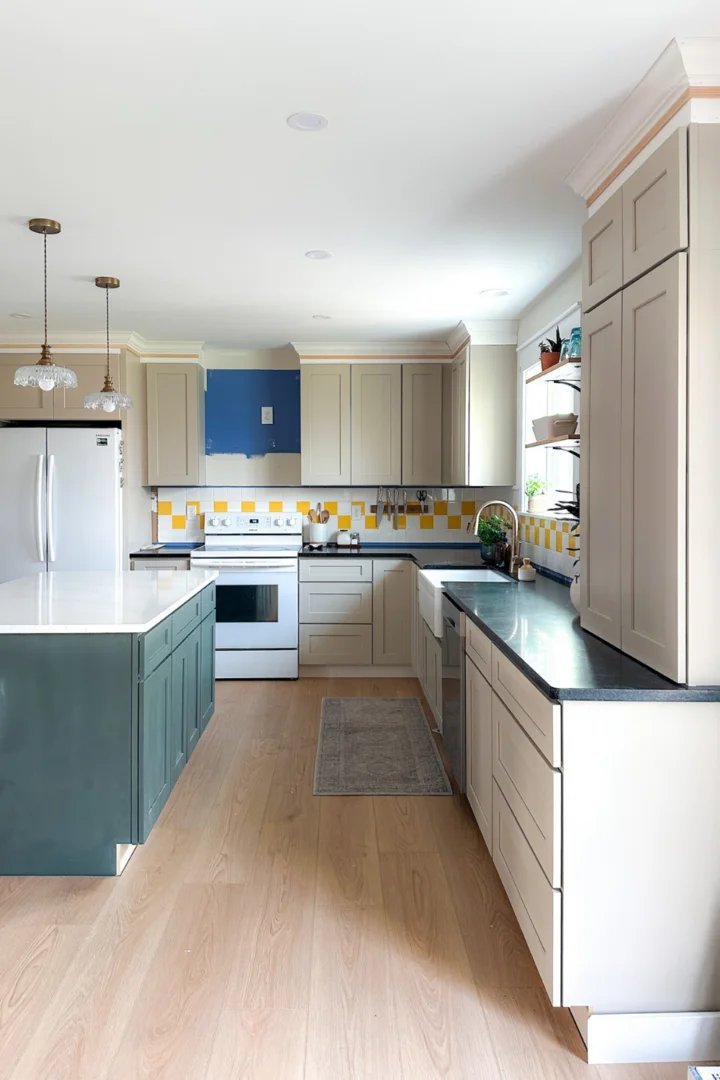
Your kitchen is stuck in 1998 — oak cabinets with that orange glow, tired laminate counters, a backsplash you’d rather not look at. A full remodel costs $25,000+, which isn’t happening. But here’s the thing: kitchens respond incredibly well to cosmetic upgrades. You can transform the whole feel of the room for under $1,000 if you spend it in the right places. These are the cheapest ways to update an outdated kitchen, ranked by impact per dollar.
1. Paint the Cabinets (Biggest Impact, ~$100–$300)
Nothing dates a kitchen like the cabinets, and nothing transforms it like paint. A quality cabinet paint job — white, soft gray, sage green, or navy — makes the entire room feel new. Cost: $100–$300 in paint and supplies for an average kitchen if you DIY.
Do it right or don’t do it: clean with degreaser, sand lightly, prime with a bonding primer, and use actual cabinet/enamel paint (not wall paint). Two thin coats beat one thick one. It’s a weekend of work, but the before-and-after is staggering — easily a $5,000 visual upgrade for a few hundred bucks.
2. Swap the Hardware (~$50–$150)
Old brass knobs and dated pulls scream “decade.” Modern bar pulls or matte black knobs cost $2–$5 each; a typical kitchen needs 20–30 pieces. It’s a one-afternoon project with a screwdriver, and it instantly modernizes every cabinet and drawer. Pro tip: if the existing holes don’t match new hardware, fill and drill — or choose hardware with the same hole spacing to skip that step. Our detailed guide to updating cabinet hardware walks through the whole process.
3. Update the Lighting (~$50–$200)
That buzzing fluorescent box or the sad single dome light is aging your kitchen more than you realize. Swap it for:
- A modern flush-mount or semi-flush fixture ($40–$100)
- Under-cabinet LED strip lights ($20–$40) — peel-and-stick, plug-in, transformative
- Updated pendant lights over an island or sink ($30–$80 each)
Good lighting makes everything else look better — the paint, the counters, the food. It’s the highest-ROI few dollars in the room. (Turn off the breaker before touching any fixture, obviously.)
4. Refresh the Walls (~$50–$100)
A fresh coat of paint in a current color does wonders, especially if your walls are beige-on-beige. Warm whites, soft greens, and light grays are safe modern choices. For the right sheen in a cooking space, see our guide to the best paint finish for kitchen walls. One weekend, one gallon or two, completely different room.
5. Add a Peel-and-Stick Backsplash (~$50–$150)
Real tile is expensive and labor-intensive. Modern peel-and-stick tiles — subway, mosaic, even faux tin — look surprisingly convincing and install in an afternoon with scissors and patience. They hold up well behind stoves and sinks for years. At $5–$10 per square foot versus $15–$30+ for real tile installed, it’s a no-brainer for a budget refresh.
6. Upgrade the Faucet (~$80–$200)
The faucet is the jewelry of the kitchen — you touch it fifty times a day, and an old crusty one drags everything down. A modern pull-down faucet in brushed nickel or matte black installs in about an hour with basic tools (shut the water off first!). It’s one of those upgrades guests notice without knowing why the kitchen feels newer. If your current faucet just drips, you might fix it instead of replacing it.
7. Declutter and Style (Free–$50)
Seriously. Clear the counters of everything except 2–3 attractive, useful items. Put small appliances in cabinets. Add one plant, a nice soap dispenser, and a wooden cutting board leaned against the backsplash. Real estate stagers do this because it works — visual calm reads as “updated.” Cost: basically zero.
What About Countertops?
If the budget stretches, counters are the next frontier. Full replacement runs $2,000–$5,000+, but there are cheaper paths: countertop refinishing kits ($100–$200, basically heavy-duty paint for laminate), butcher block from a home center ($200–$500 installed DIY), or even quality contact paper as a temporary fix. Our breakdown of budget countertop materials compares all the affordable options honestly.
What NOT to Waste Money On
Skip: replacing appliances piecemeal (mismatched looks worse than uniformly dated), expensive organizational gadgets before decluttering, and trendy finishes you’ll hate in two years. Also skip any “update” that requires a contractor unless the kitchen has real problems — the whole point is maximum visual change for minimum dollars.
Staging the “After” — Small Touches, Big Difference
Once the main updates are done, a few finishing touches make the kitchen feel truly transformed rather than just refreshed. Consistent finishes: if your new hardware is matte black, swap the switch plates and outlet covers to match ($1–$2 each) — mismatched metals are subtle but the eye notices. Under-cabinet lighting deserves repeating: $25 LED strips turn dark counters into bright workspaces and make the whole kitchen feel expensive at night.
Style the counters minimally: a wooden cutting board leaned against the backsplash, a small plant (herbs do double duty), a nice soap dispenser at the sink. Three items max — the decluttered look is what reads as “renovated.” Replace textiles: a new runner rug, fresh dish towels, and a modern oven mitt in coordinating colors cost $30 total and pull the color scheme together.
Photograph the before and after — not just for satisfaction, but because documenting the transformation helps if you sell. Buyers love a kitchen with a story, and Family Handyman’s kitchen project guides are full of similar budget transformations for inspiration on your next room.
Phasing the Project
Can’t do it all in one weekend? Phase it for maximum impact per phase. Phase 1 (biggest visual change): paint cabinets + swap hardware — one weekend, transformational. Phase 2: lighting + faucet — one afternoon, the room feels modern. Phase 3: backsplash + styling touches — the finishing layer. Spread across three weekends (or three months), each phase is manageable and the kitchen improves visibly each time — which keeps motivation up far better than a half-finished marathon.
The Bottom Line
The cheapest ways to update an outdated kitchen — paint the cabinets, swap hardware, fix lighting, refresh walls, add a stick-on backsplash, upgrade the faucet, and declutter ruthlessly — total roughly $400–$1,000 and a couple of weekends. That’s about 3% of a full remodel cost for maybe 70% of the visual transformation. Start with cabinets and hardware this weekend; you’ll be shocked at the difference by Sunday night.






2 Comments