Quick Answer: To repel carpenter bees, paint or seal all exposed wood (they strongly prefer bare, weathered wood), fill existing holes with wood filler or dowels in the fall, hang carpenter bee traps near active areas in early spring, and apply citrus oil or almond oil repellents to vulnerable surfaces. Never seal holes during nesting season while bees are still inside.
Carpenter bees look like bumblebees but behave very differently: instead of living in colonies underground, the females drill perfectly round half-inch holes into wood — decks, eaves, fascia boards, fences, pergolas, and wooden furniture — and tunnel inside to lay their eggs. Over several seasons, those tunnels weaken the wood and invite rot and woodpeckers.
The good news: carpenter bees rarely sting (males cannot sting at all), they are important native pollinators, and they are very manageable. The strategy is exclusion and deterrence, not extermination.
Step 1: Identify Carpenter Bees Correctly
Before treating, make sure you are dealing with carpenter bees and not something else:
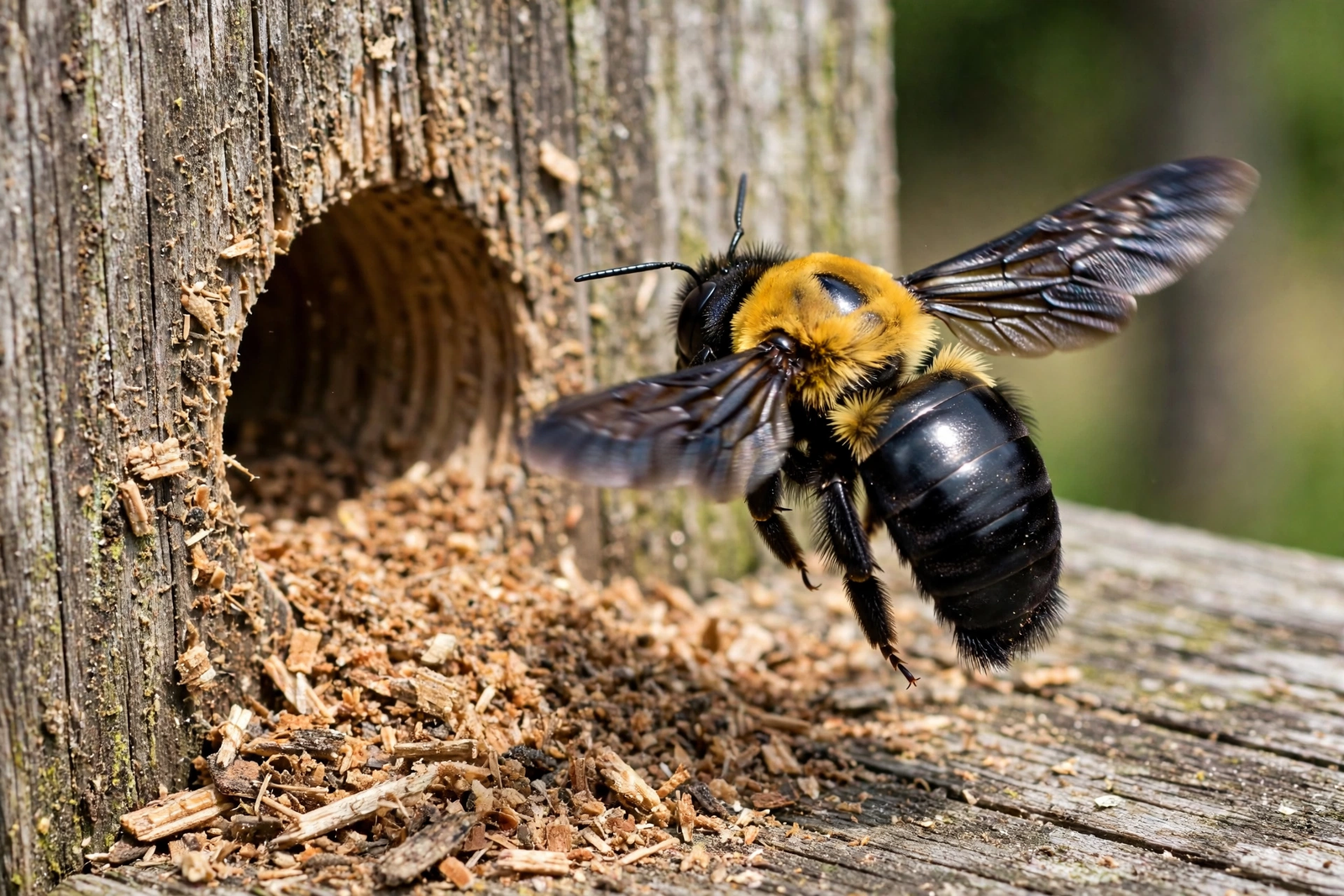
- Appearance: Carpenter bees are large (about 1 inch) and look like bumblebees, but their abdomen is shiny, smooth, and black — bumblebees are fuzzy all over.
- Behavior: Males hover aggressively around nest entrances, darting at people and pets. It looks intimidating, but male carpenter bees have no stinger — it is all bluff.
- Holes: Perfectly round entrance holes about 1/2 inch in diameter, usually on the underside of wood. Below active holes you will find piles of coarse sawdust (frass) and sometimes yellowish stains from droppings.
- Tunnels: Inside, tunnels run with the grain of the wood, typically 6-8 inches long, divided into chambers for each egg.
Carpenter bees are often confused with bumblebees (which nest in the ground and rarely damage structures) and carpenter ants (which leave fine sawdust and have narrow waists). If you are unsure, compare photos from a university extension site before treating.
Step 2: Understand Their Season
Timing matters enormously with carpenter bees. In most of the US, adults emerge in early spring (March-May depending on region), mate, and females begin drilling new holes or reusing old ones. Egg-laying happens through spring into early summer. New adults emerge in late summer, feed on pollen, and overwinter in the tunnels.
The key timing rules:
- Spring: Best time for traps and repellents — intercept bees as they emerge and look for nesting sites.
- Summer (active nesting): Do not seal holes — you will trap bees inside, and they will chew new exit holes, sometimes into your home’s interior.
- Fall: Best time to fill and seal old holes, after activity has stopped.
Step 3: Make Your Wood Unattractive — Paint and Seal
This is the single most effective long-term deterrent. Carpenter bees overwhelmingly prefer bare, weathered, unpainted softwood (pine, cedar, redwood, cypress). They rarely attack painted, stained, or sealed wood.
- Paint all exposed wood surfaces, including the undersides of eaves, deck boards, and railings — the undersides are their favorite entry points and the spots homeowners most often miss.
- Stain with polyurethane if you want to keep a natural wood look. A quality exterior stain with a sealant topcoat works nearly as well as paint.
- Use pressure-treated or hardwood for new construction and replacements — they prefer softwoods.
- Replace badly damaged wood rather than just filling it. Wood riddled with old tunnels is structurally compromised and keeps attracting new bees.
For guidance on wood-safe exterior finishes, the Better Homes & Gardens exterior guides cover product selection well.
Step 4: Fill Old Holes in the Fall
Once activity has stopped for the season (late fall), deal with existing holes — bees reuse old tunnels year after year, and each generation expands them.
- Confirm no activity: watch the holes on a warm day. No bees entering or exiting and no fresh sawdust means the tunnel is empty.
- Optional: puff a small amount of insecticidal dust labeled for carpenter bees into the hole first, and wait a few days. This kills any stragglers deep in the tunnel. Follow the label exactly and wear a dust mask.
- Plug the hole with a tight-fitting wooden dowel coated in wood glue, or pack it with wood filler/exterior caulk.
- Sand smooth, then paint or seal over the repair.
Safety note: Never plug holes during spring or summer while bees are active inside. Trapped bees will chew through drywall and emerge inside your house — a much worse problem than the original holes.
Step 5: Set Carpenter Bee Traps
Carpenter bee traps are simple wooden boxes with holes drilled at angles leading into a jar or bottle below. Bees enter the holes, see light coming from below, fly down into the container, and cannot climb back out.
- Placement: Hang traps within a few feet of active nesting areas — under eaves, on deck posts, near fascia boards. Sun-facing sides work best.
- Timing: Put traps out in early spring before nesting starts for maximum effect.
- Maintenance: Empty the collection jar regularly. A full jar of dead bees deters new visitors.
- DIY option: You can build one from a 4×4 wood block and a plastic bottle with basic tools — many free plans exist online.
Traps reduce the local population but will not eliminate carpenter bees entirely — combine them with painted wood for best results.
Step 6: Use Natural Repellents
Several substances repel carpenter bees from landing and drilling:
- Citrus oil spray: Mix 10-15 drops of citrus essential oil (or boil citrus peels) in water with a squirt of dish soap. Spray on vulnerable wood surfaces every few days during spring. Bees dislike the citrus compounds.
- Almond oil: Bitter almond oil applied to hole entrances and nearby wood is a traditional repellent.
- WD-40 or similar: Spraying into active holes kills bees inside on contact — effective but a short-term fix; the wood remains attractive afterward.
Natural repellents wash off in rain and need reapplication. Treat them as a supplement to painted wood and traps, not a standalone solution.
Step 7: Protect Specific Structures
Decks and Porches
Stain and seal all surfaces including joists and the underside of decking. Inspect each spring for new holes before the season ramps up.
Eaves, Fascia, and Soffits
These are prime targets because the wood is often unpainted underneath. Paint every surface, and consider capping fascia with aluminum cladding — bees cannot drill through metal.
Fences and Play Structures
Stain fence pickets and rails. For playsets, use a child-safe exterior sealant and inspect regularly — tunnels can weaken structural members over time.
Garden Structures
Raised beds, pergolas, and arbors made of cedar are attractive to carpenter bees. Sealing them protects the structure; also see our guide on how to start a vegetable garden for general garden pest management, since a healthy garden tolerates some pollinator activity.
What NOT to Do
- Do not spray the whole house with insecticide as a preventive measure — it is ineffective, kills beneficial insects, and washes into the environment.
- Do not seal active holes in spring/summer (explained above).
- Do not try to kill every bee. Carpenter bees are valuable native pollinators. The goal is protecting your structures, not eliminating the species. Consider leaving a sacrificial untreated wood block or bee house away from the house where they can nest harmlessly.
When to Call a Professional
Call a pest control professional if tunnels have compromised structural wood (deck supports, load-bearing beams), if you find dozens of active holes indicating a multi-year infestation, or if bees are entering wall voids where DIY treatment cannot reach. A pro can apply targeted insecticidal dusts deep into tunnel systems safely.
Carpenter bees are attracted to the same bare, weathered wood that invites other problems — our guide on how to weatherproof a treehouse structure explains exterior wood treatments, and the Penn State Extension guide to carpenter bee management details trap and treatment options for severe cases.
Frequently Asked Questions
Do carpenter bees sting?
Females can sting but almost never do — they are docile and focused on nesting. Males, which do the aggressive hovering around nest sites, physically cannot sting. Despite their intimidating behavior, carpenter bees are among the least dangerous stinging insects.
What is the difference between carpenter bees and bumblebees?
Carpenter bees have a shiny, hairless black abdomen; bumblebees are fuzzy all over including the abdomen. Carpenter bees drill into wood; bumblebees nest in the ground or in cavities. Both are important pollinators.
Will carpenter bees damage my house structurally?
A few holes are cosmetic, but the damage compounds: bees reuse and expand tunnels year after year, and old tunnels admit moisture that causes rot. Woodpeckers also tear into infested wood hunting larvae, which causes far worse damage than the bees themselves. Address it within a season or two.
Does painting really stop carpenter bees?
Yes — it is the best-studied deterrent. Research and field experience consistently show carpenter bees strongly prefer bare, weathered wood and largely avoid painted or sealed surfaces. You must paint all sides including undersides for full protection.
When are carpenter bees most active?
Spring (March through June in most regions) is peak activity — mating, drilling, and egg-laying. You will see hovering males and fresh sawdust piles. Activity drops off in summer, and by fall the new generation is sheltering in tunnels for winter.
Are carpenter bee traps humane?
Traps kill the bees they catch, so they are lethal control, not humane relocation. If you want to protect pollinators while protecting your house, the most bee-friendly approach is painting/sealing your wood and providing an alternative nesting block away from structures.