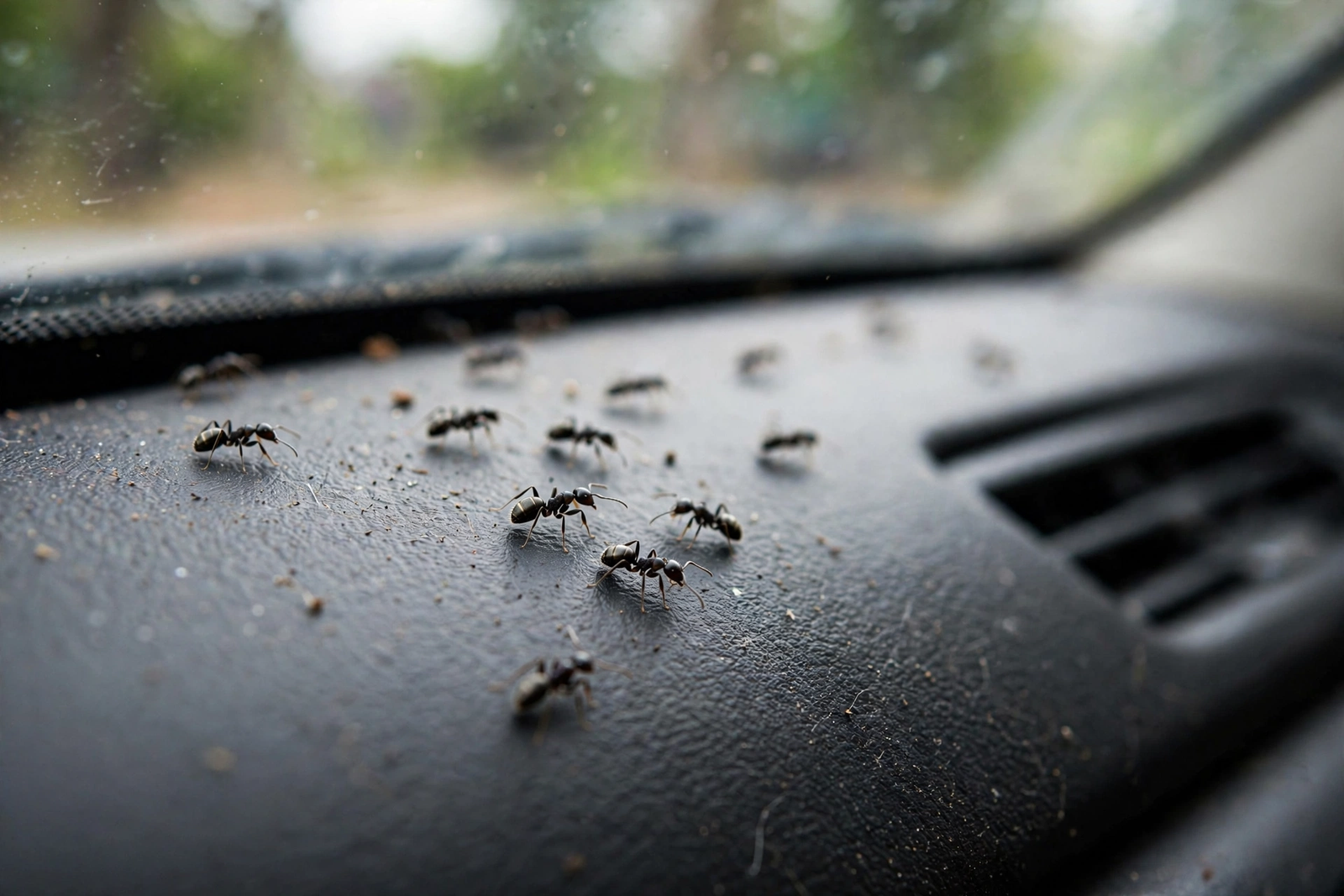
Finding a line of ants marching across your dashboard is unsettling, to say the least. Unlike ants in your kitchen, ants in your car feel especially invasive — this is your personal space, and the idea of a colony setting up shop in your vehicle is enough to make anyone’s skin crawl.
The good news is that ants in cars are a very solvable problem. Cars don’t offer ants what they truly need — a stable nest site and a reliable food supply — so once you remove the attractants and deploy the right treatment, they leave for good. Here’s exactly how to do it.
Why Ants Get in Your Car
Ants don’t invade cars randomly. They’re always there for one reason: food. A single dropped french fry, a forgotten juice box, spilled soda, or even crumbs from a granola bar is a feast for a scout ant. Once a scout finds food in your car, it lays a pheromone trail back to the colony, and within hours hundreds of workers can be streaming in.
Cars parked near the following are especially vulnerable:
- Overhanging trees — ants drop from branches onto your roof
- Ant mounds in the driveway or parking spot — easy ground access through tires and wheel wells
- Gardens and mulched beds — prime ant habitat right next to your parking spot
- Picnic areas and parks — food-scented territory
Step 1: Remove All Food Sources
Before you do anything else, strip the car of every possible food source. Check everywhere:
- Remove all trash, food wrappers, bottles, and cans
- Empty the glove box, center console, door pockets, and seat-back pockets
- Check under and between seats for old snacks, kids’ food, and pet treats
- Remove air fresheners that smell sweet — some ants are attracted to them
- Take out any reusable grocery bags (crumbs collect in the bottom)
Step 2: Deep Vacuum the Entire Interior
A thorough vacuuming is non-negotiable. Ants follow scent trails, and crumbs you can’t see are still detectable to them.
- Vacuum seats, floors, trunk, and mats
- Use a crevice tool along seat rails, under seats, and where the seat meets the backrest
- Vacuum the trunk and spare-tire well
- Wipe down hard surfaces with a damp cloth and a little dish soap — this disrupts pheromone trails
Step 3: Deploy Ant Bait Stations
Spraying ants you see is satisfying but counterproductive — it kills only the workers and alerts the colony to relocate. Bait is far more effective because foraging ants carry it back to the nest, wiping out the queen and the colony.
Choosing the Right Bait
- Sugar-based baits (e.g., Terro liquid ant bait) work best for sweet-feeding ants like odorous house ants and pavement ants — the most common car invaders
- Protein/grease baits work better for ants attracted to fats; if sugar bait is ignored after 48 hours, switch to a protein bait
Where to Place Bait
- Place bait stations on the floor where you see the heaviest ant traffic
- Put one or two stations outside the car near the tires — intercepting ants before they climb in
- Never place bait on the dashboard or seats where it could spill in heat
- Leave baits undisturbed for at least 5–7 days
Step 4: Change Your Parking Habits
While the bait does its work, break the invasion route:
- Park away from trees, bushes, and visible ant mounds
- If you park in the same driveway spot, treat ant mounds nearby with a granular outdoor bait
- Trim branches that touch or hang over your car
- Consider a different parking spot for a week or two while the colony dies off
Step 5: Seal Entry Points (If Needed)
For persistent problems, reduce access points:
- Check door seals and window seals for gaps
- Keep windows fully closed when parked
- Inspect the cabin air filter area — ants sometimes nest near it
What NOT to Do
- Don’t use foggers or “bug bombs” in your car — they leave toxic residue on every surface you’ll touch and breathe near
- Don’t spray repellent insecticide on bait stations — it contaminates the bait and the ants will avoid it
- Don’t pour boiling water anywhere in the car — obvious, but worth saying
When to Call a Professional
Most car ant infestations resolve within a week of baiting. Call a pest control professional if:
- Ants persist after two weeks of baiting
- You suspect a nest inside the car (e.g., in the dashboard, door panels, or under the carpet)
- You see carpenter ants — these can damage wiring insulation and interior components
Related reading: how to get rid of ants in the kitchen and how do i get rid of mice for keeping other pests out of your spaces.
For species identification and safe baiting practices, see the EPA’s safe pest control guidance and University of Minnesota Extension’s ant management guide.
Frequently Asked Questions
How long does it take to get rid of ants in a car?
With proper baiting, you should see a dramatic reduction within 3–5 days and full elimination within 1–2 weeks. If ants persist beyond two weeks, the nest may be inside the vehicle and need professional treatment.
Can ants damage my car?
Most common ants (pavement ants, odorous house ants) don’t damage cars — they’re just after food. Carpenter ants are the exception; they can chew through soft materials including wiring insulation, so treat them promptly.
Will ants leave my car on their own?
Eventually, yes — cars are poor nesting sites with no reliable water. But “eventually” can mean weeks of annoyance. Removing food and baiting speeds the process up dramatically.
Is it safe to use ant spray in my car?
Light, targeted use of a labeled insecticide on non-contact surfaces (like door jambs) is acceptable, but avoid spraying seats, steering wheel, dashboard, and air vents. Baits are safer and more effective overall.
Why do ants keep coming back to my car?
Recurring invasions almost always mean a food source remains (check under child car seats — a notorious crumb trap) or you’re parking in the same ant-heavy spot. Fix both and they won’t return.