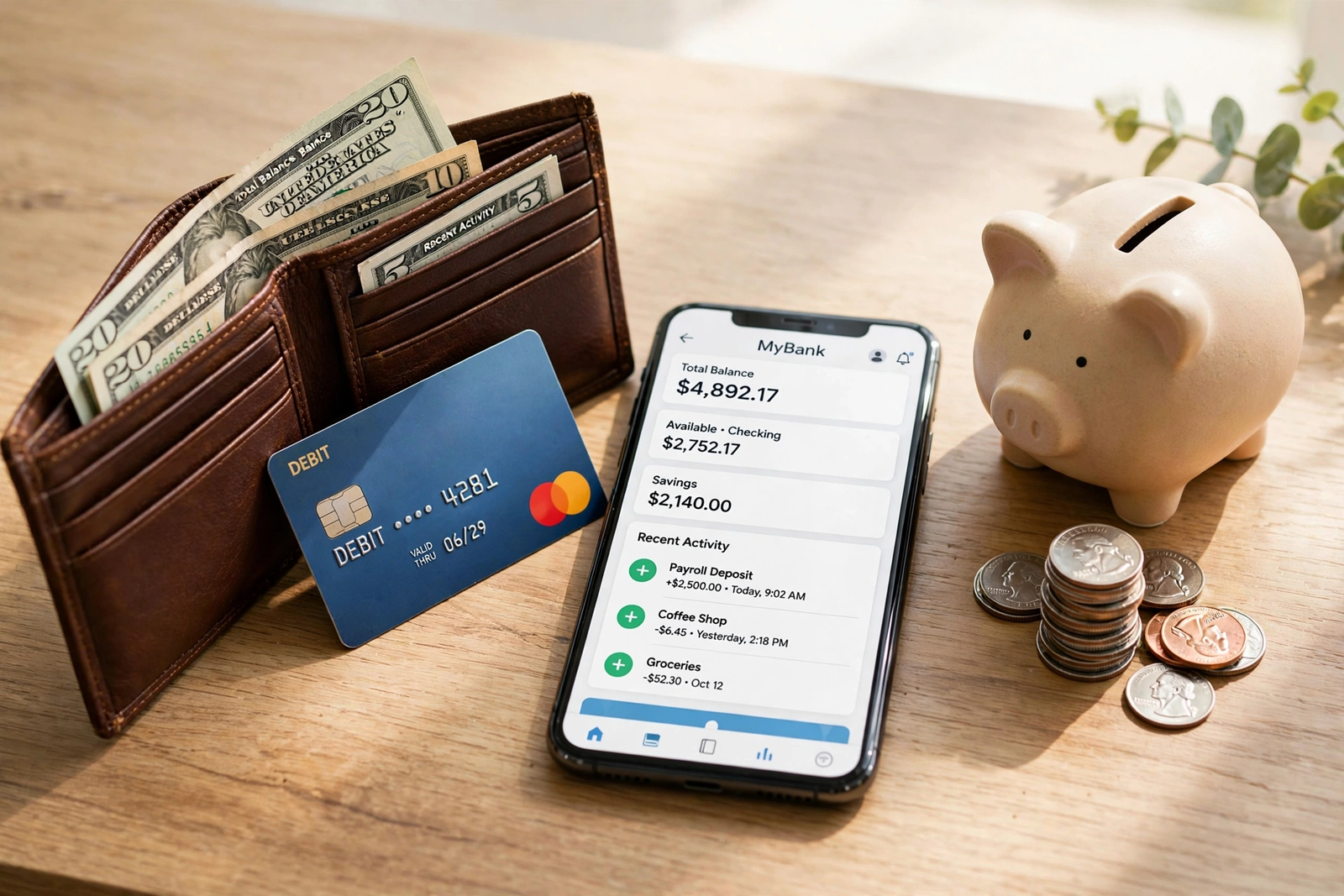
Quick answer: Keep 1 to 2 months of expenses in your checking account, roughly $2,000 to $8,000 for most households, plus a small buffer of $500 to $1,000. Any more than that is losing value to inflation. Move extra cash to a high-yield savings account where it can earn 4% or more.
Your checking account is a tool for paying bills, not a place to store wealth. Yet millions of people keep tens of thousands of dollars sitting in checking accounts earning 0.01% interest while inflation quietly erodes it. Here is exactly how to figure out your ideal checking account balance and where the overflow should go.
The Simple Rule: 1-2 Months of Expenses
Financial planners generally recommend keeping one to two months of essential expenses in checking. That covers your rent or mortgage, utilities, groceries, insurance, transportation, and minimum debt payments, with room for timing gaps between paychecks and bill due dates.
Example: if your monthly essential spending is $3,500, aim for $3,500 to $7,000 in checking. Add a $500 to $1,000 cushion on top to protect against overdrafts from surprise charges or mis-timed autopays.
Why Not Keep More in Checking?
Three reasons:
- Near-zero interest. The average checking account pays about 0.07% APY. On $20,000, that is $14 a year. A high-yield savings account at 4.5% would earn $900 on the same money.
- Inflation erosion. With inflation running 2-3%, every $10,000 sitting in checking loses $200-$300 of purchasing power per year.
- Overspending temptation. Behavioral research consistently shows people spend more when large balances feel “available.” Money earmarked for savings is safer out of sight.
The one exception: if your bank requires a minimum balance to waive monthly fees, factor that in. Better yet, switch to a free checking account with no minimums.
Where Should the Extra Money Go?
Build this cash hierarchy:
1. High-yield savings account (emergency fund)
Keep 3 to 6 months of expenses here for true emergencies: job loss, medical bills, major car repairs. Online banks routinely pay 4%+ APY with no fees. If you are unsure how many accounts you need, read how many savings accounts should i have“>how many savings accounts you should have.
2. Sinking funds for known expenses
Money for predictable costs, vacations, holiday gifts, annual insurance premiums, belongs in savings too. Consider how to start multiple savings accounts“>starting multiple savings accounts to organize these goals.
3. Investment accounts (long-term money)
Cash you will not need for 3-5+ years should be invested, not sitting in any bank account. See how can i invest in share market“>how to invest in the share market or how does a certificate of deposit work“>how certificates of deposit work for medium-term savings.
Special Situations: When to Keep More
- Irregular income (freelancers): Keep 2-3 months of expenses in checking to smooth out lean months.
- Large upcoming payment: If property taxes, tuition, or a big bill is due next month, temporarily hold that amount in checking.
- New budgeters: While learning to how to budget money“>budget, a slightly larger buffer prevents overdraft stress.
- Imminent home purchase: If you are saving for a down payment (see how to save for a down payment on a house“>how to save for a down payment), that money belongs in high-yield savings, not checking, until you are ready to move it.
How to Set Your Target Number
Do this 10-minute exercise:
- Add up your essential monthly expenses (housing, food, transport, insurance, minimum debt payments).
- Multiply by 1.5 as a starting target.
- Add your overdraft cushion ($500-$1,000).
- Round to a memorable number. Example: $3,200 x 1.5 = $4,800 + $700 cushion = $5,500 target.
- Set up automatic transfers: anything above your target sweeps to savings on payday.
Review the target twice a year or whenever your expenses change significantly.
Checking vs. Savings: Know the Difference
| Feature | Checking | High-Yield Savings |
|---|---|---|
| Purpose | Daily spending, bills | Emergency fund, goals |
| Typical APY | 0.01%-0.07% | 4.00%-5.00% |
| Debit card / checks | Yes | Usually no |
| Ideal balance | 1-2 months expenses | 3-6 months expenses |
The Consumer Financial Protection Bureau offers a clear overview of how checking accounts work and what fees to watch for.
FAQs
Is $10,000 too much to keep in checking?
For most people, yes. Unless your monthly expenses exceed $5,000 or you have a large payment due imminently, $10,000 in checking means several thousand dollars earning nothing. Move the excess to high-yield savings.
What is the minimum I should keep in checking?
At least enough to cover your largest monthly bills plus a $500 cushion, and any minimum required to avoid account fees. For most households that floor is around $1,500-$2,500.
Should my emergency fund be in checking or savings?
Savings, specifically high-yield savings. It earns 50-100x more interest, stays slightly out of reach (reducing impulse spending), and is still accessible within 1-2 days when you truly need it.
Does keeping a large checking balance help my credit?
No. Checking account balances are not reported to credit bureaus and do not affect your credit score. What matters is avoiding overdrafts and paying bills on time.
How often should I move excess money out of checking?
Automate it. Set a recurring transfer for the day after payday that sweeps everything above your target balance into savings. Manual transfers work too, but automation removes willpower from the equation.
Is my money safe in checking accounts?
Yes, up to $250,000 per depositor per bank is insured by the FDIC (or NCUA for credit unions). Safety is not the issue; lost interest is.