
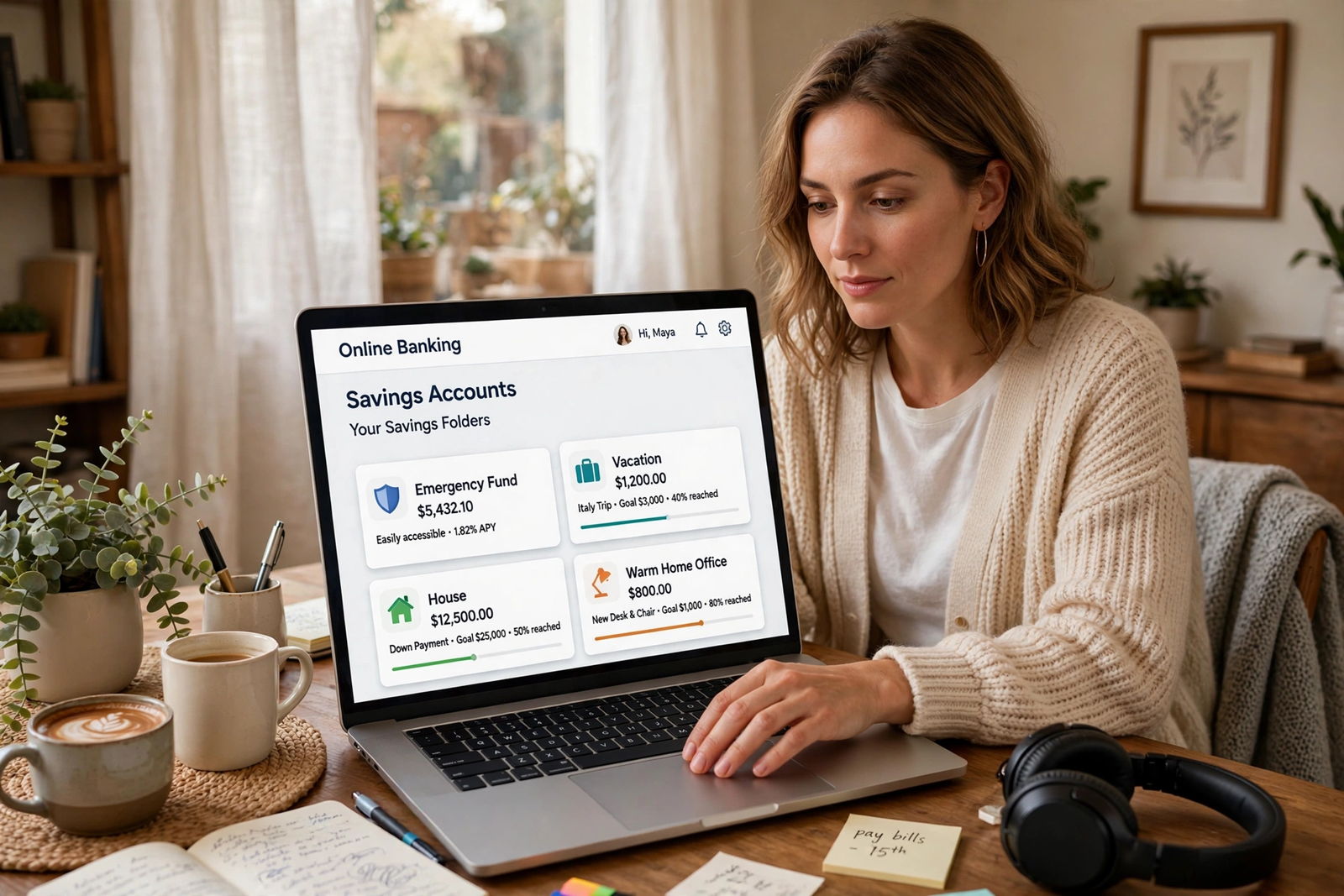
Keeping all your savings in one account is like throwing your groceries, clothes, and tools into a single closet — technically stored, but impossible to manage. Multiple savings accounts give every dollar a job, making it dramatically easier to save for specific goals without accidentally spending the money.
This strategy — sometimes called “bucket budgeting” — is one of the simplest ways to get your finances organized. Here’s how to set it up properly.
Why Multiple Savings Accounts Work
- Mental clarity: You can see exactly how much you’ve saved toward each goal
- Less temptation: Money earmarked for a house down payment feels “off limits” compared to a general savings blob
- Automated discipline: Separate automatic transfers for each goal run on autopilot
- Emergency protection: Your emergency fund stays visibly separate from vacation savings
Step 1: Choose the Right Bank
Not all banks make this easy. Look for:
- No limit on number of savings accounts — many online banks (Ally, Marcus, Capital One 360) allow unlimited accounts
- No monthly fees or minimum balances — fees defeat the purpose of small goal accounts
- Competitive APY — high-yield savings accounts (4%+ APY as of 2026) grow your money faster
- Easy nicknaming — the ability to label accounts (“Emergency Fund,” “Japan Trip”) is essential
- Automatic transfer tools — scheduled transfers on payday
Traditional brick-and-mortar banks often limit you or charge fees per account — online banks are usually the better choice for this strategy.
Step 2: Decide on Your Savings Buckets
Common accounts to open:
- Emergency fund — 3–6 months of expenses; never touch except for true emergencies
- Short-term goals — vacation, holidays, annual insurance premiums
- Medium-term goals — car down payment, home repairs, wedding
- Long-term goals — house down payment (how to save for a down payment on a house)
- Sinking funds — predictable irregular expenses like car maintenance or annual subscriptions
Start with 2–3 accounts if you’re new to this; you can always add more. There’s no magic number — see how many savings accounts should i have for guidance.
Step 3: Open the Accounts
With most online banks, the process takes minutes per account:
- Log in to your existing online banking (or open your first account — you’ll need ID and a funding source)
- Select “Open a new savings account”
- Choose the account type (standard savings)
- Fund it — even $1 to start is fine
- Name it immediately after its goal
- Repeat for each goal
Step 4: Automate Transfers
Automation is what makes this system work. On each payday:
- Set up recurring transfers from checking to each savings bucket
- Prioritize the emergency fund until it’s fully funded, then redirect that amount to other goals
- Even $25 per paycheck per goal adds up — consistency beats amount
- Review and adjust amounts quarterly or when income changes
Step 5: Track and Adjust
- Check balances monthly — most banking apps show all accounts on one screen
- Celebrate milestones (50% to a goal is worth acknowledging)
- Close or repurpose accounts when goals are met
- Resist “borrowing” between buckets — that’s what the emergency fund is for
Potential Downsides to Know
- FDIC limits: Coverage is $250,000 per depositor per bank — spread across banks if you exceed this
- Overcomplication: More than 6–8 accounts gets hard to manage for most people
- Temptation to micro-manage: Set automations and check monthly, not daily
For broader money management, see how to budget money and our explainer on how credit cards work.
Learn more from the Consumer Financial Protection Bureau and FDIC deposit insurance resources.
Frequently Asked Questions
Is it bad to have multiple savings accounts?
No — it’s a widely recommended budgeting strategy. The only real risks are overcomplication (too many accounts) and exceeding FDIC insurance limits at a single bank.
Does opening multiple savings accounts hurt your credit score?
No. Savings accounts don’t appear on credit reports and opening them involves no hard credit inquiry (banks may do a soft ChexSystems check, which doesn’t affect your credit score).
How many savings accounts should I have?
Most people do well with 3–5: emergency fund, plus one per major goal. Start small and add accounts only when you have a specific purpose for each.
Can I have multiple savings accounts at different banks?
Yes, and it can be smart — you might chase the highest APY at one bank while keeping your primary checking elsewhere. Just make sure you can manage transfers easily between them.
Should each savings account have a different interest rate?
Not necessarily. Simplicity usually wins — one high-yield bank for all your buckets is easier to manage than rate-chasing across five institutions.





3 Comments