Quick Answer: To budget money, list your monthly take-home pay, track where it currently goes, then assign every dollar a job using a system like the 50/30/20 rule or zero-based budgeting. Automate savings first, build a small emergency fund, and review your budget monthly. A budget you follow beats a perfect one. The FDIC’s free Money Smart program includes budgeting worksheets.
Most people do not have an income problem — they have a “where did it all go?” problem. Budgeting is deciding where your money goes before it disappears. It is not about restriction or guilt; it is about making your money do what you want instead of wondering what happened to it.
This guide walks you through building a budget from scratch in 2026, with two proven systems, practical tracking methods, and the adjustments that keep a budget alive past the first month.
Step 1: Know Your Real Numbers
Before choosing any system, you need two numbers: what comes in and what goes out. Use your monthly take-home pay (after taxes and deductions) — if income varies, budget off your lowest typical month. Then pull 2–3 months of bank and credit card statements and categorize every transaction; most banking apps auto-categorize spending, making this a 30-minute job. Do not skip this step: a budget built on guesses collapses within weeks. The Consumer Financial Protection Bureau offers free budgeting worksheets if you want a structured starting point.
Step 2: Pick a System — 50/30/20 Rule
The 50/30/20 rule is the simplest framework and the best starting point for beginners. Divide your take-home pay like this:
- 50% — Needs: Housing, utilities, groceries, insurance, minimum debt payments, transportation, childcare.
- 30% — Wants: Dining out, entertainment, hobbies, subscriptions, shopping.
- 20% — Savings and extra debt payments: Emergency fund, retirement contributions, anything above minimum debt payments.
Example: on $4,000 monthly take-home, that is $2,000 for needs, $1,200 for wants, and $800 for savings and debt payoff. If your needs exceed 50% — common in high-cost cities — use 60/25/15 as a transitional target and rebalance over time by trimming wants or increasing income.
Or Try Zero-Based Budgeting
Zero-based budgeting gives every dollar a job until income minus planned spending equals zero. Nothing is left “unassigned” to drift away.
- Write down your monthly income.
- List every expense category — bills, groceries, gas, savings, debt, fun money — and assign each a specific dollar amount.
- Adjust until income minus allocations equals exactly zero (zero unassigned dollars, not zero in your account).
- Track spending against each category and shift money between categories as needed.
Zero-based budgeting takes more effort than 50/30/20 but is far more precise, and works especially well for variable incomes and aggressive debt payoff. Many people use 50/30/20 for the big picture and zero-based detail for the categories that leak money.
Step 3: Track Your Spending (Pick a Method You Will Actually Use)
- Budgeting apps (YNAB, Monarch, EveryDollar): Auto-import and categorize transactions. Worth the subscription if manual tracking has failed you before.
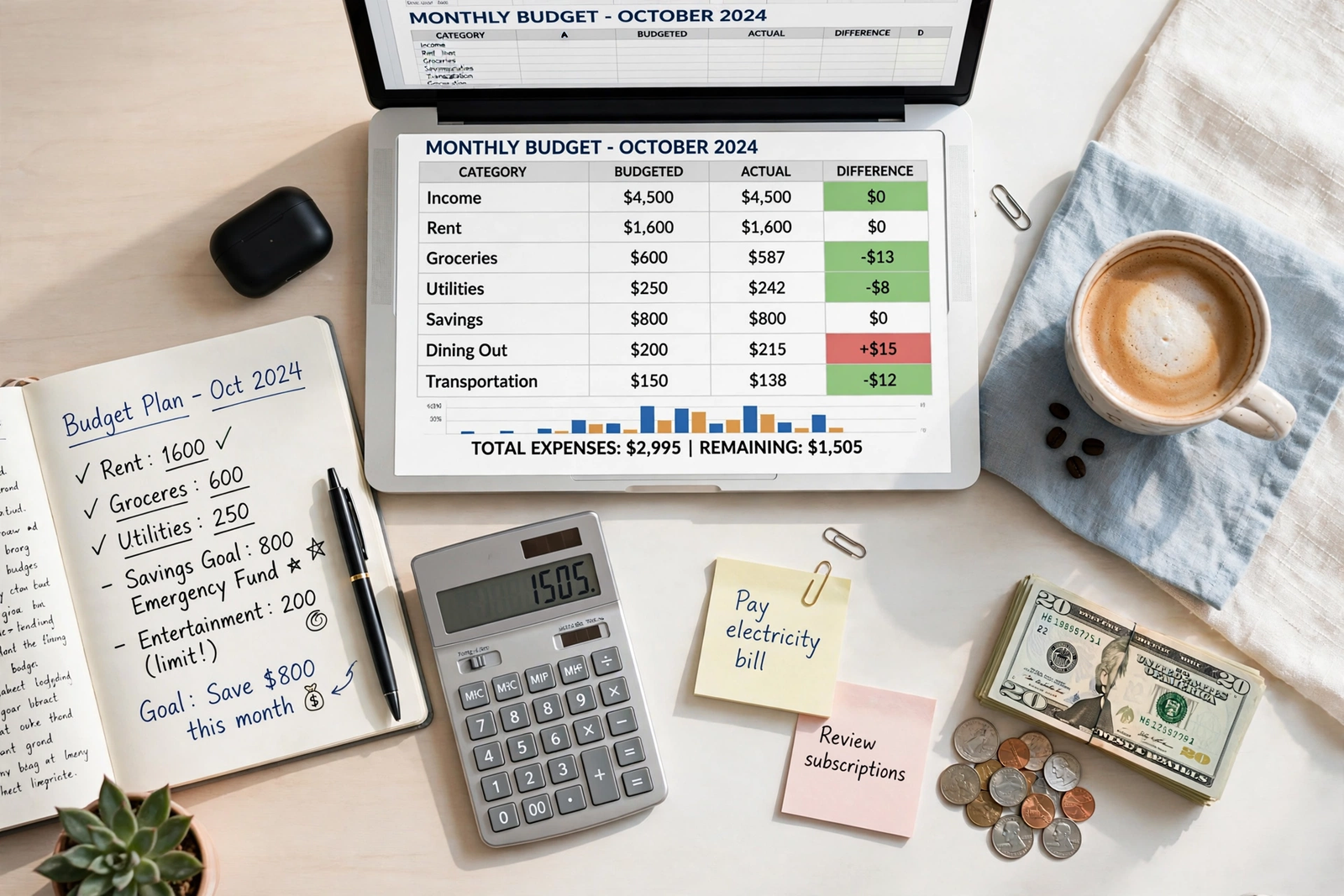
- Spreadsheet: Free, customizable, and forces you to confront the numbers. Update weekly — daily is overkill, monthly is too late to correct course.
- Envelope method: Physical cash in labeled envelopes for variable spending. When the envelope is empty, spending stops. Brutally effective.
- Bank alerts: Balance and transaction alerts turn overspending into a notification, not a month-end surprise.
Whatever you choose, schedule a 15-minute weekly money check-in — Sunday evening works well. Review what you spent, what is left in each category, and what needs adjusting. This single habit separates successful budgeters from everyone else.
Step 4: Pay Yourself First and Build an Emergency Fund
The most common budgeting mistake is treating savings as “whatever is left over.” There is never anything left over. Automate savings the day your paycheck arrives — before you can spend it.
- Starter emergency fund: $1,000 as fast as possible. This covers the flat tire, urgent-care visits, broken appliances — small shocks that otherwise go on a credit card.
- Full emergency fund: 3–6 months of essential expenses in a high-yield savings account, built after high-interest debt is under control.
- Automate it: Set an automatic payday transfer. Even $50 per paycheck builds the habit; increase it as debts shrink.
A how does a certificate of deposit work what you need to know“>certificate of deposit can be a good home for part of your emergency fund once it is fully built. And if you are thinking long-term, our guide on how much money do you need to retire 2026“>how much money you need to retire helps you size your bigger savings goals.
Step 5: Adjust and Review Monthly
A budget is a living document. At each month’s end, compare planned vs. actual spending and ask three questions: Which category blew past its limit — and why? (A car repair is noise; chronic dining-out overspending is a signal.) What can I trim or renegotiate? (Subscriptions, insurance, and phone plans are the usual suspects.) Did my income or fixed costs change? (Raises and new bills mean a rewrite, not a tweak.)
Give any new budget three full months. Month one is calibration — you will get categories wrong. Month two is adjustment. Month three is when it starts feeling natural.
Common Budgeting Mistakes to Avoid
- Too restrictive: A budget with zero fun money lasts two weeks. Build in guilt-free spending — it is cheaper than a binge.
- Forgetting irregular expenses: Car insurance, holiday gifts, and annual subscriptions ambush monthly budgets. Divide each annual cost by 12 and save that monthly.
- Budgeting gross instead of net: Always budget the money that hits your account.
- Ignoring small purchases: The $6 coffees are exactly where budgets bleed. They are not too small to track — they are the point of tracking.
- Quitting after one bad month: One overspent month is data, not failure. Adjust and continue.
Frequently Asked Questions
How much should I save each month?
Aim for at least 20% of take-home pay, including retirement contributions. If that is impossible now, start with any consistent amount — even 5% — and raise it 1% every few months or with each raise. The habit matters more than the starting number.
What is the 50/30/20 rule?
A guideline allocating 50% of after-tax income to needs, 30% to wants, and 20% to savings and debt repayment. It is a starting framework, not a law — adjust the ratios to your cost of living and goals.
Should I pay off debt or save first?
Build a $1,000 starter emergency fund first (so new emergencies do not create new debt), then attack high-interest debt aggressively. Once expensive debt is gone, redirect those payments into full emergency and retirement savings.
What is the best budgeting app?
YNAB is best for hands-on zero-based budgeting, Monarch and Copilot are strong all-rounders, and EveryDollar has a solid free tier. The best app is the one you will open every week — try free trials first.
How do I budget with irregular income?
Budget off your lowest typical month, not your average; surplus in good months goes straight to savings or debt. List expenses in priority order so a short month already has its cuts planned.
How often should I review my budget?
Quick 15-minute check weekly, full review monthly. Rebuild from scratch whenever income, housing costs, or major life circumstances change.