
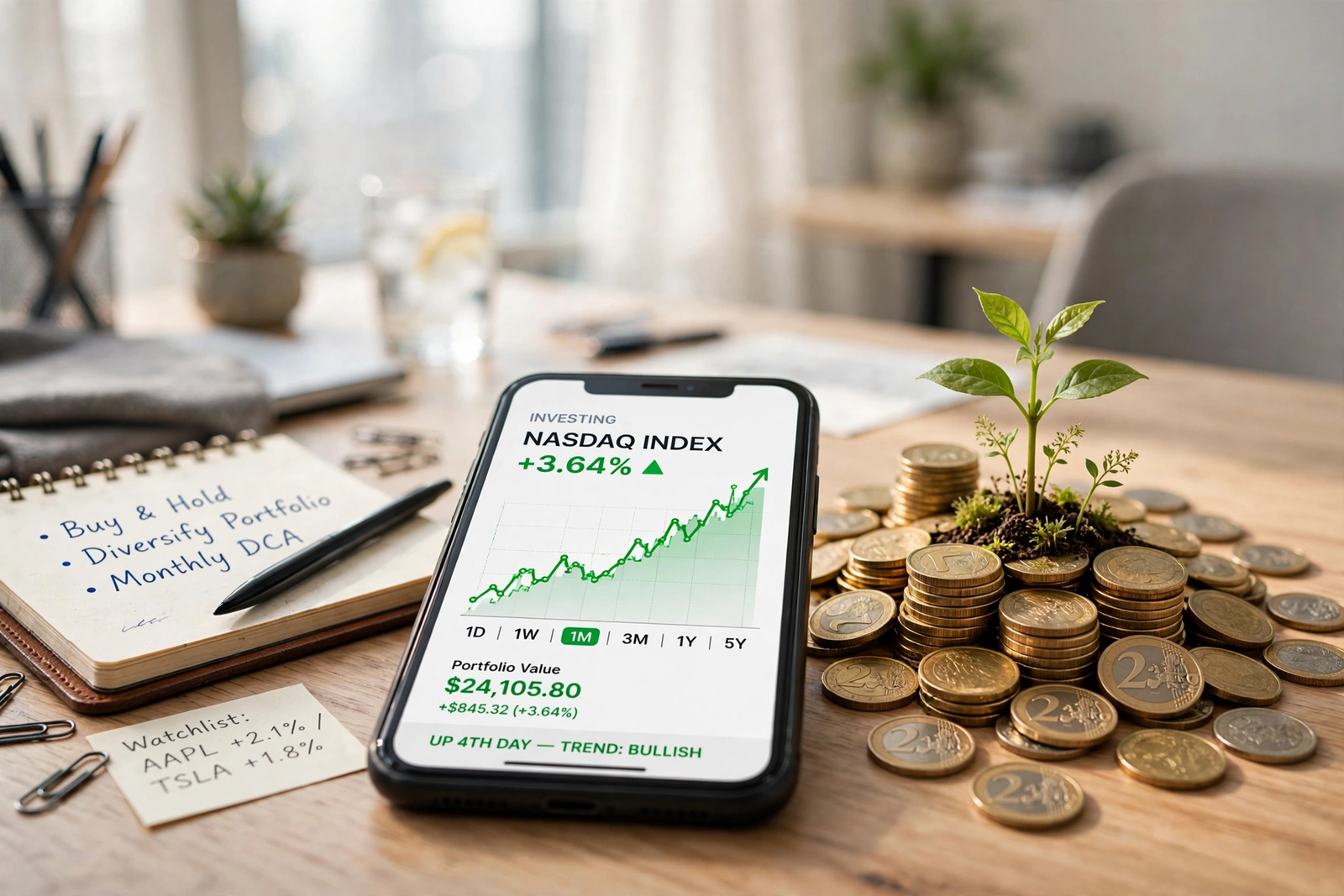
Quick answer: To invest in the share market, open a brokerage account (online brokers like Fidelity, Schwab, or Vanguard let you start with $0 minimums), fund it, then buy shares of individual stocks or low-cost index funds. Beginners should start with diversified index funds, invest money they will not need for at least 3-5 years, and contribute regularly rather than trying to time the market.
The “share market” (called the stock market in the US) is where pieces of publicly traded companies are bought and sold. It has historically been one of the best long-term wealth-building tools available: the S&P 500 has averaged roughly 10% annual returns over the long run. But getting started can feel intimidating. This guide walks you through everything, step by step.
Step 1: Understand What You Are Buying
When you buy a share of stock, you are buying a small ownership stake in a real business. If the company grows and earns more profit, your shares typically become more valuable. You can also earn dividends, which are cash payments some companies distribute to shareholders.
The main ways to invest:
- Individual stocks: Shares of single companies (Apple, Microsoft, etc.). Higher potential reward, higher risk.
- Index funds and ETFs: Baskets holding hundreds or thousands of stocks at once. Instant diversification with very low fees. Ideal for beginners.
- Mutual funds: Similar to ETFs but priced once daily; often have higher fees.
- Dividend stocks: Companies with a history of paying regular cash dividends, popular for income-focused investors.
Step 2: Choose the Right Account Type
Before picking investments, decide where to hold them. The account type determines your tax treatment:
- Taxable brokerage account: Flexible, no contribution limits, no withdrawal penalties. You pay tax on gains and dividends. Best for general investing.
- Roth IRA: Contributions are after-tax, but growth and qualified withdrawals are tax-free. 2026 contribution limit is $7,000 ($8,000 if 50+). Income limits apply, so check how to calculate magi for roth ira“>how to calculate MAGI for Roth IRA eligibility.
- Traditional IRA / 401(k): Pre-tax contributions lower your taxable income now; you pay tax on withdrawals in retirement.
- Employer 401(k): If your employer matches contributions, contribute enough to capture the full match first. It is free money.
Step 3: Open a Brokerage Account
Opening an account takes about 15 minutes online. Reputable brokers with $0 minimums and commission-free stock and ETF trades include Fidelity, Charles Schwab, Vanguard, and E*TRADE. You will need your Social Security number, employment information, and a bank account to fund it.
What to look for:
- Zero commissions on stocks and ETFs
- No account minimums or inactivity fees
- Fractional shares (lets you buy expensive stocks with small amounts)
- Good educational resources for beginners
- Easy mobile app
Step 4: Fund Your Account
Link your bank account and transfer money in. Most brokers accept ACH transfers (free, takes 1-3 business days; see how long does ach transfer take“>how long ACH transfers take) or wire transfers (faster, usually a fee). Start with an amount you are comfortable with. Many successful investors began with $100 or less thanks to fractional shares.
Step 5: Make Your First Investments
For most beginners, the smartest first purchase is a broad-market index fund, such as one tracking the S&P 500 or the total US stock market. One purchase instantly spreads your money across hundreds of companies, and expense ratios are often under 0.05% per year.
A simple beginner portfolio might look like:
- 80-90% in a total US stock market index fund
- 10-20% in an international stock index fund
- Add a bond index fund as you get older or want less volatility
Avoid these beginner traps:
- Day trading: The vast majority of day traders lose money. It is not investing; it is speculation.
- Penny stocks: Extremely risky, often manipulated, and usually a fast way to lose money.
- Investing money you need soon: The market can drop 20%+ in a bad year. Only invest money you can leave alone for years.
- Following social media hype: By the time a stock is trending online, the easy gains are usually gone.
Step 6: Keep Investing Regularly
The real secret of the share market is not picking winners. It is consistency. Set up automatic monthly contributions. This strategy, called dollar-cost averaging, means you buy more shares when prices are low and fewer when prices are high, smoothing out market swings over time.
Reinvest your dividends too. Compounding, earning returns on your returns, is what turns modest regular contributions into serious wealth over decades. If you are investing during volatile times, read how to invest during a recession“>how to invest during a recession to keep your nerve.
Understanding the Risks
Be honest with yourself about risk:
- Stock prices go up and down. A 10-20% drop in a given year is normal.
- Past performance does not guarantee future results.
- Never invest borrowed money or your emergency fund.
- Diversification reduces risk but cannot eliminate it.
The U.S. Securities and Exchange Commission and FINRA both offer free investor education resources worth reading before you put significant money to work.
How Much Money Do You Need to Start?
Less than you think. With fractional shares and $0 minimums, you can start with $50 or $100. What matters far more than your starting amount is your savings rate and time in the market. Someone investing $200 a month from age 25 will likely end up far wealthier than someone investing $1,000 a month starting at 45, thanks to compounding.
Before investing, make sure your financial foundation is solid: an emergency fund of 3-6 months of expenses (kept in a high-yield savings account, not the market), high-interest debt paid down, and a basic how to budget money“>budget in place. For guidance on where to park cash you might need soon, see how much money should i keep in my checking account“>how much money to keep in your checking account.
FAQs
Is investing in the share market safe?
No investment is without risk, but diversified, long-term stock market investing has historically grown wealth reliably. The danger comes from speculation, lack of diversification, and panic-selling during downturns, not from the market itself.
Can I lose all my money in stocks?
If you buy a single company’s stock and it goes bankrupt, yes. That is why beginners should use diversified index funds: hundreds of companies would all have to fail simultaneously for you to lose everything, which has never happened.
How much should a beginner invest?
Start with whatever you can afford after covering bills, debt payments, and emergency savings. Even $50-$100 a month builds the habit. Increase contributions as your income grows.
Should I use a financial advisor?
Most beginners do not need one. Low-cost index funds in a tax-advantaged account cover the essentials. Consider an advisor if you have complex taxes, a windfall, or need help staying disciplined. If you hire one, choose a fee-only fiduciary.
What is the difference between the share market and the stock market?
They are the same thing. “Share market” is the term commonly used in the UK, India, and Australia; “stock market” is the standard American term. Both refer to exchanges like the NYSE and Nasdaq where company shares trade.
How are stock market gains taxed?
In a taxable account, profits on shares held over a year qualify for lower long-term capital gains rates (0%, 15%, or 20% depending on income). Short-term gains are taxed as ordinary income. In IRAs and 401(k)s, different tax rules apply.






One Comment