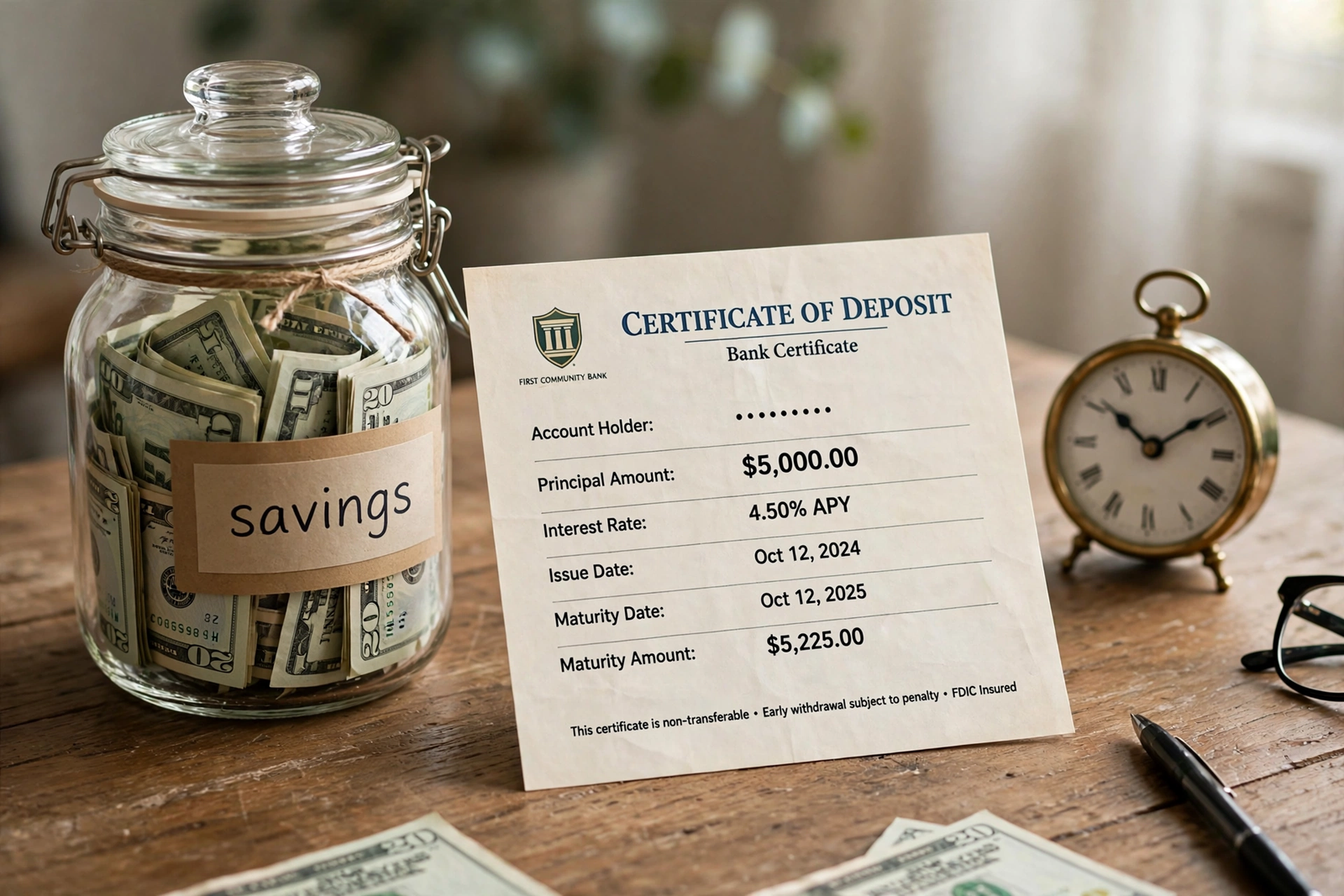
Quick Answer: A certificate of deposit (CD) is a savings account where you agree to leave your money untouched for a fixed term (3 months to 5 years) in exchange for a guaranteed, typically higher interest rate than a regular savings account. If you withdraw early, you pay a penalty. CDs are FDIC-insured up to $250,000 per depositor, per bank.
If you have savings you won’t need for a while — an emergency fund cushion, a down payment for next year, or cash you’re holding between investments — a certificate of deposit can put that money to work at a guaranteed rate with virtually no risk. CDs are one of the simplest, safest savings products banks offer.
This guide explains exactly how CDs work, the different types available, how interest and penalties work, and how to decide if a CD is right for your money. Rates change with the market, so always check current offers before opening one.
How a CD Works: The Basics
A CD is a time deposit. Here’s the deal you make with the bank:
- You deposit a lump sum — the minimum is often $0 to $1,000 depending on the bank (many online banks have no minimum).
- You choose a term — typically 3 months, 6 months, 1 year, 2 years, 3 years, or 5 years.
- The bank pays you a fixed interest rate for the entire term, guaranteed regardless of what market rates do.
- At maturity, you get your principal back plus all the interest earned — or you can roll it into a new CD.
In return for locking up your money, the bank pays you more than a standard savings account — because it knows your deposit won’t disappear tomorrow.
Why CD Rates Are Higher Than Savings Rates
Banks profit by lending out deposits. A regular savings account can be emptied any day, so the bank can’t rely on it. A CD guarantees the bank your money for a fixed period, so it can lend more confidently — and shares some of that profit with you through a higher rate.
Generally, longer terms pay higher rates. A 5-year CD usually pays more than a 6-month CD. Rates also track the Federal Reserve’s benchmark rate, so CDs pay the most when overall interest rates are high.
Types of CDs
- Traditional CD: Fixed rate, fixed term, early withdrawal penalty. The standard option.
- No-penalty (liquid) CD: Lets you withdraw once during the term without penalty. Rates are slightly lower, but you get flexibility.
- Bump-up CD: Allows you to raise your rate once (or twice) during the term if rates go up. Good when rates are rising.
- Jumbo CD: Requires a large minimum deposit (often $100,000) and may pay slightly higher rates.
- IRA CD: A CD held inside an Individual Retirement Account — same mechanics, but with retirement tax advantages.
- Brokered CD: Sold through brokerages instead of banks. They can be bought and sold on a secondary market, but their value can fluctuate if you sell before maturity.
CD Interest: How Earnings Are Calculated
CDs typically compound interest daily or monthly. The key number to compare is the APY (annual percentage yield) — it includes compounding, so it’s the true measure of what you’ll earn in a year.
Example: $10,000 in a 1-year CD at 4.50% APY earns about $450. The same amount in a 5-year CD at 4.00% APY earns roughly $2,166 over the full term thanks to compounding.
Interest is taxable as ordinary income in the year it’s earned, even if you don’t withdraw it — you’ll receive a 1099-INT from the bank. Learn more about deposit insurance and safe banking at the FDIC deposit insurance information.
Early Withdrawal Penalties
This is the main trade-off. Pull your money out before maturity and you’ll pay a penalty — typically a set number of months’ interest:
- Terms under 1 year: Often 3 months of interest.
- 1–3 year terms: Often 6 months of interest.
- Longer terms: Can be 12 months of interest or more.
The penalty comes out of your earnings first, but if you withdraw very early, some banks can dip into principal. Always read the penalty terms before opening a CD — the the CFPB guide to how certificates of deposit work including penalty rules.
CD Laddering: A Smart Strategy
Instead of locking all your money into one long CD, a CD ladder spreads it across multiple terms:
- Split your money into equal parts (say $5,000 each).
- Open 1-year, 2-year, 3-year, 4-year, and 5-year CDs.
- Each year, one CD matures — reinvest it in a new 5-year CD at the current rate.
This gives you access to some money every year while capturing higher long-term rates on the rest. It’s the most popular CD strategy for a reason.
Are CDs Safe?
Yes — CDs from banks are FDIC-insured up to $250,000 per depositor, per bank (credit union CDs carry the same protection through the NCUA). Your principal is guaranteed as long as you stay within the limit. The only real “risk” is opportunity cost: if rates rise sharply after you lock in, you’re stuck at the lower rate until maturity.
CD vs. Other Savings Options
- CD vs. savings account: CDs pay more, but savings accounts let you withdraw anytime. Use savings for money you might need soon.
- CD vs. money market account: Similar rates, but money market accounts offer check-writing and debit access with limited withdrawals.
- CD vs. Treasury bonds: Treasuries are also very safe and their interest is exempt from state tax, but buying them is slightly more complex.
Related guides: how much does it cost to file bankruptcy and high yield savings account vs cd.
Frequently Asked Questions
How does a certificate of deposit work in simple terms?
You deposit money for a fixed period (like 1 year), the bank pays you a guaranteed interest rate, and at the end of the term you get your money back plus interest. Withdrawing early triggers a penalty.
Can you lose money in a CD?
Essentially no. Bank CDs are FDIC-insured up to $250,000 per depositor, per bank. The only way to lose money is an early-withdrawal penalty eating into principal if you withdraw very early — and even that is rare and capped by the bank’s terms.
What happens when a CD matures?
You get a grace period (usually 7–10 days) to withdraw, add funds, or change terms. If you do nothing, most banks automatically renew the CD at the current rate for the same term.
Are CD interest rates fixed?
Traditional CDs have fixed rates locked in for the whole term. Bump-up CDs let you raise your rate once if market rates rise. Variable-rate CDs exist but are uncommon.
How much money do you need to open a CD?
Many online banks have no minimum. Traditional banks often require $500 to $1,000. Jumbo CDs require $100,000 or more. Shop around — minimums vary widely.
Is a CD better than a savings account?
For money you won’t need during the term, usually yes — CDs typically pay higher rates. For emergency funds or money you might need soon, a high-yield savings account is better because there’s no withdrawal penalty.