
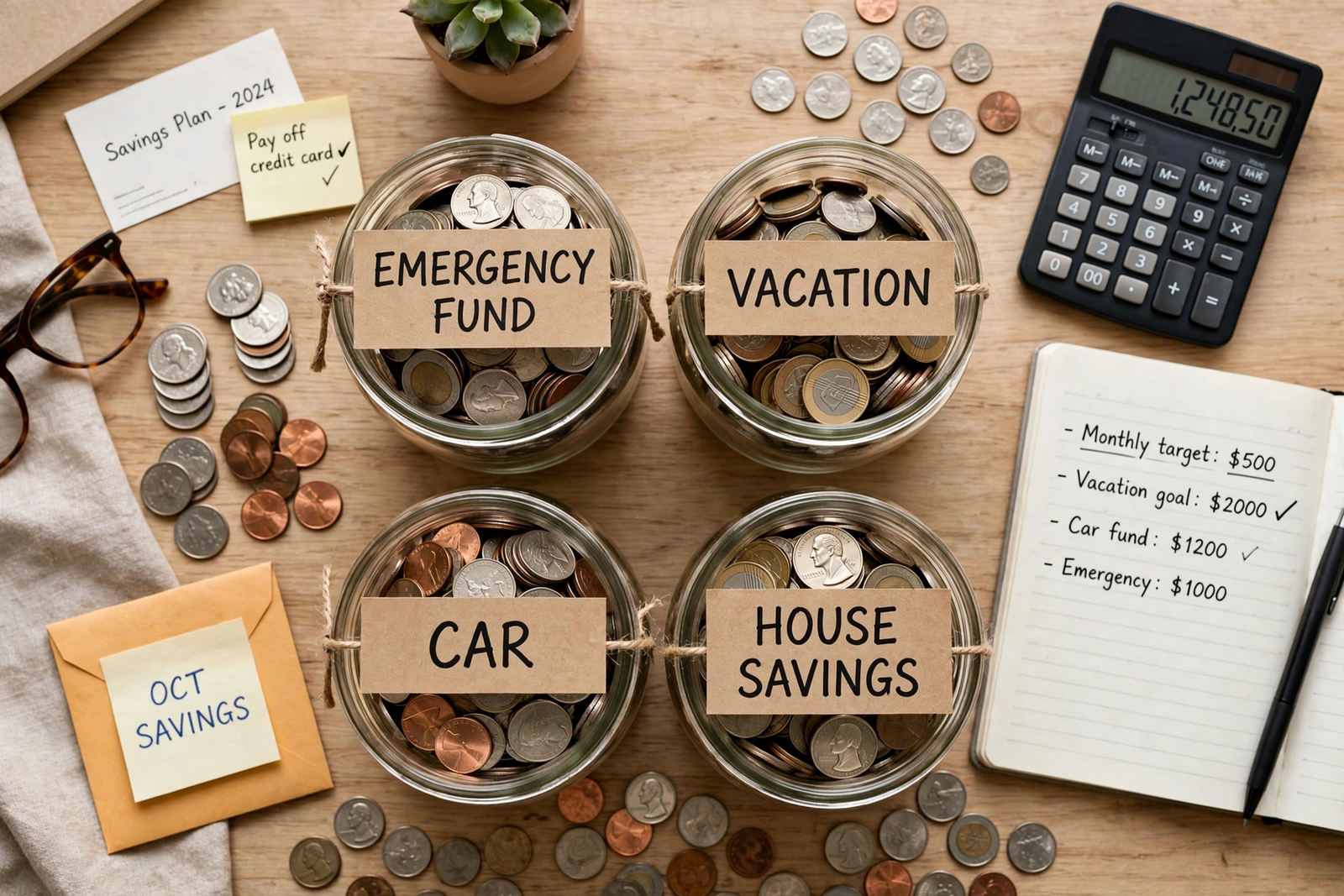
There’s no law prescribing how many savings accounts you can have — most online banks allow unlimited accounts with no fees. The real question is how many you should have, and the answer depends on your goals, not a magic number.
The Sweet Spot: 3–5 Accounts
For most households, this structure works beautifully:
- Emergency fund — 3–6 months of essential expenses; the non-negotiable foundation
- Short-term goal — vacation, holidays, or annual bills
- Medium-term goal — car, home repairs, wedding
- Long-term goal — house down payment or other major purchase
- Sinking fund (optional) — predictable irregular costs like car maintenance or insurance premiums
Each account gets its own automatic transfer on payday. You always know exactly where every goal stands.
Signs You Have Too Few
- You “borrow” from savings for spending and lose track of what was for what
- Your emergency fund keeps getting raided for vacations or shopping
- You can’t answer “how much have I saved for X?” without guessing
- Saving feels abstract and unmotivating
Signs You Have Too Many
- You have accounts with tiny balances you never contribute to
- Monthly management feels like a chore
- You’re spreading money so thin no goal makes meaningful progress
- You’ve lost track of what some accounts are even for
Rule of thumb: if you can’t name every account’s purpose from memory, consolidate.
Special Situations
High Earners / Complex Finances
May justify 6–8 accounts: tax payments (quarterly estimated), business reserves, multiple properties’ maintenance funds, education savings per child.
Couples
Common setups: fully joint buckets, or “yours/mine/ours” hybrids. What matters is agreeing on the structure — the number itself is secondary.
FDIC Insurance Limits
Coverage is $250,000 per depositor, per bank. If your combined balances exceed that at one bank, spreading across institutions isn’t just tidy — it’s protected. Learn more from the FDIC’s deposit insurance guide.
How to Set Yours Up
- List your active savings goals and rank by priority
- Open one account per goal at a no-fee, high-yield online bank
- Name each account after its goal (“Emergency Fund,” “Japan 2027”)
- Automate a payday transfer to each — even $25 counts
- Fund the emergency fund first, then redirect to other goals
- Review quarterly; close or repurpose accounts as goals are met
For the full setup walkthrough, see how to start multiple savings accounts and how to budget money for funding them consistently.
The CFPB’s savings account explainer covers account basics if you’re starting from scratch.
Example Setups for Different Life Stages
Young Professional, Renting (3 accounts)
- Emergency fund — target: 3 months’ expenses
- Travel/fun fund — guilt-free spending money
- Future home down payment — even $100/month builds the habit (see how to save for a down payment on a house)
Couple With Kids, Homeowners (5 accounts)
- Emergency fund — target: 6 months’ expenses (higher with dependents and a mortgage)
- Home maintenance sinking fund — budget ~1% of home value per year
- Car replacement fund
- Vacation fund
- Kids’ activities/education fund
Freelancer / Variable Income (4 accounts)
- Emergency fund — target: 6–9 months (variable income needs a bigger buffer)
- Tax fund — set aside 25–30% of each payment for quarterly estimated taxes
- Business investment fund
- Personal goal fund
Automating the Whole System
The bucket strategy only works if money actually flows into the buckets. Set it up once:
- Payday split: Most employers allow direct deposit into multiple accounts — route fixed amounts to each savings bucket automatically
- Bank auto-transfers: If your employer can’t split deposits, schedule recurring transfers from checking the day after payday
- Round-up tools: Some banks round purchases to the dollar and sweep the difference into a chosen bucket — painless micro-saving
- Windfall rule: Decide in advance — e.g., 50% of any bonus/tax refund/gift goes to the top-priority bucket
When to Consolidate
Buckets should shrink as goals are met. Good times to consolidate:
- A goal is fully funded and spent (vacation taken) — repurpose or close the account
- Two goals merge naturally (car fund becomes part of general transport costs)
- You’re down to maintaining rather than building — a funded emergency fund plus one goal account may be all you need for a season
Closing an empty savings account takes minutes online and has zero credit impact — don’t let dead accounts clutter your financial life.
Frequently Asked Questions
Is there a limit to how many savings accounts I can have?
No legal limit. Most online banks allow unlimited savings accounts; some traditional banks cap you or charge per account — another reason online banks suit this strategy.
Does having multiple savings accounts affect my credit score?
No. Savings accounts aren’t reported to credit bureaus and opening them requires no hard credit inquiry.
Should I keep savings at multiple banks?
It can make sense for FDIC coverage above $250,000 or chasing the best rates, but one good high-yield bank keeps things simpler for most people.
How much should I keep in each savings account?
Emergency fund: 3–6 months of expenses. Other accounts: whatever your goal requires, divided by your timeline. A $6,000 vacation in 12 months = $500/month.
Can I have too many savings goals?
You can — spreading $200/month across eight goals means none reaches critical mass. Prioritize 2–3 goals at a time; fully fund the emergency fund first.






One Comment