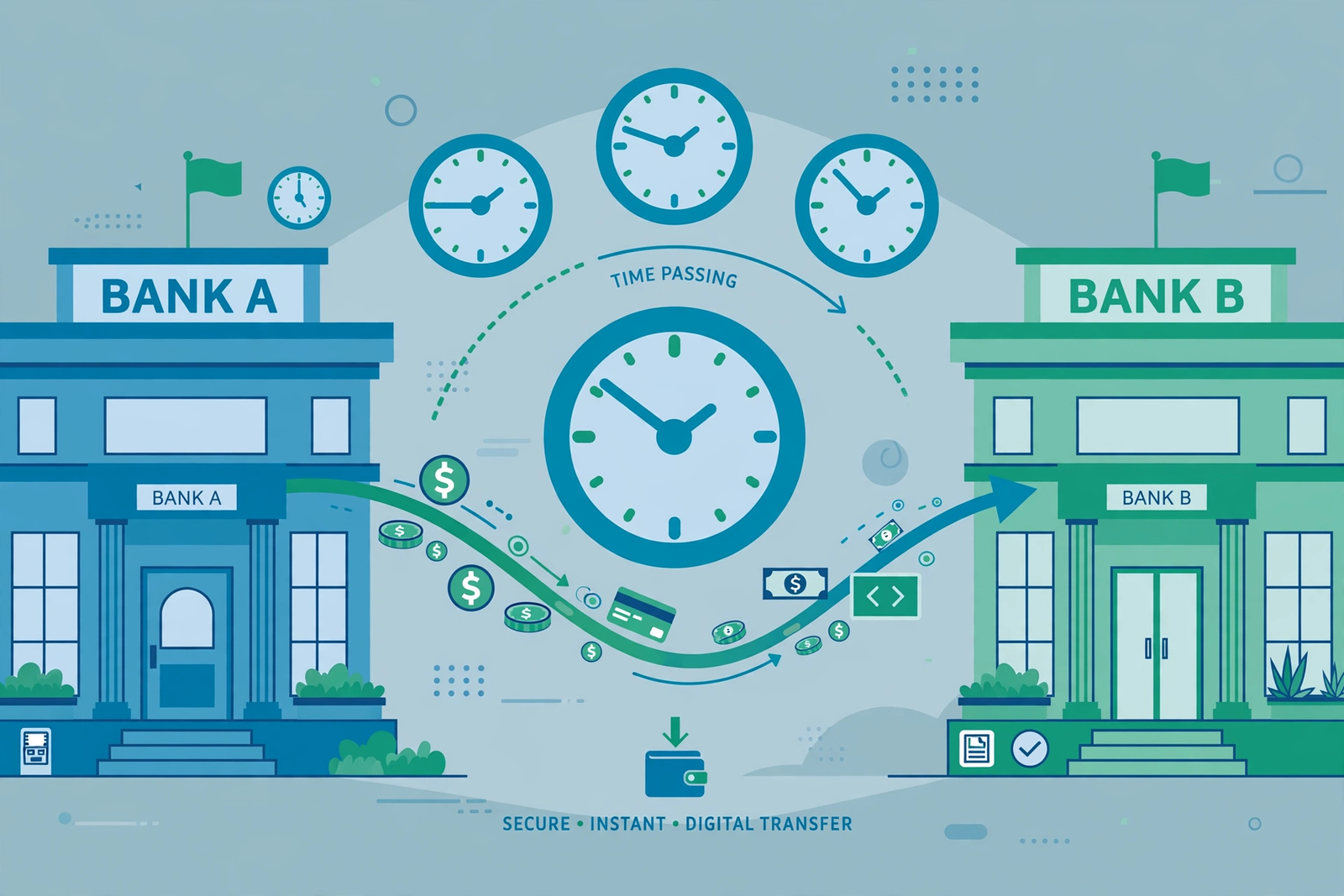
ACH (Automated Clearing House) transfers are the workhorse of American banking — they power direct deposits, bill payments, and bank-to-bank transfers. They’re cheap (usually free) but not instant, and understanding the timing helps you avoid missed payments and overdraft surprises.
ACH Transfer Timeframes at a Glance
- Standard ACH: 1–3 business days
- Same-day ACH: Within hours, typically by end of the business day (must be submitted before the bank’s cutoff, often 2–4 PM ET)
- Next-day ACH: 1 business day (offered by some banks as a middle option)
- ACH debit (pull): Often 1–2 business days longer than ACH credit (push), because the receiving bank verifies funds
Why ACH Isn’t Instant
Unlike wire transfers, which move money directly between banks in real time, ACH transfers are processed in batches by the clearing house several times per day. Your bank groups your transfer with thousands of others, sends the batch, and the receiving bank processes it on arrival. Each step adds time — and each bank’s internal processing adds a little more.
The Federal Reserve, which operates part of the ACH network alongside Nacha, has been expanding same-day processing windows, but the batch architecture remains fundamentally slower than real-time systems.
What Affects ACH Timing
1. Weekends and Holidays
ACH only processes on business days. A transfer started Friday at 6 PM won’t begin processing until Monday — and if Monday is a federal holiday, Tuesday. Plan bill payments accordingly.
2. Bank Cutoff Times
Each bank sets daily cutoff times (commonly 2–5 PM ET). Miss the cutoff and your transfer waits for the next processing window — effectively adding a day.
3. Push vs. Pull
Pushing money (sending from your bank) is faster than pulling (authorizing another institution to debit your account), because pulls include extra verification to prevent fraud.
4. First-Time Transfers
New payees, new linked accounts, and large first-time transfers often face additional holds (1–2 extra days) while the bank verifies legitimacy.
5. Transfer Amount
Very large transfers may trigger manual review, adding a day. Same-day ACH also has per-transaction limits (currently $1 million, though most banks set much lower caps).
How to Speed Up an ACH Transfer
- Use same-day ACH if your bank offers it — submit before the cutoff time
- Initiate early in the day on a business day (Monday–Thursday mornings are ideal)
- Push rather than pull when you control the sending side
- Consider alternatives for urgency: wire transfers (same day, $15–30 fee) or real-time payment networks like Zelle, FedNow, or RTP (instant, but with lower limits)
ACH vs. Wire Transfer vs. Zelle
- ACH: Free/cheap, 1–3 business days, best for routine transfers and bill pay
- Wire: $15–30+, same business day, best for large or urgent transfers (like how long after appraisal to close timelines)
- Zelle / FedNow: Free, minutes, best for small person-to-person payments (limits typically $2,500–$5,000/day)
For moving money between your own accounts, see how to transfer funds from one bank to another.
Official timing rules are set by Nacha (the ACH network administrator); the Federal Reserve’s FedACH service page explains processing windows.
ACH for Business Payments
Businesses use ACH heavily for payroll (direct deposit), vendor payments, and recurring billing. Business ACH follows the same timing rules, but a few differences matter:
- Payroll: Employers typically submit payroll 2–3 business days before payday to guarantee on-time arrival — this is why “payday is Friday” means the transfer started Tuesday or Wednesday
- Higher limits: Business accounts usually enjoy much higher ACH limits than consumer accounts, often $25,000–$250,000 per day
- ACH origination: Businesses that send many ACH payments (rather than just receiving) need ACH origination services from their bank, which involves underwriting and per-batch fees
- Returns and reversals: Businesses must handle ACH returns (insufficient funds, closed accounts) promptly — return rates above thresholds can get origination privileges revoked
Troubleshooting Delayed ACH Transfers
If your transfer is taking longer than expected, work through this checklist:
- Count business days only — weekends and federal holidays (New Year’s Day, Memorial Day, July 4th, Labor Day, Thanksgiving, Christmas, etc.) pause all ACH processing
- Check the cutoff — transfers initiated after your bank’s daily cutoff roll to the next processing window
- Verify first-time holds — new payees and newly linked accounts commonly face 1–3 day verification holds
- Look for bank notices — large or unusual transfers can trigger fraud-review holds; a quick call usually clears them
- Contact the sending bank first — they can trace the batch; the receiving bank can’t help until the batch arrives
Frequently Asked Questions
How long does an ACH transfer take on weekends?
ACH doesn’t process on weekends. A transfer initiated Saturday won’t start moving until Monday morning, arriving Tuesday–Thursday depending on your bank.
Why is my ACH transfer taking longer than 3 days?
Common causes: first-time transfer holds, large amounts triggering review, bank holidays you didn’t account for, or the receiving bank’s internal posting delay. Contact your bank after 5 business days.
Can an ACH transfer be reversed?
Yes — ACH debits can generally be reversed within 60 days if unauthorized, which is one reason pulls take longer. Credits are harder to reverse once settled. This reversibility is a consumer protection, not a bug.
Is same-day ACH available at all banks?
Most large and mid-size banks offer it; some small banks and credit unions don’t yet. Fees range from $0 to about $10. Ask your bank about cutoff times.
Are ACH transfers safe?
Yes — ACH is one of the safest payment methods available. It’s regulated, traceable, and reversible in cases of fraud or error. Consumer protections under federal Regulation E cover unauthorized electronic transfers, giving you strong recourse if something goes wrong.
Do ACH transfers go through at night?
Processing batches run throughout the business day, including overnight windows — but “overnight” only counts on business days, and your bank may not post the funds until morning.