
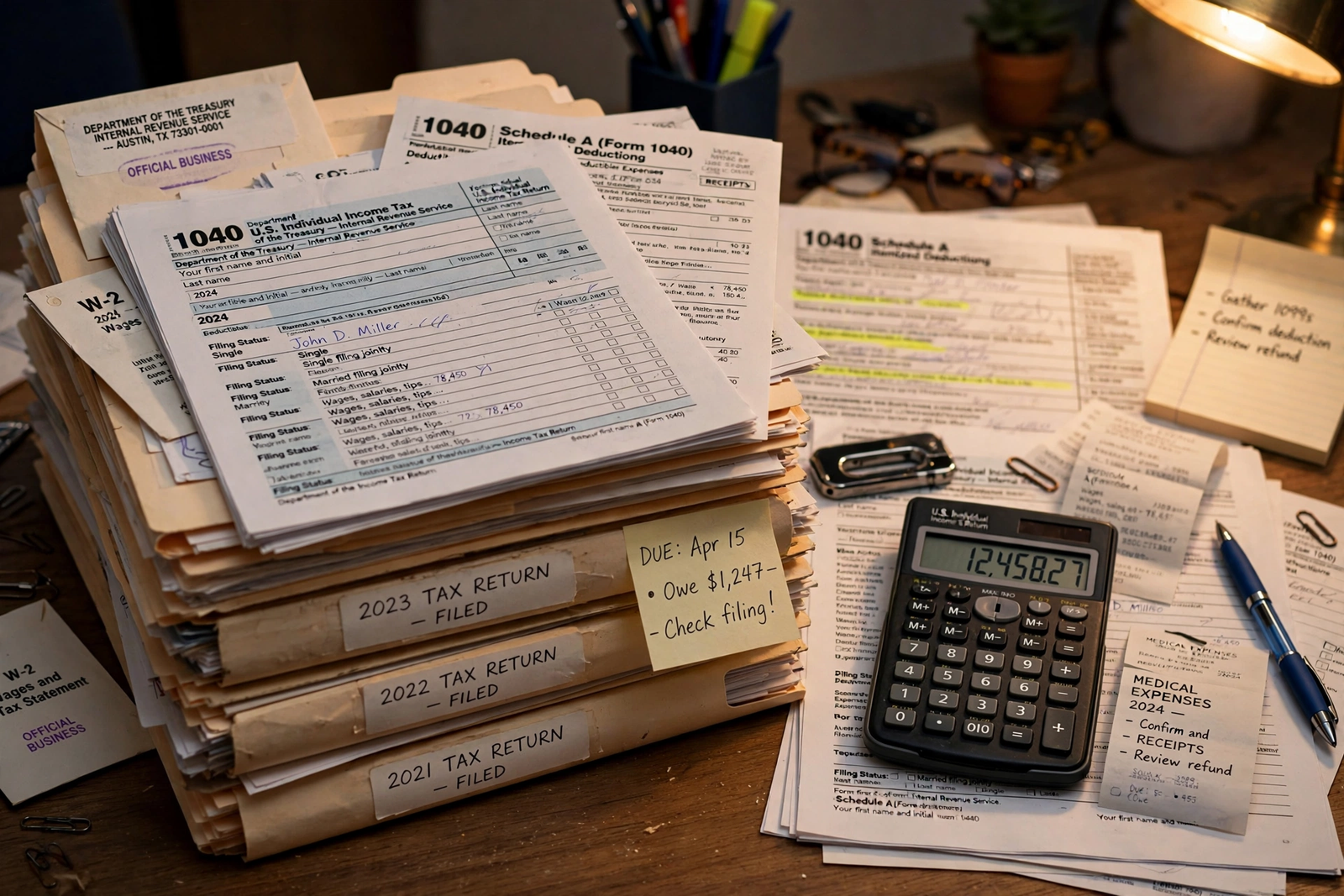
Life happens — and sometimes tax returns don’t get filed. Whether you missed one year or five, the path back to compliance is straightforward, and the IRS is far more lenient with people who come forward voluntarily than those it has to chase. Here’s exactly how to back file.
Step 1: Determine Which Years You Must File
The IRS generally requires the last 6 years of unfiled returns to consider you compliant (its enforcement policy). However:
- If you’re owed refunds, you can only claim them for returns filed within 3 years of the original due date — older refunds are forfeited to the Treasury
- There’s no statute of limitations on unfiled returns — the IRS can come after you indefinitely until you file
- Once you file, the normal 3-year audit window and 10-year collection window begin
Bottom line: file all 6 years if the IRS asks; at minimum, file every year you had a filing requirement.
Step 2: Gather Your Documents
For each missing year, collect:
- W-2s from employers
- 1099s (NEC, MISC, INT, DIV, R)
- Records of business income and expenses (if self-employed)
- Mortgage interest statements, charitable donation receipts, medical expenses
- Prior-year filed returns (for carryovers and reference)
Missing Documents?
Request a Wage and Income Transcript from the IRS for each year — it shows all W-2s and 1099s reported under your SSN. Get it free at the IRS Get Transcript tool or by filing Form 4506-T. Note: transcripts don’t show state withholding or all details, but they’re an excellent starting point.
Step 3: Prepare Each Year’s Return Separately
Critical: use the tax forms and rules for each specific year — not current-year forms. Tax law changes annually (brackets, standard deductions, credits).
- Tax software: Most commercial software supports prior years (usually up to 3–4 years back)
- IRS Free File: Available for recent years if you qualify by income
- Tax professional: Strongly recommended for 3+ missing years, self-employment income, or complex situations — a CPA or Enrolled Agent knows each year’s rules and can spot missed deductions
- Paper filing: Older years (beyond e-file limits) must be mailed — e-file is generally only available for the current and two prior years
Step 4: File the Returns
- Mail each year’s return in a separate envelope via certified mail with return receipt
- File oldest to newest if possible
- Keep copies of everything
- If you owe and can’t pay in full, file anyway — the failure-to-file penalty (5%/month, up to 25%) is 10x the failure-to-pay penalty (0.5%/month)
Step 5: Handle Penalties and Payment
Expect:
- Failure-to-file penalty: 5% of unpaid tax per month, max 25%
- Failure-to-pay penalty: 0.5% per month, max 25%
- Interest: Compounds daily on tax + penalties (rate adjusts quarterly)
- Penalty relief: First-time abatement may waive penalties if you have a clean 3-year history; reasonable-cause relief for illness, disaster, etc.
If you can’t pay in full, apply for an IRS installment agreement online — most taxpayers owing under $50,000 qualify automatically. An Offer in Compromise (settling for less) is possible but difficult to obtain.
What If the IRS Already Filed for You?
The IRS can file a Substitute for Return (SFR) using only its records — with no deductions, no filing status benefits, and maximum tax. If you received an SFR notice, file your own correct return immediately to replace it; this almost always lowers what you owe.
State Taxes Too
Don’t forget state returns — most states with income taxes have their own back-filing processes and penalties. Handle federal first, then states, since state calculations often start from federal AGI.
For current-year filing basics, see how do you file taxes and how do you pay taxes. For record-keeping going forward, read how long should you keep tax returns.
Frequently Asked Questions
How many years back can I file taxes?
You can file as far back as needed — there’s no limit. The IRS typically requires the last 6 years for compliance, but refunds can only be claimed within 3 years of the original due date.
Will I go to jail for not filing taxes?
Criminal prosecution is extremely rare and reserved for willful tax evasion, not simple non-filing. The IRS overwhelmingly prefers collecting through civil penalties. Filing voluntarily essentially eliminates criminal risk.
Can I e-file back taxes?
E-file is generally available for the current year plus two prior years. Older returns must be paper-filed by mail.
What if I can’t afford to pay what I owe?
File anyway — then set up an installment agreement, request penalty abatement, or explore Offer in Compromise. The IRS works with taxpayers who engage; it punishes those who hide.
How much are penalties for unfiled taxes?
Combined penalties can reach 47.5% of unpaid tax plus daily-compounding interest. But first-time abatement and reasonable-cause relief can eliminate penalties entirely in qualifying cases — always ask.






One Comment