
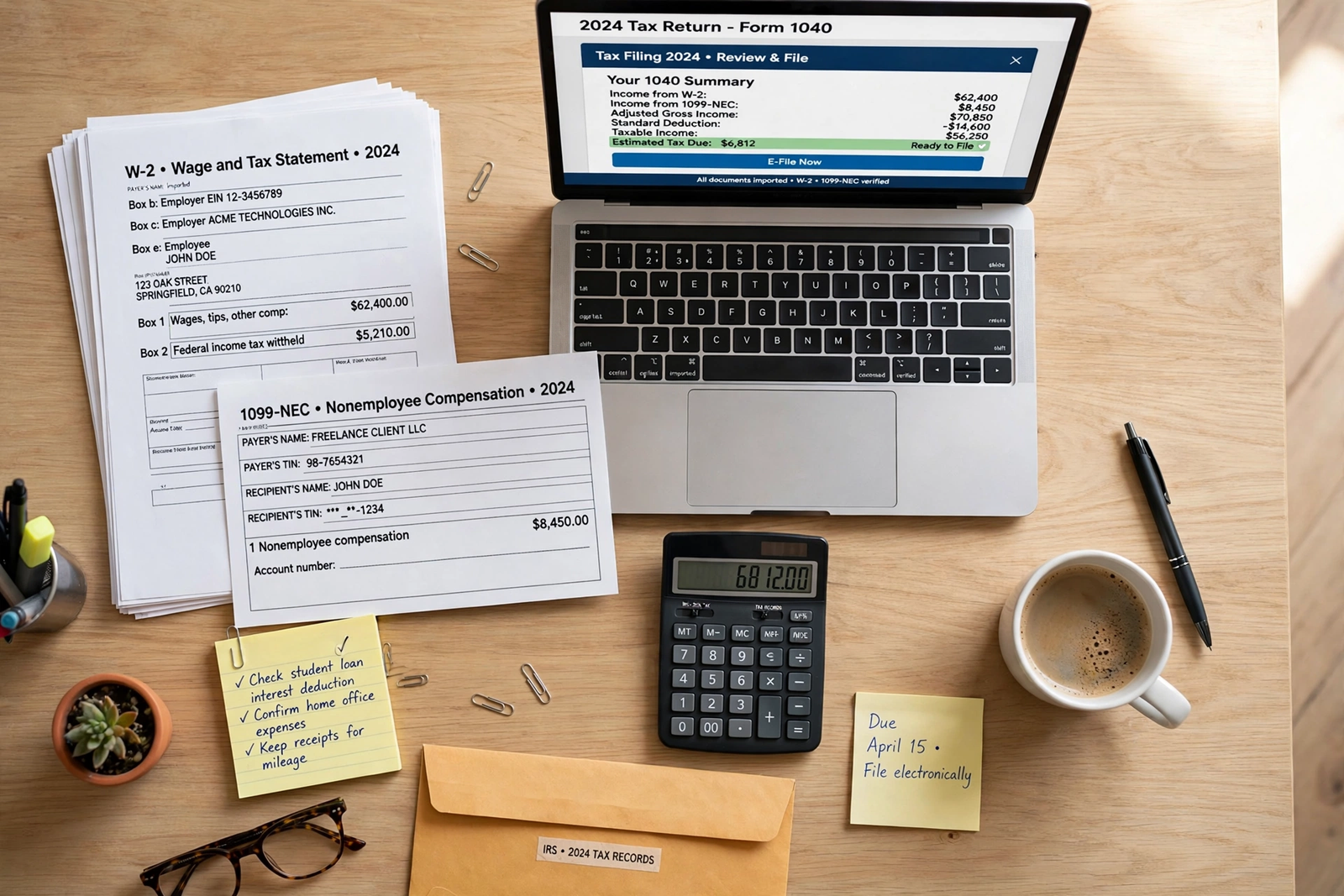
Quick Answer: You file taxes by gathering your income documents (W-2s, 1099s), choosing a filing method, calculating your tax, and submitting your return to the IRS. Most people file electronically using IRS Free File, commercial tax software, or a tax professional. The federal filing deadline is typically April 15 each year.
Filing taxes is one of those adulting tasks that feels intimidating until you have done it once. In reality, the process is straightforward: collect your paperwork, pick a filing method that fits your situation, fill out the return, and send it to the IRS. Whether you do it yourself for free or hire a professional, the steps are the same.
This guide walks you through every stage of filing a federal tax return in 2026, from the documents you need to the deadlines you cannot miss.
Your Filing Options, Compared
There is no single right way to file. The best method depends on your income, how complicated your taxes are, and how much help you want.
IRS Free File (free for qualifying incomes)
If your adjusted gross income is below the IRS threshold (historically around $79,000 to $84,000, adjusted yearly), you can use IRS Free File to prepare and e-file your federal return at no cost through guided tax software from IRS partners. Many states also offer free filing through the same program.
Commercial tax software
Programs like TurboTax, H&R Block, and TaxSlayer walk you through the return with interview-style questions. Most offer a free tier for simple returns (W-2 income only, standard deduction) and paid tiers for investments, self-employment income, or rental property. E-filing and direct deposit make refunds arrive in as little as 21 days.
Tax professional (CPA or enrolled agent)
Worth the fee if you have self-employment income, own rental property, sold investments, experienced a major life change, or just do not want the hassle. A good preparer can also find deductions you would miss. Expect to pay roughly $150 to $500 for a typical individual return, more for complex situations.
Documents You Need Before You Start
Gather everything before you sit down to file. Missing forms are the number one cause of delayed or rejected returns.
Income documents
- Form W-2: From each employer, showing wages earned and taxes withheld. Employers must send these by January 31.
- Form 1099-NEC: For freelance or contract work paying $600 or more.
- Form 1099-INT / 1099-DIV: Interest and dividend income from banks and brokerages.
- Form 1099-G: Unemployment compensation and state tax refunds.
Deduction and credit records
- Charitable donation receipts: Required for any claimed contribution.
- Childcare expenses: Provider name, address, and tax ID for the child and dependent care credit.
Identity information
- Social Security numbers for yourself, your spouse, and any dependents.
Standard Deduction vs. Itemizing
One of the first decisions on your return is whether to take the standard deduction or itemize deductions. The standard deduction is a flat amount that reduces your taxable income, and most filers take it because it is larger than their itemizable expenses.
- Standard deduction (2025 tax year, filed in 2026): $15,750 for single filers, $31,500 for married couples filing jointly, and $23,625 for heads of household. These figures adjust for inflation each year.
- Itemizing makes sense when your deductible expenses exceed the standard deduction. Common itemized deductions include mortgage interest, state and local taxes (capped at $10,000), charitable donations, and large medical expenses.
Tax software calculates both automatically and picks the larger one. If you are unsure, just enter your expenses and let the software decide.
Step-by-Step: How to File Your Taxes
- Gather your documents. Collect every W-2, 1099, and deduction record listed above. Create a folder, physical or digital, and check items off as they arrive in January and February.
- Choose your filing method. Decide between IRS Free File, paid software, or a professional based on your income and complexity.
- Enter your personal information. Name, Social Security number, filing status (single, married filing jointly, head of household, etc.). Filing status affects your tax rates and deduction amounts, so choose carefully.
- Report all income. Enter every W-2 and 1099. The IRS receives copies of these forms, so omitting one is the fastest way to trigger a notice.
- Claim deductions and credits. Deductions reduce your taxable income; credits reduce your tax bill dollar for dollar. Do not leave common credits on the table: the Child Tax Credit, Earned Income Tax Credit, education credits, and the Saver’s Credit.
- Review for errors. Check names, Social Security numbers, and math. A mismatched name or transposed digit is the most common reason e-filed returns get rejected.
- Sign and submit. E-filing requires an electronic signature, usually your prior-year adjusted gross income or a self-selected PIN. Paper filers mail the return to the IRS address for their state.
Filing Deadlines and Extensions
The federal individual filing deadline is April 15 in most years. When April 15 falls on a weekend or holiday, the deadline shifts to the next business day. Missing the deadline without an extension can trigger a failure-to-file penalty of 5% of unpaid taxes per month, up to 25%.
- Need more time? File Form 4868 before April 15 for an automatic six-month extension to October 15. This extends your time to file, not your time to pay. Estimate and pay what you owe by April 15 to avoid interest and penalties.
- State deadlines usually mirror the federal date but vary. Check your state revenue department’s website.
- Quarterly estimated taxes apply if you are self-employed or have significant income without withholding. If you end up owing the IRS, learn how do you pay taxes what you need to know“>how to pay your taxes to avoid penalties.
What Happens After You File
E-filed returns are usually accepted within 24 to 48 hours. The IRS issues most refunds within 21 days of acceptance when you e-file and choose direct deposit. Paper returns take six weeks or longer.
Track your federal refund with the IRS Where’s My Refund tool. If you owe taxes and cannot pay in full, the IRS offers installment plans and short-term payment extensions. And keep your records: the IRS recommends holding onto tax documents for at least three years, and how long should you keep tax returns complete answer“>you should keep tax returns even longer in certain situations.
Frequently Asked Questions
Do I have to file taxes if I earned very little?
It depends on your filing status, age, and income type. For 2025, single filers under 65 generally must file if gross income exceeds $15,750. But even below the threshold, filing can pay off: you may be owed a refund of withheld taxes or qualify for refundable credits like the Earned Income Tax Credit.
What if I miss the April 15 deadline?
File as soon as possible. The failure-to-file penalty (5% per month) is much steeper than the failure-to-pay penalty (0.5% per month), so filing on time even if you cannot pay saves money. If you need more time, file Form 4868 before the deadline for an automatic extension.
How long does it take to get my refund?
Most e-filed returns with direct deposit are refunded within 21 days. Paper returns can take six weeks or more. Returns claiming the Earned Income Tax Credit or Additional Child Tax Credit face extra review and may take longer by law.






One Comment