
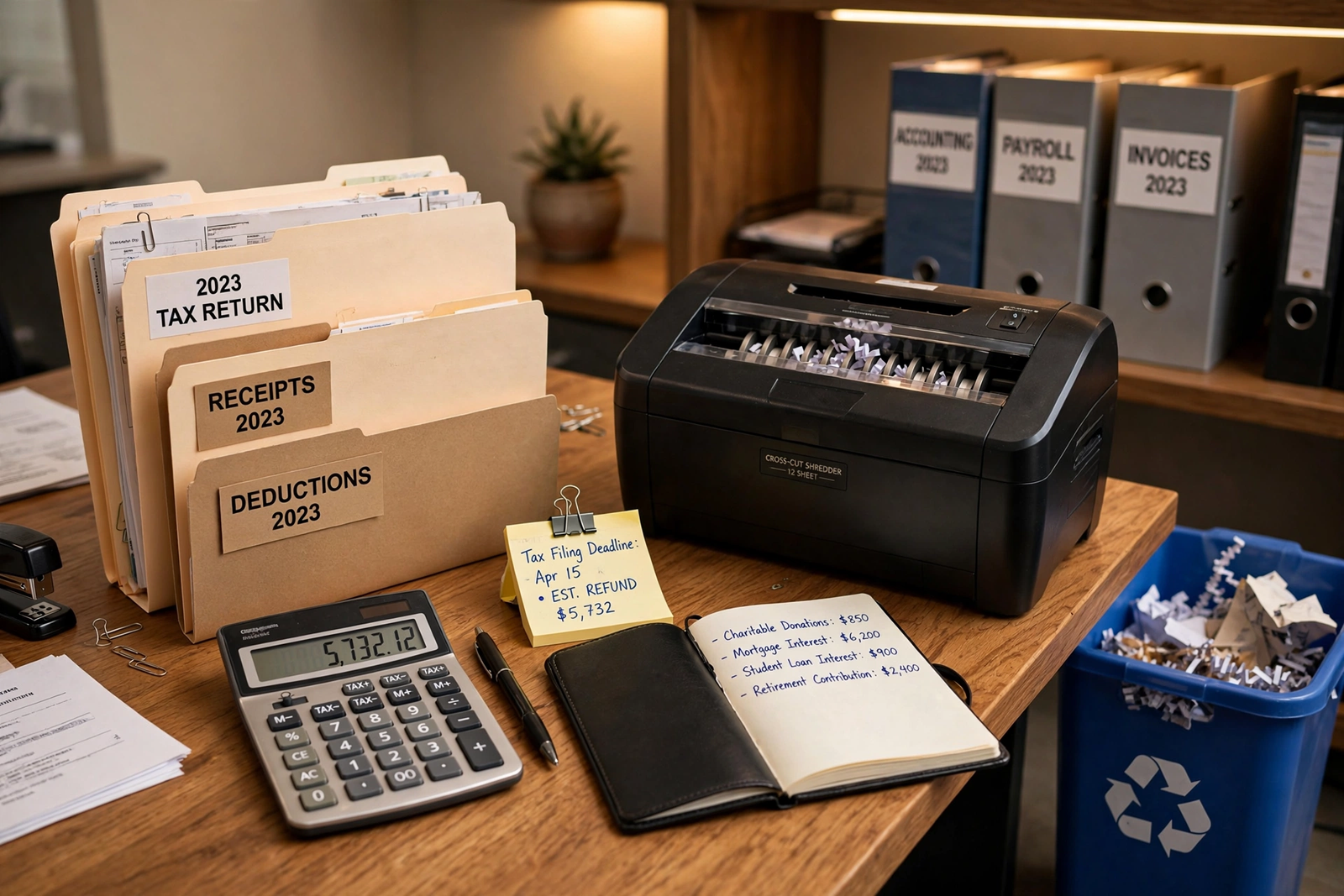
Quick Answer: The IRS recommends keeping tax returns and supporting documents for at least 3 years from the date you filed, 6 years if you underreported income by more than 25%, and 7 years if you claimed a loss from worthless securities. Keep returns indefinitely if you didn’t file or filed a fraudulent return. When in doubt, 7 years is a safe rule of thumb.
Most people keep their tax returns in a drawer, a filing cabinet, or (increasingly) a cloud folder — and then wonder how long they actually need to hold onto them. Keeping them too short can leave you defenseless in an IRS audit; keeping them forever just creates clutter and a pile of sensitive personal data.
This guide breaks down exactly how long to keep tax returns, which documents to save alongside them, and when it is safe to shred. Tax laws change, so verify current IRS guidance before discarding anything.
Why You Need to Keep Tax Returns
Tax returns are your proof of what you reported. The IRS can audit your return within a certain window (called the statute of limitations), and if it does, you need your records to back up every number. Without supporting documents, you could lose deductions you were entitled to — or face penalties on income you reported correctly.
Beyond the IRS, you may need old returns for mortgage applications, financial aid, employment verification, state tax issues, or amending a past return. A complete set of returns protects you on all fronts.
The IRS Rules: How Long to Keep Each Record
The IRS doesn’t require one single retention period — it depends on your situation:
- Standard case — 3 years: Keep returns and supporting documents for 3 years from the date you filed (or the due date, whichever is later). This covers most filers with straightforward returns.
- Underreported income — 6 years: If you underreported gross income by more than 25%, the IRS can go back 6 years, so keep records that long.
- Worthless securities or bad debt deductions — 7 years: Keep returns claiming these deductions for 7 years.
- No return filed or fraudulent return — indefinitely: There is no statute of limitations, so keep these records forever.
- Employment tax records — 4 years: Keep payroll and employment tax records for at least 4 years after the tax becomes due or is paid, whichever is later.
- Property records — until 3 years after you sell: Keep purchase documents, closing statements, and records of improvements until 3 years after the year you report the sale.
For details on these timeframes, see the IRS’s official guidance at the IRS official guidance on how long to keep tax records.
What Counts as a Supporting Document?
Your tax return alone isn’t enough — you need the documents that justify it. Keep:
- W-2s, 1099s (interest, dividends, freelance income), and K-1s
- Receipts for deductions: charitable donations, business expenses, medical bills, education costs
- Bank and investment statements used to prepare the return
- Property tax statements, mortgage interest statements (1098), and closing documents
- Records of home improvements (they affect your cost basis when you sell)
- Copies of the filed return itself, plus any amendments
Should You Keep Paper or Digital Copies?
The IRS accepts digital records, including scanned documents and electronic receipts, as long as they are accurate, complete, and accessible. Many filers now keep everything digitally — it’s safer from fire and easier to organize.
- Scan paper documents at a readable resolution (300 DPI is fine) and name files clearly (e.g., “2025-W2-employer-name.pdf”).
- Store backups in at least two places: a local drive and an encrypted cloud backup.
- Protect files with encryption, since tax records contain Social Security numbers and financial data.
When Is It Safe to Shred?
Once the retention period has passed and you have no reason to expect an audit, amendment, or dispute, shredding is safe. A good conservative rule: shred returns older than 7 years unless they relate to property you still own, a business with open tax issues, or an unfiled/fraudulent return.
- Always shred, never trash: Tax documents contain Social Security numbers, income data, and bank details. Use a cross-cut shredder or a professional shredding service.
- Destroy digital copies too: Deleting the file isn’t enough — empty the trash and remove cloud backups of expired documents.
- Check state rules: Some states have longer statutes of limitations than the IRS. If your state allows audits going back 5+ years, hold records accordingly. The IRS page at the official IRS website covers federal rules; check your state revenue agency for state rules.
Special Situations
Amended returns
You can generally amend a return to claim a refund within 3 years of filing or 2 years of paying the tax, whichever is later. Keep everything you might need to file an amendment.
Self-employed or business owners
Business owners should keep full books, receipts, invoices, and payroll records for at least 6 to 7 years, since income and expense claims are the most commonly audited items. The IRS recordkeeping requirements for small businesses explain the recordkeeping requirements in detail.
Homeowners
Keep purchase and improvement records until 3 years after you sell the home — improvements increase your cost basis and can significantly reduce capital gains tax on the sale.
For related money topics, see how much does it cost to file bankruptcy and how long does unemployment last.
Frequently Asked Questions
Can the IRS audit me after 3 years?
Usually no — 3 years is the standard limit. But it extends to 6 years if you underreported income by more than 25%, and there is no time limit at all if you never filed or filed a fraudulent return.
Do I need to keep state tax returns as long as federal?
Often longer. Several states have statutes of limitations beyond the federal 3 years. Check your state’s department of revenue — many advisors recommend keeping state returns for at least 5 years.
What happens if I lose my tax returns?
You can request a free transcript of past returns from the IRS at irs.gov, or order a full copy (for a fee) using Form 4506. Transcripts are usually enough for loan applications and most verification needs.
Is 7 years the safest rule for everyone?
For most individuals, yes — 7 years covers every standard IRS statute of limitations. But keep property records until 3 years after selling, and keep unfiled or disputed returns indefinitely.
Can I throw away supporting receipts once the return is filed?
No. The return is just a summary — the receipts, W-2s, and statements are your evidence in an audit. Keep them for the full retention period that applies to that return.
Should I keep digital or paper copies?
The IRS accepts both. Digital is fine as long as records are accurate, readable, and backed up. Store them encrypted in at least two locations since they contain sensitive personal information.






3 Comments