
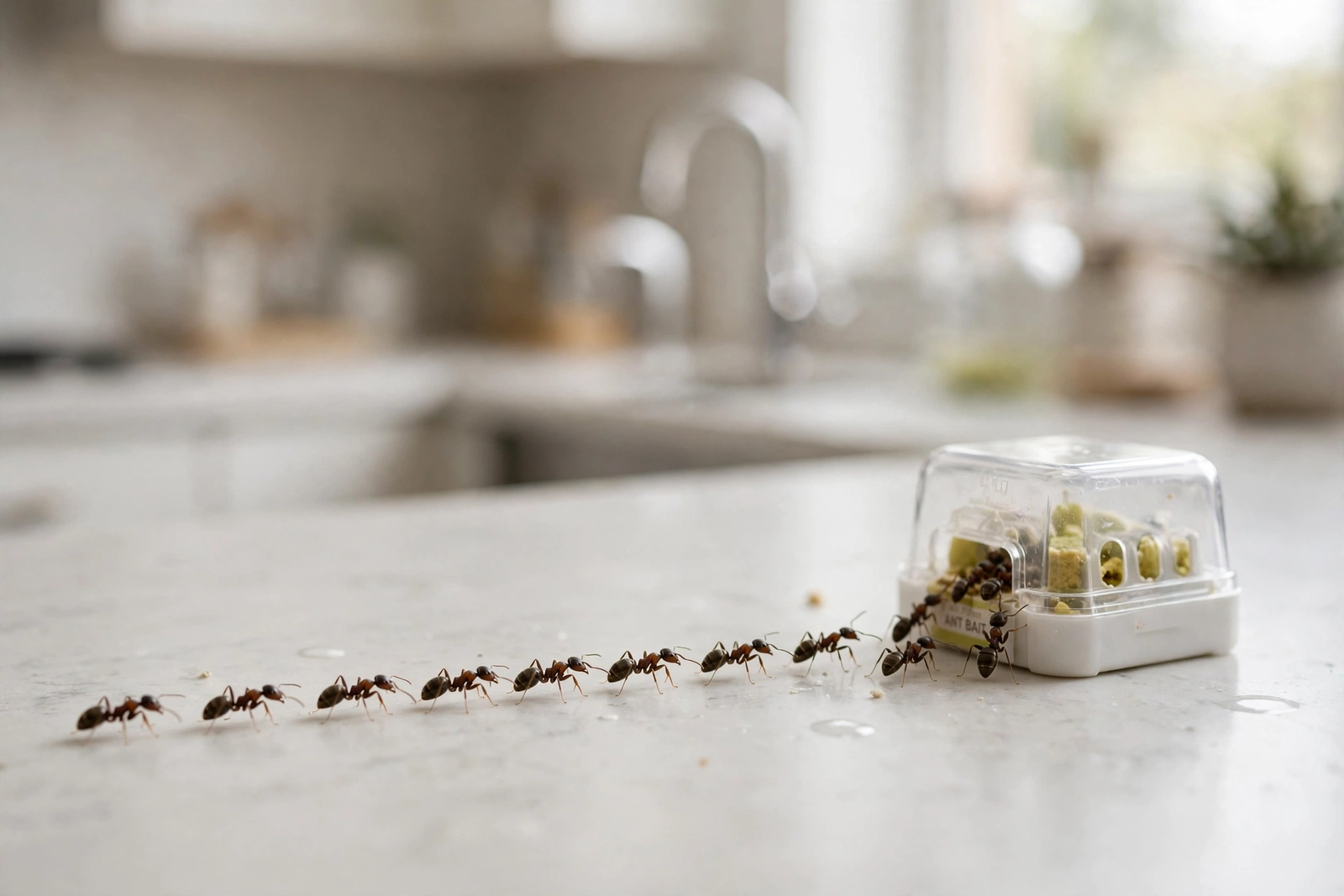
Quick Answer: To get rid of ants in the kitchen, first remove all accessible food and wipe down surfaces, then follow the ant trail to find where they’re entering. Place slow-acting bait stations (borax-based or commercial ant bait) along the trail — not spray — so foraging ants carry the poison back to the colony. Seal entry cracks with caulk, and keep counters crumb-free. The colony usually collapses within 1–2 weeks.
Few things are more annoying than opening a cabinet to find a marching line of ants across your countertop. Kitchen ants are almost always after the same three things: sugar, grease, and water. The good news is that kitchen ant invasions are very solvable — but the method matters enormously. Spraying the ants you see feels satisfying, yet it almost never kills the colony and often makes the problem worse by scattering it.
First, Identify What You’re Dealing With
Most kitchen ants in the US and UK fall into a few common types:
- Odorous house ants — small, dark brown; smell like rotten coconut when crushed. The most common kitchen invader; they love sweets.
- Pavement ants — small brown ants that nest under slabs and enter through foundation cracks.
- Pharaoh ants — tiny yellow ants; notorious for splitting into multiple colonies (called “budding”) when sprayed with repellent insecticides. Bait only — never spray these.
- Carpenter ants — large black ants. They don’t eat wood but tunnel through damp wood to nest. Seeing them regularly indoors can signal moisture damage worth investigating.
You don’t need a perfect ID to start, but knowing that spraying can backfire — especially with pharaoh ants — shapes the whole strategy.
Why Spraying the Ants You See Doesn’t Work
The ants on your counter are foragers — typically less than 10% of the colony. The queen and the vast majority of workers stay hidden in the nest, which may be inside a wall void, under the foundation, or outdoors. Contact sprays kill foragers on contact but never reach the queen, so the colony simply sends more foragers. Worse, repellent sprays can cause some species to split the colony into several new ones, multiplying your problem. That’s why baiting beats spraying every time for kitchen ants.
Step-by-Step: Eliminating Kitchen Ants
- Do a deep clean first. Wipe counters, sweep floors, clean under appliances, take out trash, and wash pet bowls. Store sugar, cereal, flour, and snacks in sealed airtight containers. Fix dripping faucets — ants need water too. This removes competing food so the ants actually take your bait.
- Find the trail and entry point. Watch the ant line (don’t disturb it yet) and follow it to where ants enter — often a window frame, pipe penetration, baseboard gap, or door threshold. Mark the spot; you’ll seal it later, after baiting.
- Set out bait stations. Place slow-acting bait directly on or beside the active trail. Options:
- Commercial ant bait stations (look for borax/boric acid or fipronil-based products labeled for sweet-feeding ants)
- DIY borax bait: mix 1 tablespoon borax with 3 tablespoons powdered sugar, add just enough water to make a syrup, and soak it into cotton balls placed in bottle caps
The key word is slow-acting: foragers must live long enough to carry the bait back and feed the colony, including the queen. You should see ant activity at the bait increase for a few days — that’s the colony feeding, and it’s a good sign.
- Do not spray or wipe the trail. Resist the urge. The pheromone trail is what leads nestmates to your bait. Leave foragers alone while baiting is underway.
- Seal entry points. Once activity drops (usually 7–14 days), seal the entry gaps with silicone caulk. Also check where pipes and cables enter walls, and weather-strip doors.
- Monitor and maintain. Keep food sealed and counters clean for a few weeks after the ants disappear. Leave one bait station in place for another week as insurance.
What About Natural Remedies?
You’ll see many suggestions online. Here’s an honest assessment:
- Vinegar or soapy water: good for wiping up trails and cleaning — they erase pheromone trails. They don’t kill colonies.
- Diatomaceous earth (food grade): can kill individual ants that cross it, and it’s low-toxicity. Useful as a barrier in dry areas, but it won’t eliminate a nest.
- Cinnamon, coffee grounds, cucumber peels: mild repellent effects at best; ants usually walk around them.
- Boiling water: only useful if you can locate an outdoor nest mound and drench it directly.
Natural options are fine as supplements, but for actually eliminating the colony, slow-acting bait is the proven method. For help with other kitchen invaders, see how to get rid of fruit flies in kitchen and how to get rid of german cockroaches.
Safety: Kids, Pets, and Borax
Borax is low in toxicity but it is still a poison — keep all bait (homemade or commercial) where children and pets cannot reach it: inside tamper-resistant bait stations, under appliances, or inside cabinets. Wipe up any spilled bait immediately. If you have curious pets, commercial enclosed bait stations are safer than open DIY baits. Always read and follow the product label — it’s the law and it’s written for your safety. The University of Minnesota Extension offers science-based guidance on managing household ants, and the EPA’s tips on using pesticides safely around the home are worth reading. Practical walkthroughs are also available at The Spruce.
Preventing the Next Invasion
- Store dry goods in airtight glass or hard-plastic containers.
- Wipe counters and sweep floors daily during ant season (spring and summer).
- Take trash out regularly and keep bins sealed and clean.
- Trim tree branches and shrubs touching the house — they act as ant highways.
- Fix moisture problems: leaky pipes, damp basements, and condensation attract ants.
- Caulk foundation cracks and gaps around windows, doors, and utility lines.
For pantry-specific protection, see how to keep pantry moths away.
When to Call a Professional
Call a licensed pest control professional if: baiting for 2–3 weeks hasn’t reduced activity, you’re seeing large black carpenter ants regularly (possible structural nesting), ants are in wall voids you can’t access, or the infestation keeps returning despite sealing and sanitation. A pro can use non-repellent professional baits and dust wall voids safely.
Frequently Asked Questions
How long does it take for ant bait to work?
Expect visible reduction in 5–7 days and colony collapse in 1–3 weeks. Ant activity at the bait often increases first — that means foragers are carrying poison back to the nest, which is exactly what you want.
Why do ants keep coming back to my kitchen?
Usually because a food or water source remains, the entry point was never sealed, or the colony was only partially killed (often after spraying instead of baiting). Full sanitation plus sealed entry points plus complete baiting breaks the cycle.
Is it safe to use ant bait around pets?
Yes, if used correctly: keep bait inside enclosed, tamper-resistant stations placed where pets can’t reach, and clean up spills immediately. Borax-based baits are low-toxicity but still poisonous if eaten in quantity.
Does killing the ants I see help at all?
Very little — you’re only removing foragers while the queen keeps producing more. Worse, spraying repellent insecticides can scatter some colonies into multiple new ones. Bait the trail; don’t spray it.
What attracts ants to kitchens the most?
Sugar and sweets first, then grease and protein, plus any water source. Even tiny residues — a sticky jar, crumbs under the toaster, a dripping faucet — can sustain a foraging trail.
Can ants in the kitchen contaminate food?
Ants can carry bacteria from garbage and drains onto food-contact surfaces. Discard any food they’ve swarmed over, and sanitize counters and utensils the trail crossed.


One Comment