
Here’s a paradox of modern life: we’re busier than ever, yet our schedules are full of things we didn’t choose. The week fills up by default — work expands, obligations multiply, and “me time” becomes the thing that happens never. Learning how to plan a weekly schedule that leaves time for yourself isn’t about finding extra hours. It’s about deciding in advance what your hours are for, and defending the ones that are yours.
I’ve planned my weeks every Sunday for years, and the weeks I skip it are visibly worse — more reactive, more drained, less done. The planning itself takes 20 minutes. The return is a week that feels like yours.
The Mindset Shift: Schedule Yourself First
Most people plan like this: work, obligations, errands… and then see if anything’s left for themselves. Nothing is ever left. Flip it: your non-negotiables go on the calendar first, and everything else fills around them.
Your non-negotiables might include:
- Exercise (whatever form you’ll actually do)
- Sleep (a consistent bedtime is a schedule item, not a hope)
- One real break per day (lunch away from the desk counts)
- Relationship time (date night, family dinner, friend call)
- Solo recharge time (even 30 minutes — non-negotiable for introverts, valuable for everyone)
This isn’t selfish; it’s structural. A schedule with no recovery time doesn’t produce more — it produces burnout, resentment, and the kind of exhaustion where you’re technically “resting” but never feel rested. If burnout’s already knocking, these simple self-care habits are the micro-version of the same principle.
How Do I Plan a Weekly Schedule That Leaves Time for Myself? The Sunday 20
Once a week — Sunday evening works best for most — spend 20 minutes on this sequence:
1. Review last week (5 min)
What worked? What didn’t? Where did time leak? No judgment, just data. If every evening dissolved into scrolling, that’s information about your energy management, not a character flaw.
2. Identify the week’s big rocks (5 min)
What are the 3–5 things that would make this week feel successful? Not 25 tasks — 3 to 5 outcomes. A work deadline, a health appointment, a social plan, a personal project milestone. Write them down. Everything else is gravel that fills around the rocks, not the other way around.
3. Block the calendar (10 min)
Put the big rocks on specific days and times. Then add your non-negotiables. Then — and only then — let everything else fill the gaps. Be realistic about durations: everything takes longer than you think, so add 25% buffer to estimates and leave white space between blocks. A schedule with no breathing room shatters at the first surprise.
If weekly planning feels foreign, start with the daily version: a solid morning routine is really just this principle applied to the first two hours.
Design Principles for a Schedule That Holds
- Theme your days. Batch similar work: admin day, deep-work days, errand day, meeting day. Context-switching is expensive; theming minimizes it.
- Protect one “white space” block weekly. 2–3 unscheduled hours for whatever comes up — overflow, spontaneity, or glorious nothing. Schedules without slack break; schedules with slack bend.
- Batch errands ruthlessly. One errand run per week, route-planned. Five separate 20-minute trips are an hour-plus of overhead you’re not counting.
- Schedule the fun stuff too. “Relax sometime” never happens. “Saturday 2–4: hike with Sam” happens. Fun you don’t schedule loses to obligations every time.
- End each day with a 5-minute review. Check tomorrow’s blocks, adjust for reality, go to bed with a plan instead of a swirl.
Defending Your Time (The Hard Part)
A schedule is only as good as your ability to defend it. The scripts that work:
- “Let me check my calendar and get back to you.” Buys thinking time; prevents reflexive yeses.
- “I can’t do Thursday, but I could do Tuesday afternoon.” A no with an alternative is 10x easier to say and receive.
- “I’m at capacity this week.” Complete sentence. No justification required.
- For work: “I can take that on — which of these other priorities should I deprioritize?” Makes the trade-off visible instead of absorbing it silently.
And audit monthly: what recurring commitments drain you? The standing meeting that could be an email, the volunteer role you’ve outgrown, the social obligation maintained purely by guilt. Stopping procrastination often starts here — many “procrastinated” tasks are really tasks you never truly committed to.
Sample Week: What It Looks Like Filled In
Abstract advice is hard to picture. Here’s a realistic filled-in week for a working parent — adapt freely:
- Monday: Deep work 9–12, admin afternoon, kids’ soccer 5:30–6:30, family dinner, 30-min read before bed (non-negotiable personal time).
- Tuesday: Meetings morning, project work afternoon, gym 6–7 p.m. (calendar-blocked), date night in (takeout + movie after kids’ bedtime).
- Wednesday: Deep work 9–12, errands lunch block (batched), kids’ homework help evening, 20-min walk after dinner (solo recharge).
- Thursday: Flexible workday (appointments, overflow), friend coffee 3 p.m. (scheduled joy), family game night 7–8.
- Friday: Wrap-up + planning by 3 p.m., hard stop, pizza-and-movie night (weekly tradition — protected).
- Saturday: Morning hike or project (personal), afternoon family time, evening free.
- Sunday: Slow morning, 20-min weekly planning session, meal prep, early bedtime.
Notice: personal time appears 5+ times, but never as big empty blocks labeled “me time” — it’s woven in as specific activities. That’s the trick. Vague “free time” gets eaten; scheduled specific joys survive.
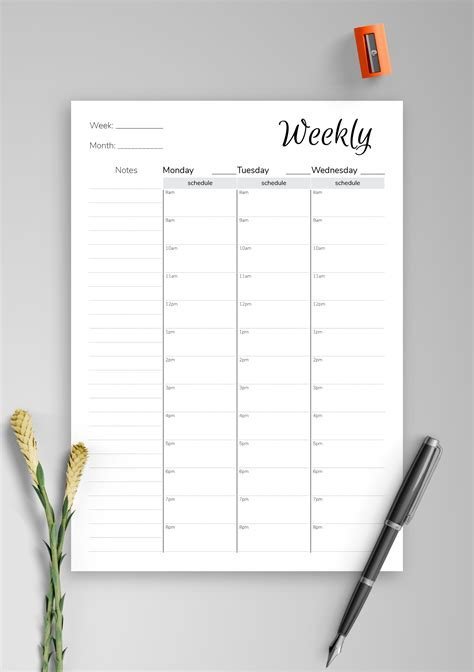
Paper vs. Digital Planning
The eternal debate, settled pragmatically: paper planning (a notebook or printed weekly template) wins for thinking — writing by hand engages planning and memory better, and a paper week-view on your desk is ambiently visible all week. Digital (Google Calendar, etc.) wins for logistics — shared schedules, reminders, recurring events, and access everywhere. The best system for most people is hybrid: paper for the Sunday planning session and daily MITs (the thinking work), digital for the actual calendar with alerts (the logistics work). Try paper-first for a month; if the double-entry annoys you, go all-digital. The tool debate is secondary — the non-negotiable is the weekly review itself, in whatever medium you’ll actually do it.
The Takeaway
Planning a weekly schedule that leaves time for yourself means scheduling yourself first, running a 20-minute Sunday review-and-block session, theming days to reduce switching, building in white space, and defending the result with simple scripts. Twenty minutes of planning buys back hours of drift and days of resentment. Try it this Sunday — and notice how different next week feels when it was designed instead of defaulted. For the science of why planning works, the APA’s research on stress and time management connects the dots between perceived control and well-being.






2 Comments