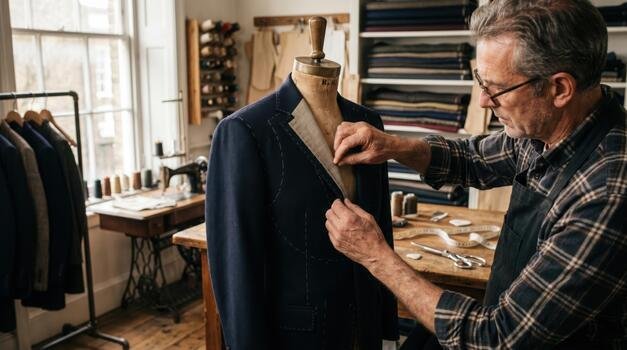
The open secret of well-dressed people: almost nothing fits perfectly off the rack, and the best-dressed among us tailor everything. Buying slightly big and tailoring down is often smarter than squeezing into the smaller size — you get the room where you need it and precision where it shows. So let’s take what is the best way to tailor clothes that are slightly too big seriously and answer it properly.
But not everything is worth altering, and some fixes are easy DIY while others need a professional. Here’s the complete breakdown.
Easy DIY Fixes (No Sewing Machine Needed)
Several ‘too big’ problems have simple home solutions. Hemming pants: iron-on hem tape ($5) creates a clean hem with zero sewing — measure twice, iron once, done in 15 minutes. Taking in a waistband slightly: a hidden elastic band sewn (or even safety-pinned) inside the waistband cinches an inch discreetly. Sleeves too long on casual shirts: the military tuck or a simple sleeve roll handles it stylishly.
For knit tops slightly too roomy: a hot wash and dryer can shrink cotton knits a half-size (check fabric first — this is one-way). Drawstring waists, belts, and strategic tucking (the French tuck — front tucked, back out) visually tailor oversized tops without a needle. These fixes handle the ‘slightly’ in slightly-too-big for free. The Spruce clothing alteration guides
- Iron-on hem tape: $5, 15 minutes, clean hems with zero sewing.
- Waistband elastic trick: hidden elastic cinches a loose waistband an inch.
- French tuck: front-tucked tops look tailored without alteration.
- Hot wash for knits: shrinks cotton knits ~half size — one-way, so be careful.
- Strategic rolling: sleeve rolls and cuffing handle slightly-long sleeves.
Worth Paying a Tailor For (and What It Costs)
Some alterations are tailor territory, and they’re cheaper than you think. Taking in trouser waists ($15-25), hemming dress pants ($12-20), tapering pant legs ($20-30), taking in shirt sides ($15-25), shortening sleeves on button-downs ($20-30), and taking in jacket waists ($30-50) are all routine. A $40 thrifted blazer plus $50 in alterations becomes a $300-looking garment.
The golden rule: buy to fit the hardest-to-alter part (shoulders on jackets, hips/thighs on pants) and tailor the rest. Taking in is almost always possible; letting out is limited by seam allowances (usually 1 inch max). Ask the tailor ‘is this worth altering?’ before committing — good tailors will tell you honestly when a garment isn’t worth the cost. Art of Manliness tailoring guides
- Waist/hem/taper ($12-30): routine alterations that transform fit cheaply.
- Jacket waist suppression ($30-50): turns boxy into bespoke-looking.
- Buy for shoulders/hips: fit the unalterable parts; tailor the rest.
- Taking in > letting out: letting out is limited to ~1 inch of seam allowance.
- Ask first: good tailors honestly tell you when it’s not worth it.
What’s Not Worth Tailoring
Know the limits. Shoulders on jackets: essentially unalterable — if shoulders don’t fit, don’t buy. Anything needing more than 2 inches taken in: the garment’s proportions distort (pockets migrate, patterns misalign). Very cheap fast-fashion pieces: a $15 shirt isn’t worth $25 in alterations — put the money toward a better piece instead.
Complex construction (lined jackets, formal gowns, leather) multiplies alteration costs — get a quote first. And be realistic about ‘someday’ alterations: the bag of clothes awaiting tailoring that sits for a year is just clutter with guilt attached. Either take it to the tailor this week or donate it. The best alteration is the one that actually happens.
- Shoulders: unalterable — the dealbreaker. Never buy bad shoulders.
- More than 2″ to take in: proportions distort; find a smaller size.
- Cheap pieces: don’t put $25 of tailoring into a $15 garment.
- Complex construction: lined/leather/formal — get quotes first, costs multiply.
- Do it or donate it: the ‘to be tailored’ bag is guilt-clutter — act this week.
Common Mistakes to Avoid
Before you put any of this into practice, save yourself the learning curve: here are the classic errors that derail progress. I’ve made several of these myself, so consider this the shortcut I wish I’d had.
- Altering before washing: wash and dry new clothes first — then tailor to the post-shrink fit. Tailoring pre-shrunk clothes wastes money.
- Taking in more than 2 inches: proportions distort beyond that — pockets migrate, patterns misalign. Find a closer size instead.
- Cheap garment, expensive alterations: $25 of tailoring on a $15 shirt is bad math. Put the money toward a better piece.
- Ignoring the tailor’s honest advice: good tailors tell you when it’s not worth it. Listen — they’re saving you money.
- The eternal ‘to be tailored’ bag: clothes awaiting alterations for a year are guilt-clutter. This week or donate.
Frequently Asked Questions
How much does basic tailoring cost?
Hemming pants $12-20, taking in waists $15-25, tapering legs $20-30, shortening sleeves $20-30, jacket waist suppression $30-50. Most ‘slightly too big’ fixes land in the $15-40 range — transformative for the price.
What can’t a tailor fix?
Shoulders on jackets (the dealbreaker), more than ~2 inches of taking in, letting out beyond 1 inch of seam allowance, and fundamentally wrong proportions. Know these limits before buying ‘close enough.’
Is it worth tailoring cheap clothes?
Sometimes — a $20 thrifted wool blazer plus $40 tailoring becomes a $200-looking garment. But a $15 fast-fashion shirt plus $25 alterations is bad math. Worth it when the base garment has good bones (fabric, construction).
How do I find a good tailor?
Ask well-dressed friends, check reviews for alteration specialists (not just dry cleaners with a sewing machine), and test with a simple hem first. A good tailor relationship is worth cultivating — they’re increasingly rare.
Pro tip: Tell one person what you’re working on. Social accountability — even casual — measurably increases follow-through. You don’t need an accountability partner; you need a witness.
What is the best way to tailor clothes that are slightly too big: The Bottom Line
For slightly-too-big clothes: DIY the easy stuff (iron-on hems, waistband elastic, French tucks, strategic shrinking), pay a tailor for the transformative stuff ($12-50 for waists, hems, tapers, and jacket suppression), and skip what’s unalterable (shoulders) or uneconomical (more than 2 inches, cheap pieces). Buy to fit shoulders and hips, tailor everything else. The best-dressed people aren’t luckier with sizing — they just finish the job the manufacturer started.