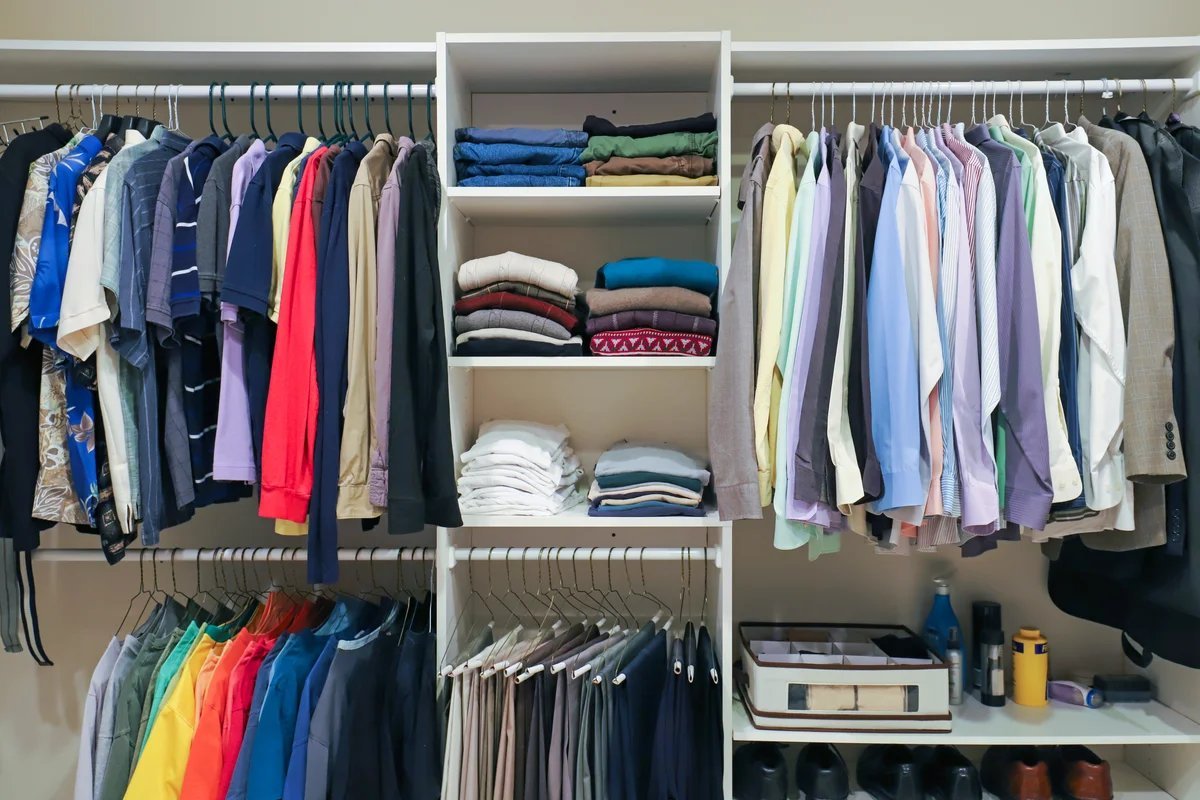
Small closets aren’t a storage problem — they’re an organization problem. I’ve seen people fit a full professional wardrobe into a closet most would call unusable, and I’ve seen walk-ins that hold nothing because everything’s in a heap. The difference is systems, not square feet. The question of how can I organize a small closet to fit more clothes comes up constantly — here’s what actually works.
Here’s how to roughly double what your small closet holds, without a renovation.
Maximize Hanging Space: The Biggest Win
Most closets waste their vertical space — there’s a single rod with dead air above and below it. A double-hang rod (a second rod hung below the first, $15-25) instantly doubles hanging capacity for shirts, pants, and folded-over items. Keep long items (dresses, coats) on one side at full length, double-hang everything else. This one change is the highest-impact move in small-closet organization.
Then fix your hangers. Bulky plastic and wooden hangers eat inches; slim velvet hangers ($15 for 50) are a fraction of the width and grip clothes so nothing slides off. Switching hangers alone can free up 30% more rod space. Hang everything facing the same direction, grouped by category — the uniformity itself creates visual space and makes outfits findable. The Container Store closet organization guides
- Double-hang rod: $15-25, instantly doubles shirt/pants capacity — the #1 move.
- Slim velvet hangers: fraction of the width; switching frees ~30% more space.
- Group by category: shirts, pants, dresses together — findable and visually calm.
- Face everything one way: uniformity creates the illusion (and reality) of space.
- Full-length zone: reserve one section for dresses and coats; double-hang the rest.
Use Every Inch: Doors, Floors, and Vertical Space
The back of the closet door is free real estate: over-door hooks for robes, bags, and tomorrow’s outfit; over-door shoe organizers for shoes, accessories, or rolled items. The floor under hanging clothes fits shoe racks, storage bins, or a small dresser — measure the clearance and use it. Above the top rod, a shelf (or added shelf) holds out-of-season items in labeled bins.
Inside, go vertical everywhere: shelf dividers keep stacked sweaters from avalanching, hanging shelf organizers create cubbies for folded items, and slim rolling carts fit in gaps as narrow as 6 inches. The principle: every cubic inch should have a job. Dead space is just storage you haven’t claimed yet. Apartment Therapy small space organization
- Over-door organizers: hooks and shoe organizers claim the door’s free space.
- Under-hanging floor: shoe racks, bins, or a small dresser in the clearance.
- Top shelf + labeled bins: out-of-season and rarely-used items go up high.
- Shelf dividers: stop sweater stacks from avalanching.
- Slim rolling carts: exploit gaps as narrow as 6 inches.
Edit Ruthlessly: Less Stuff Fits Better
Here’s the uncomfortable truth: no organization system overcomes too much stuff. Before buying a single organizer, purge. The rule: if you haven’t worn it in a year (excluding occasion wear), if it doesn’t fit, or if you don’t feel good in it — out. Be honest about ‘someday’ clothes; they’re renting space from clothes you actually wear.
After purging, maintain with one-in-one-out: every new piece means one leaves. Store out-of-season clothes elsewhere (under-bed bins, top shelf) so your daily closet holds only the current season — this alone can halve the apparent volume. A small closet with only what you wear, well-organized, feels luxurious. A small closet stuffed with maybes feels like a burden.
- Purge first: unworn in a year, doesn’t fit, or doesn’t feel good — out.
- One in, one out: the maintenance rule that prevents re-cluttering.
- Seasonal rotation: current season only in the closet; rest in under-bed bins.
- Be honest about ‘someday’: aspirational clothes rent space from clothes you wear.
- Donate/sell immediately: bags sitting around migrate back into the closet.
Common Mistakes to Avoid
A quick word on what not to do — because the fastest way to succeed at anything is to stop doing the things that guarantee failure. These five mistakes are more common than the right moves.
- Buying organizers before purging: organizing clutter is just expensive clutter. Purge first, then buy only what the edited closet needs.
- Keeping ‘someday’ clothes: the jeans from 2019 aren’t coming back. Aspirational clothes rent space from clothes you actually wear.
- Bulky hangers: thick plastic and wood hangers eat inches per garment. Slim velvet hangers free ~30% more rod space instantly.
- Single rod, dead air: one rod with empty space above and below is wasted capacity. A $15 double-hang rod doubles it.
- Skipping seasonal rotation: storing off-season elsewhere halves the working closet’s volume. Current season only, always.
Frequently Asked Questions
How do I start organizing a messy closet?
Purge first (unworn in a year, doesn’t fit, doesn’t feel good — out), then install a double-hang rod and switch to slim hangers, then assign zones by category. Organizers come last, bought for the edited closet’s actual needs.
Are velvet hangers really better?
For space: yes — dramatically slimmer than plastic or wood, freeing ~30% more rod space. For function: the velvet grips clothes so nothing slides off. The one downside: they’re harder to slide, so reorganizing takes slightly longer.
How often should I declutter my closet?
A quick seasonal pass (4x yearly) when rotating clothes, plus the ongoing one-in-one-out rule for new purchases. The seasonal rhythm prevents the slow re-accumulation that undoes one big purge.
What do I do with clothes I remove?
Sell quality pieces (Poshmark, ThredUp, consignment), donate the rest promptly — bags sitting around migrate back. Get removed items out of the house within a week or the purge unhappens.
Pro tip: Track the one metric that matters most for your goal (not five metrics — one) for 30 days. What gets measured gets managed, and a single number keeps you honest without overwhelming you.
How can I organize a small closet to fit more clothes: The Bottom Line
Double your small closet’s capacity with: a double-hang rod ($15-25, the biggest win), slim velvet hangers (30% more space), over-door and under-hanging storage claiming dead zones, vertical organization everywhere, and — the prerequisite — a ruthless purge plus seasonal rotation and one-in-one-out maintenance. Small closets reward systems. Build the system once, and getting dressed becomes the easiest part of your day.