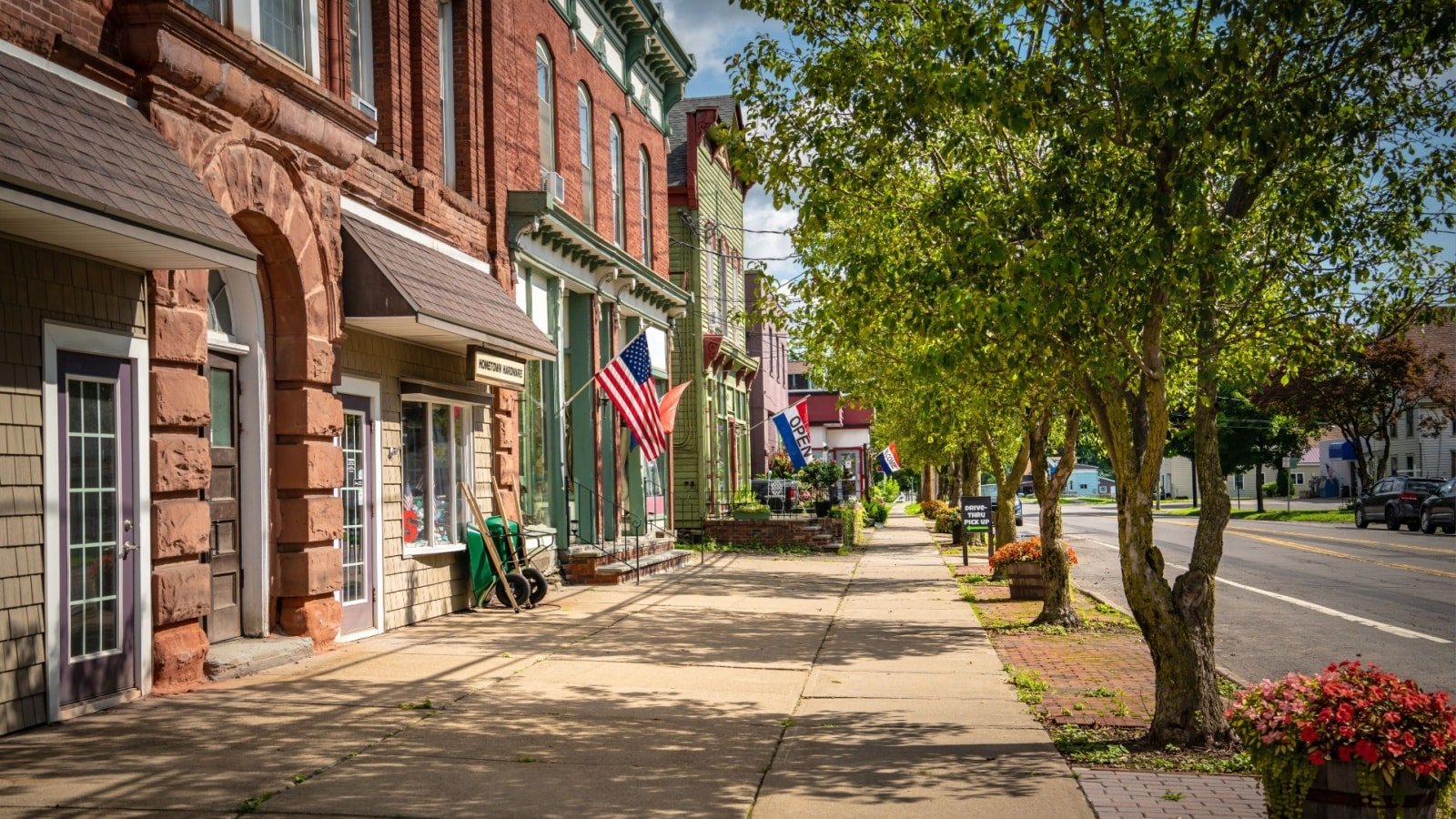
America’s small towns are having a moment — and it’s deserved. Beyond the famous cities and national parks, thousands of small towns offer the things travelers increasingly crave: walkable main streets, local food, genuine character, natural beauty, and prices that don’t require a second mortgage. So what are the best small towns in America worth visiting? Not the tourist-trap “quaint” towns selling fudge to bus tours — the ones with real soul, where the visit feels like a discovery.
I’ve road-tripped through dozens of small towns across 40+ states. The standouts below earned it — each offers a distinct flavor of small-town America at its best.
The Mountain Towns
Ouray, Colorado
“The Switzerland of America” — and it earns the nickname. A Victorian main street boxed in by 13,000-foot peaks, natural hot springs (the town pool is fed by them), world-class ice climbing in winter, and the Million Dollar Highway starting at its doorstep. Population ~1,000, scenery per capita off the charts. Go in fall for golden aspens and empty streets.
Marfa, Texas
Minimalist art installations in the middle of the Chihuahuan Desert — the Prada Marfa sculpture, the Chinati Foundation, the mysterious Marfa Lights. It’s weird, wonderful, and unlike anywhere else in America. Come for the art, stay for the vast desert sky. Book lodging early; tiny town, big reputation.
Lewisburg, West Virginia
A historic main street (Carnegie Hall! A 1902 opera house still running!), the nearby New River Gorge National Park, and Greenbrier Valley farmland. It’s the small town that makes you wonder why you ever needed a city. The general store, the local theater, the farm-to-table food — all genuine, none performed.
What Are the Best Small Towns in America Worth Visiting? The Coastal Gems
Beaufort, South Carolina
Antebellum architecture draped in Spanish moss, waterfront sunsets, horse-drawn carriage tours that are actually charming, and Lowcountry food (shrimp and grits where they were invented). Less discovered than Charleston or Savannah, with 90% of the beauty and half the crowds. The nearby Hunting Island State Park has one of the East Coast’s best beaches.
Mendocino, California
Cliffside Victorian village above crashing Pacific surf — foggy, moody, romantic in a way Southern California never is. Art galleries, headlands trails, glass beach at nearby Fort Bragg. It’s the California coast for people who find Big Sur too crowded (and it’s often foggier and more atmospheric).
St. Augustine, Florida
America’s oldest city (1565) — Spanish colonial architecture, the Castillo de San Marcos fortress, walkable historic district, and beaches minutes away. It threads the needle: enough to do for days, small enough to feel intimate. Go in shoulder season to dodge the crowds (see uncrowded beach planning).
The Heartland Originals
Galena, Illinois
Eighty-five percent of the town is a historic district — brick main street, 19th-century storefronts, Ulysses S. Grant’s pre-war home. Three hours from Chicago and a world away. The rolling hills surprise everyone (Illinois isn’t all flat), and the fall colors rival New England’s.
Thomas, West Virginia
A former coal town reborn as an arts colony — galleries, live music, and the Purple Fiddle’s legendary shows, all on a single walkable street above the Blackwater Canyon. It’s the blueprint for small-town reinvention, and visiting supports the experiment.
Lanesboro, Minnesota
Root River bike trail, Amish country, a historic inn-and-theater scene (the Commonweal Theatre is genuinely excellent), and bluff country scenery. The Midwest’s best-kept secret for a long weekend — bike by day, theater by night, pie in between.
The Desert Southwest
Taos, New Mexico (the town, not just the ski valley)
Taos Pueblo (a UNESCO site, inhabited for 1,000 years), the art colony legacy, adobe everything, and the Rio Grande Gorge. It’s tourist-aware but not tourist-consumed — the culture is real because it’s lived, not performed. Green chile everything.
Bisbee, Arizona
A former copper mining town turned funky arts enclave in the Mule Mountains — steep streets, Victorian and art deco architecture, the Queen Mine tour, and a vibe somewhere between Austin and a Wes Anderson film. Day-trip distance from Tucson, worth an overnight.
How to Do Small Towns Right
- Stay overnight, not just drive through. Small towns reveal themselves in the evening — the local restaurant, the sunset, the morning coffee shop. Day-trippers see the postcard; overnighters see the place.
- Eat where locals eat. The diner with the full parking lot, not the “historic” restaurant with the tour bus. (See finding authentic local food.)
- Talk to people. Small-town residents are often delighted to share their town — the shop owner, the bartender, the innkeeper. Ask “what should I not miss?” and follow the advice.
- Check the calendar: Festivals transform small towns (in both directions — charming or overrun). Time your visit deliberately.
- String them together: Small towns shine on road trips — 2–3 towns over a long weekend, connected by scenic drives. (See road trip packing.)
Planning a Small-Town Road Trip Loop
Small towns shine in combination. Here’s how to string them into an unforgettable loop:
- The 3-town long weekend: Pick 3 towns within 2–3 hours of each other. Two nights in the middle town (day-trip the others) or one night each. Total driving: 6–9 hours over 3–4 days — relaxed, not rushed.
- Sample loops: Colorado: Ouray → Telluride → Durango (mountain majesty). Texas Hill Country: Fredericksburg → Luckenbach → Wimberley (music, wine, swimming holes). Blue Ridge: Lewisburg WV → Thomas WV → Floyd VA (arts, music, mountains). Hudson Valley: Beacon → Cold Spring → Rhinebeck (art, river, food).
- Timing: Shoulder season (spring/fall) — small towns are loveliest uncrowded, and festivals should be deliberate choices, not surprises. Check each town’s event calendar.
- Lodging: B&Bs and historic inns are the small-town specialty — often cheaper than city hotels and infinitely more characterful. Book direct; innkeepers give the best local advice.
- The daily rhythm: Morning: explore on foot (main street, shops, café). Midday: the thing the town is known for (hike, museum, historic site). Afternoon: drive the scenic route to the next town. Evening: local restaurant, sunset, early bed.
- Budget: Small-town loops are among the cheapest great trips — $100–150/day for two covers lodging, food, and activities comfortably.
The loop structure turns “nice stop” into “great trip” — each town contrasts with the last, the driving is scenic, and you come home with a highlight reel instead of a single snapshot. Pick your three towns this week.
The National Trust for Historic Preservation highlights distinctive historic destinations across the country — a great source for finding small towns with real character.
The Takeaway
The best small towns in America worth visiting — Ouray, Marfa, Beaufort, Mendocino, Galena, Taos, Bisbee, and hundreds more like them — offer what big destinations increasingly can’t: authenticity, affordability, beauty without crowds, and the feeling of discovery. Pick one for your next long weekend, stay overnight, eat local, talk to people. You’ll come home with better stories than any big-city trip — and probably already planning the next small town. For trip-planning frameworks, planning a vacation on a tight budget pairs perfectly with small-town travel’s natural affordability.