Quick Answer: You can pay federal taxes online through IRS Direct Pay (free, from your bank account), the Electronic Federal Tax Payment System (EFTPS), or by card through an IRS-approved processor (for a fee). If you cannot pay in full, apply for an IRS payment plan — most taxpayers qualify online in minutes. Pay as much as you can by the deadline to minimize penalties and interest.
Every year millions of Americans owe the IRS money — a balance due on a return, estimated quarterly payments, or back taxes from prior years. The good news: paying has never been easier, and the IRS offers more flexible options than most people realize for those who cannot pay all at once.
This guide covers every legitimate way to pay federal taxes, how payment plans work, and what actually happens if you cannot pay on time.
Option 1: IRS Direct Pay (Free, Fastest for Most People)
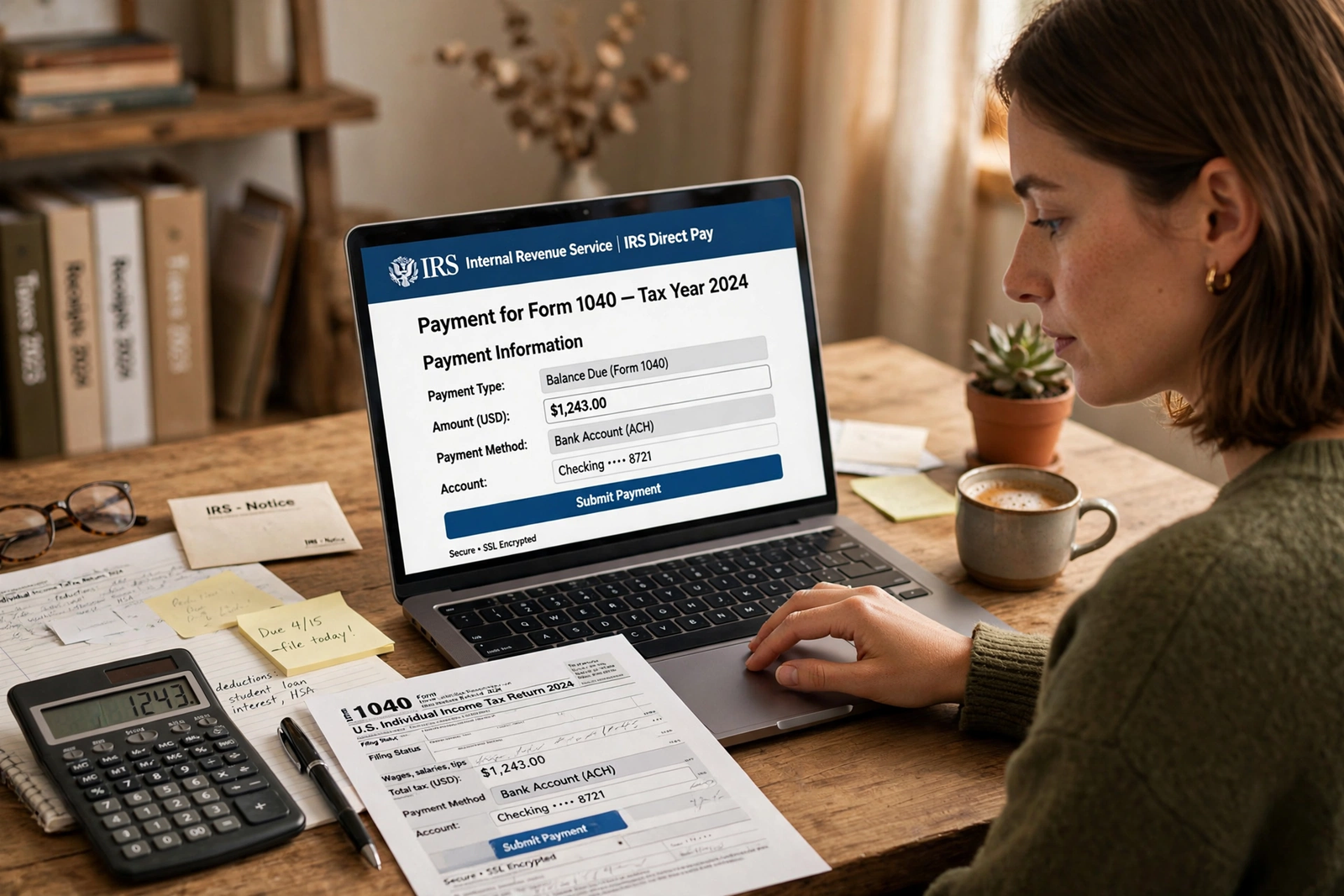
IRS Direct Pay lets you pay directly from your checking or savings account at no cost. It covers balances due on filed returns, estimated quarterly taxes, extension payments, and amended return balances.
To use it, go to the IRS payments page, verify your identity with information from a prior return, select the payment type and tax year, enter your bank details, and schedule the payment. You can schedule up to 365 days in advance and get email confirmation with a confirmation number. There is no account to create — it is a one-time guest payment each time.
Option 2: EFTPS — The Electronic Federal Tax Payment System
EFTPS is the IRS’s dedicated payment system: free, but requiring advance enrollment (allow 5–7 business days to receive your PIN by mail). Once enrolled, you can pay any federal tax by phone or online, schedule payments up to a year ahead, and view 15 months of payment history.
EFTPS is the best choice for freelancers and business owners making regular estimated payments — schedule all four quarterly payments at once and track everything in one place. For a one-off balance, Direct Pay is simpler since it needs no enrollment.
Option 3: Paying by Card (Convenient, but With a Fee)
The IRS authorizes several third-party processors to accept debit and credit cards — the IRS itself does not take cards directly. Expect roughly 1.75–1.99% for credit cards and a flat $2–$3 for debit; the fee goes to the processor, not the IRS.
Paying by card makes sense if your rewards outweigh the fee or you need a billing cycle’s float to assemble the cash. It does not make sense if you will carry the balance at 20%+ APR — an IRS payment plan charges far less. Always start from the IRS official website to reach an authorized processor; copycat sites exist.
Other Ways to Pay
- IRS2Go app: The official IRS mobile app includes Direct Pay and card options.
- Electronic Funds Withdrawal: When e-filing, authorize the IRS to debit your bank account for the balance due — free and automatic.
- Check or money order by mail: Payable to “United States Treasury,” with your Social Security number, tax year, and form number written on it. Use certified mail for proof.
- Cash at retail partners: Start online, then pay up to $1,000 per day in-store (small service fee applies).
Cannot Pay in Full? Get a Payment Plan
Owing taxes you cannot immediately pay is common, and the IRS would much rather set up a plan than chase you. If you need help determining what you owe first, see our guide on how do you file taxes what you need to know“>how to file your taxes.
Short-term payment plan (120 days or less)
Apply online if you can pay within 120 days. There is no setup fee and it halts aggressive collection action, though interest and penalties still accrue — so pay as fast as you can.
Long-term installment agreement
Need more than 120 days? A formal installment agreement lets you pay monthly over up to 72 months. Most individuals owing $50,000 or less can apply online in minutes with automatic approval. Setup fees run $31 (online direct debit) to about $130 — reduced or waived for low-income taxpayers.
Offer in Compromise
In genuine hardship cases, the IRS may settle for less than you owe. Approval is strict — you must show that full payment would cause economic hardship. Be skeptical of ads promising to “settle for pennies”; most people do not qualify.
Estimated Quarterly Payments: Pay As You Go
The U.S. tax system is pay-as-you-go. If you are self-employed, a freelancer, or have investment income without withholding, you generally must make quarterly estimated payments (January, April, June, September) or face an underpayment penalty.
- Safe harbor rule: Pay at least 90% of this year’s tax, or 100% of last year’s (110% if income exceeds $150,000), through withholding and estimates to avoid penalties.
- How to pay: Use Direct Pay or EFTPS and select “1040-ES” as the reason.
- Adjust as you go: If income changes mid-year, recalculate and adjust remaining payments.
What Happens If You Do Not Pay?
Two penalties stack on top of each other:
- Failure to file: 5% of unpaid tax per month (up to 25%). This is the expensive one — always file on time even if you cannot pay.
- Failure to pay: 0.5% per month (up to 25%), reduced to 0.25% while on an installment agreement.
- Interest: Compounds daily on the unpaid balance plus penalties.
Unresolved debt can lead to a federal tax lien, bank levies, or wage garnishment — but only after many notices. The single most important move: file on time, pay what you can, and arrange a plan for the rest. Keep your records organized — our guide on how long should you keep tax returns complete answer“>how long to keep tax returns explains what to hold onto. For official details on every payment method, the authoritative source is the IRS payments page.
Frequently Asked Questions
What is the cheapest way to pay the IRS?
IRS Direct Pay or Electronic Funds Withdrawal when e-filing — both are free bank transfers. EFTPS is also free. Card payments always carry a processor fee.
Can I pay my taxes in installments?
Yes. Most taxpayers owing $50,000 or less can set up a long-term installment agreement online in minutes, paying monthly over up to 72 months. Short-term plans (120 days) have no setup fee.
What happens if I cannot pay my taxes at all?
File your return on time anyway to avoid the failure-to-file penalty, pay whatever you can, then apply for a payment plan or Currently Not Collectible status. Ignoring the debt makes it dramatically worse through penalties, interest, liens, and levies.
Do I have to pay estimated taxes quarterly?
If you expect to owe $1,000 or more after withholding and credits — common for freelancers — yes. Quarterly payments are due in January, April, June, and September; missing them triggers an underpayment penalty even if you pay in full at filing time.
How do I confirm the IRS received my payment?
Direct Pay and EFTPS both provide confirmation numbers — save them. You can also create an IRS Online Account to view your balance, payment history, and notices.