Here’s a humbling statistic: we’ve mapped the surface of Mars and the Moon in greater detail than the floor of our own ocean. More people have been to the Moon than to the deepest part of the sea. The commonly cited figure — that we’ve explored less than 25% of the ocean, with only about a quarter of the seafloor mapped at high resolution — surprises almost everyone, because the ocean feels familiar. We swim in it, fly over it, eat from it. But the deep ocean is Earth’s true final frontier: a vast, dark, high-pressure wilderness we’ve barely begun to survey, let alone understand.
What “Explored” Actually Means (and the Real Numbers)
“Explored” is doing heavy lifting in that famous statistic, so let’s get precise. As of recent NOAA figures, roughly 25% of the global seafloor has been mapped with modern high-resolution sonar — the rest is known only through coarse satellite estimates or not at all. NOAA’s Ocean Service publishes the ongoing mapping progress and what each new survey reveals. That mapping milestone (a quarter of the seafloor) was only recently passed, driven by the Seabed 2030 initiative’s push to map the entire ocean floor by 2030. But mapping isn’t exploring: a sonar map shows terrain, not life. Biologically, we’ve sampled a tiny fraction — scientists estimate we’ve described perhaps 240,000 marine species while millions likely remain unknown, with new species discovered on nearly every deep-sea expedition.
Human presence is rarer still. The hadal zone — depths below 6,000 meters, named for Hades — has been visited by fewer than 30 people in history, ever. For perspective, over 600 people have been to space. The deepest point, Challenger Deep in the Mariana Trench (~10,900 meters), has seen fewer human visits than the surface of the Moon. We know the ocean’s surface intimately and its depths hardly at all.
Why the Deep Ocean Is So Hard to Explore
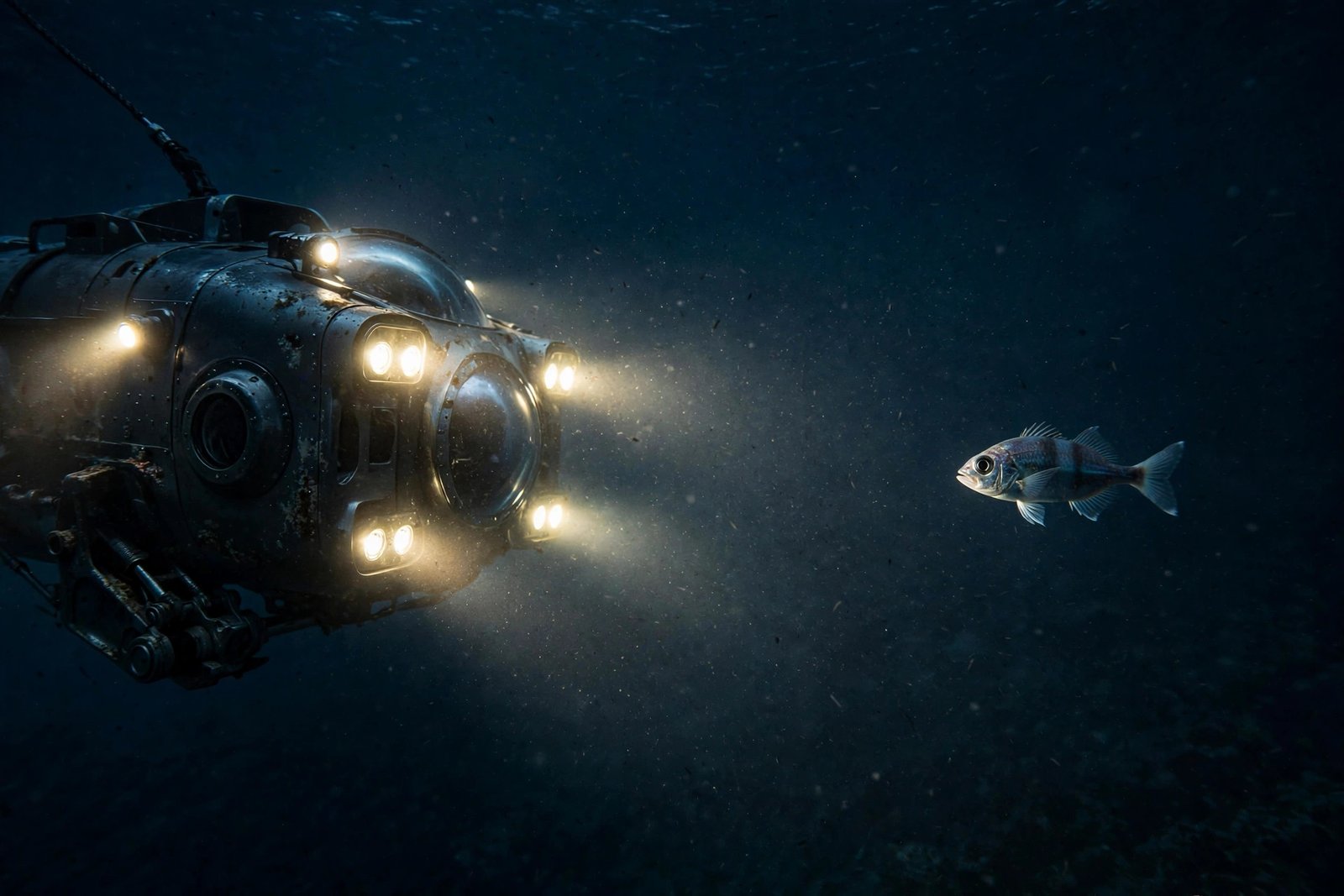
The obstacles are physical and brutal. Pressure: every 10 meters of depth adds another atmosphere of pressure; at Challenger Deep it’s over 1,000 atmospheres — roughly eight tons per square inch, enough to crush anything not specifically engineered for it. Submersibles like the DSV Limiting Factor (which has made repeated Challenger Deep dives) are marvels of engineering — titanium spheres, syntactic foam, every system pressure-proofed. Darkness: sunlight penetrates only the top ~1,000 meters (and usefully only the top 200); below that is permanent night, requiring vehicles to carry their own light through an environment where most life is adapted to blackness.
Scale and cost: the ocean covers 71% of Earth’s surface with an average depth of 3.7 kilometers — the volume is staggering, and ship time costs tens of thousands of dollars per day. Communication: radio doesn’t propagate underwater, so deep vehicles can’t be piloted live like drones — they run autonomously or on tethers, with all the limitations that implies. Exploring the ocean is, in practical terms, harder than exploring space: space is far but empty and predictable; the deep sea is near but crushing, dark, corrosive, and corrosive to electronics.
What we’re finding down there
Every expedition returns discoveries: hydrothermal vent ecosystems running on chemosynthesis instead of sunlight — entire food webs independent of the sun, rewriting assumptions about where life can exist. Brine pools, underwater lakes denser than seawater. Microbes in subseafloor rock suggesting the deep biosphere may contain a substantial fraction of Earth’s total biomass. Each find reshapes biology, and astrobiologists study these ecosystems as analogs for life on Europa and Enceladus — exploring our ocean is practice for exploring ocean worlds.
How Exploration Actually Happens Today
Modern ocean exploration is a robot story. ROVs (remotely operated vehicles, tethered) and AUVs (autonomous underwater vehicles, untethered) do the dangerous deep work — NOAA’s Okeanos Explorer livestreams ROV dives, letting anyone watch deep-sea exploration in real time. Multibeam sonar maps swaths of seafloor from surface ships. Argo floats — thousands of autonomous profilers drifting globally — continuously measure temperature, salinity, and currents. Environmental DNA lets scientists detect species from water samples without ever seeing the animal.
The mapping push is accelerating: Seabed 2030 has roughly tripled the mapped fraction in under a decade through coordinated international effort and crowdsourced bathymetry from commercial vessels. At current rates, a complete high-resolution map of the seafloor is genuinely achievable within the decade — the terrain, at least, will be known. The life on it will take far longer. Ocean lovers who want the surface experience can plan an uncrowded beach trip — but remember the shallows you swim in are the explored 1% of a mostly unknown world.
Why It Matters: What the Unexplored Ocean Holds
This isn’t just curiosity — the unknown ocean has concrete stakes. Medicine: marine organisms produce unique chemistry; deep-sea sponges and microbes are promising sources of novel antibiotics and cancer drugs at a time when antibiotic resistance is a growing crisis. Climate: the ocean absorbs ~90% of excess heat and ~30% of human CO2 emissions — understanding deep-ocean circulation is essential to predicting climate change, and the deep sea is where the long-term carbon story plays out. Resources and risk: seafloor minerals, methane hydrates, and unknown geological hazards all sit in unmapped territory. Life itself: the deep biosphere may reshape our understanding of biology’s limits — and our search for life beyond Earth.
For the visually curious, great ocean documentaries capture what words can’t — bioluminescent creatures, vent ecosystems, and the sheer alien beauty of a world we’ve barely visited.
Frequently Asked Questions
What percentage of the ocean have we explored?
About 25% of the seafloor has been mapped at high resolution as of recent NOAA/Seabed 2030 figures; the commonly quoted “less than 25% explored” reflects that most of the ocean’s volume and nearly all of its deep ecosystems remain unsurveyed. Biologically, we’ve likely described under 10% of marine species.
Why do we know more about Mars than our ocean?
Space is empty and predictable — engineering for vacuum and radiation is well understood. The deep ocean combines crushing pressure, corrosive saltwater, total darkness, and no radio communication, making it in many ways a harsher engineering environment. Plus, space exploration gets more funding and public attention.
What’s the deepest part of the ocean anyone has visited?
Challenger Deep in the Mariana Trench, about 10,900 meters down. Fewer than 30 people have ever been there — the first in 1960 (Trieste), then decades passed before James Cameron’s 2012 solo dive and the recent Limiting Factor expeditions.
Could there be huge undiscovered sea creatures?
Large unknown animals are unlikely at this point — but new species of everything from sharks to octopuses to microbes are discovered constantly, and the deep sea’s largest animals (like the colossal squid) were barely known to science until recently. The surprises now are mostly in the small, the strange, and the microbial.
Will we ever fully explore the ocean?
Fully mapping the seafloor terrain is achievable within a decade or so. Fully cataloging its life and understanding its ecosystems will take generations — it’s the largest habitat on Earth, and we’ve sampled a fraction of a fraction of it.
We’ve mapped a quarter of the seafloor, visited the deepest trench fewer times than the Moon, and described maybe a tenth of marine species. The ocean isn’t the familiar blue backdrop of vacations — it’s Earth’s great unknown, holding medicines, climate answers, and life forms we can’t yet imagine. The final frontier isn’t up there. It’s down here, waiting.