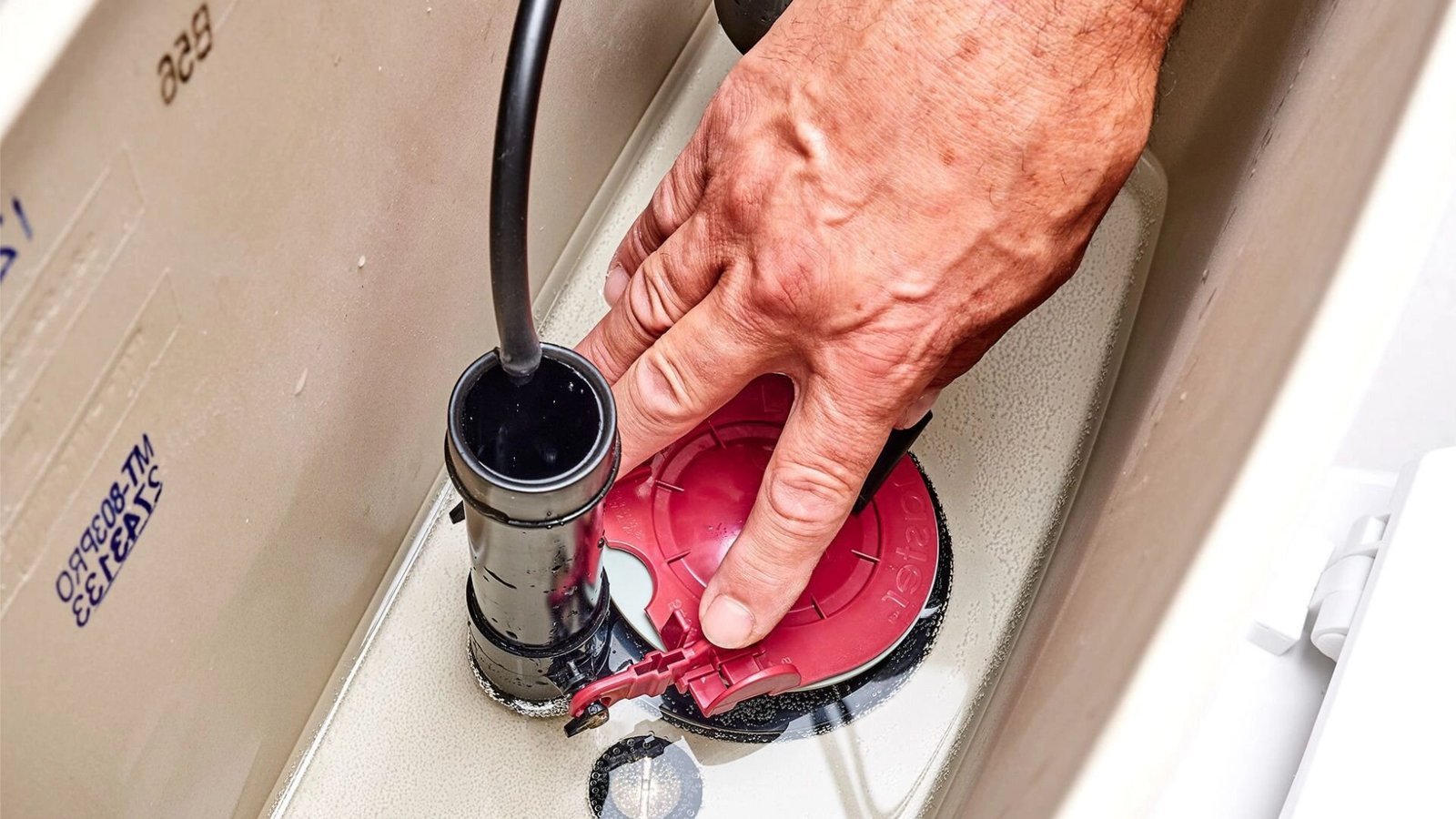
That toilet has been running for… how long now? An hour? All night? A running toilet isn’t just annoying — it can waste up to 200 gallons of water per day, which shows up on your water bill as a very unpleasant surprise. The good news: 95% of running toilets are caused by one of three cheap parts inside the tank, and the fix takes 15–30 minutes with no special skills. Here’s how to repair a running toilet that will not stop.
Quick Diagnosis: What’s Actually Wrong
Take the tank lid off (carefully — it’s heavy porcelain) and look inside while it runs:
- Water running into the overflow tube? The water level is too high — the fill valve needs adjustment or replacement.
- Water level fine but tank keeps refilling periodically? The flapper is leaking — water seeps into the bowl, the tank drops, the valve refills. The classic “phantom flush.”
- Constant running with water at normal level? The fill valve itself is faulty or has debris stuck in it.
- Handle feels loose or sticks? The chain or handle mechanism is the culprit.
Do the food coloring test for a sneaky flapper leak: drop food coloring in the tank, wait 15 minutes without flushing. Color in the bowl = flapper leak, confirmed.
Fix #1: The Flapper (Most Common Cause)
The flapper is the rubber seal at the tank’s bottom that lifts when you flush. They warp, crack, and get slimy over 3–5 years. Replacement: $5–$10, 10 minutes.
- Turn off the water supply valve behind the toilet.
- Flush to empty the tank; sponge out remaining water.
- Unhook the old flapper from the pegs/chain.
- Bring it to the store to match size and type — flappers aren’t universal, and the wrong one won’t seal.
- Install the new flapper, reconnect the chain with slight slack (about 1/2 inch — too tight prevents sealing, too loose tangles).
- Turn water on, let tank fill, test flush twice.
While you’re in there, wipe the flush valve seat (where the flapper sits) clean — mineral buildup there prevents sealing even with a new flapper.
Fix #2: The Fill Valve (Water Won’t Shut Off)
If water keeps flowing into the overflow tube, the fill valve isn’t shutting off. First try adjusting: most modern valves have a screw or clip to lower the float — set the water level about 1 inch below the overflow tube top. If adjustment doesn’t work, replace the valve ($10–$15, 20 minutes):
- Water off, tank drained.
- Disconnect the water supply line and unscrew the valve’s lock nut underneath the tank.
- Lift out the old valve, drop in the new one at the correct height (marked on the valve — critical step).
- Reconnect supply line and refill tube to the overflow.
- Turn water on, check for leaks at every connection, adjust water level.
Universal fill valves fit 99% of toilets and come with decent instructions. The EPA WaterSense program notes that fixing leaks is among the highest-impact water-saving actions — a running toilet wastes more than most people imagine.
Fix #3: Chain and Handle Issues
- Chain too short/tangled: Adjust to 1/2 inch slack. Replace a corroded chain ($3).
- Handle sticks: Clean mineral buildup from the handle mechanism, or replace the handle ($8–$12, 5 minutes — unscrew the nut inside the tank, remembering it’s reverse-threaded).
- Float ball (older toilets): If you have the old ball-and-arm style, the ball may be waterlogged (replace, $5) or the arm bent (bend it gently so the ball sits lower).
When It’s Not a Tank Problem
- Water on the floor? That’s a different issue — wax ring, supply line, or tank-to-bowl gasket. Don’t ignore it; water damage compounds fast.
- Weak flush + running? Could be low water level combined with a partial clog — address both.
- Toilet rocks? Tighten closet bolts gently (overtightening cracks porcelain) — a rocking toilet will eventually break its wax seal.
Prevent the Next One
- Don’t use drop-in tank tablets. The chlorine ones degrade flappers and valves prematurely — they’re the #1 cause of early flapper death. Use in-bowl cleaners instead.
- Replace the flapper proactively every 4–5 years — it’s $7 and 10 minutes.
- Address hard water — mineral buildup shortens every tank part’s life. A whole-house softener or regular vinegar soaks help.
While you’re fixing bathroom plumbing, you might also check that drippy faucet — and if the bathroom needs broader attention, our minor remodel cost guide has the numbers.
Upgrading to a Better Toilet (When Repair Isn’t Enough)
Sometimes the running toilet is a symptom of a toilet that’s simply done. Consider replacement if: the toilet is over 20 years old (pre-1994 models use 3.5+ gallons per flush versus 1.28 for modern WaterSense models — that’s thousands of gallons yearly), the porcelain is cracked or stained beyond cleaning, or you’ve repaired the same toilet three times in two years.
A quality new toilet costs $200–$400 plus $150–$300 installation (or DIY in 2–3 hours — it’s genuinely doable: shut off water, drain, unbolt, lift off, replace wax ring, set new bowl, reconnect). Look for WaterSense certification (1.28 gpf or less), comfort height (17–19 inches — easier on knees), and a fully glazed trapway (fewer clogs). Dual-flush models save more water but have more parts to maintain — a quality single-flush 1.28 gpf is the reliability sweet spot.
The water savings are real: replacing a 3.5 gpf toilet with a 1.28 gpf model saves a family of four roughly 13,000 gallons per year. At average water rates, that’s $100–$200 yearly — the toilet pays for itself while you stop thinking about it.
When the Whole Toilet Needs Replacing
Sometimes the running is a symptom of a toilet past saving. Consider replacement when: the porcelain is cracked, the tank wobbles on a corroded base, internal parts are obsolete (no replacements available), or you’ve repaired the same toilet three times in two years. A new efficient toilet ($150–$300 + installation) uses 1.28 gallons per flush versus 3.5+ for old models — the water savings pay for the toilet within a few years. If the toilet is 20+ years old and troublesome, stop repairing and start shopping.
The Bottom Line
To repair a running toilet that won’t stop: diagnose with the tank lid off (flapper leak, fill valve, or chain), then replace the $5–$15 part — flapper first, fill valve second. It’s a 30-minute fix that stops hundreds of gallons of daily waste and the water bill that comes with it. Keep a spare flapper in the house; you’ll use it eventually, and future you will be grateful.