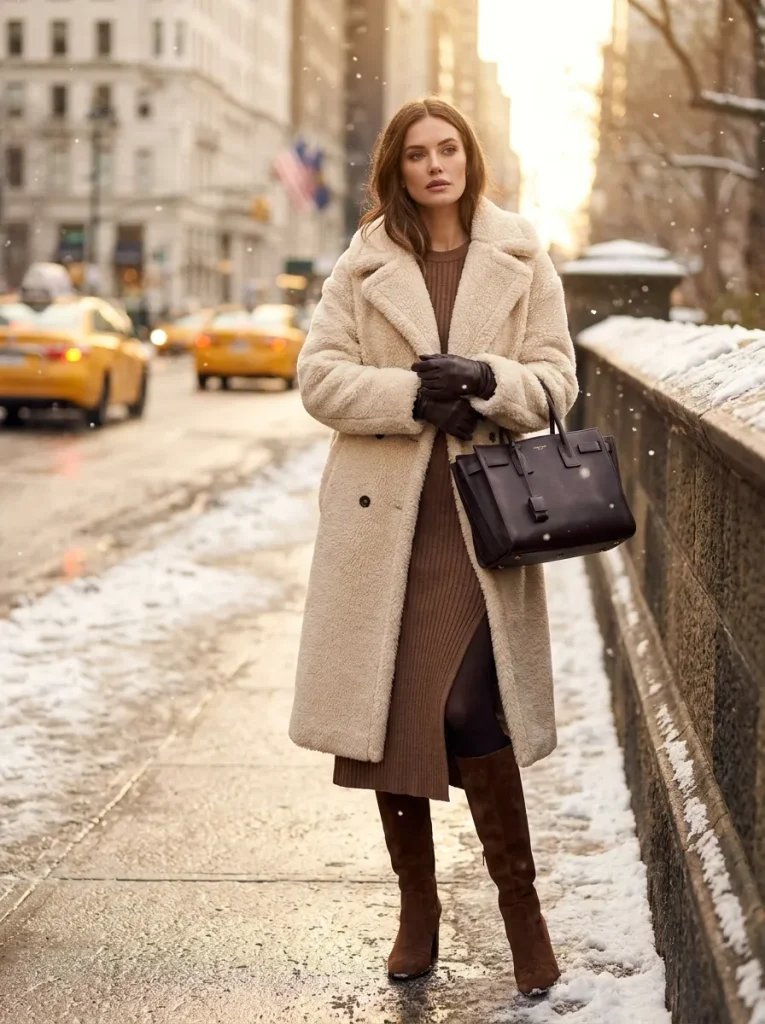
Every winter, people choose between the marshmallow puffer that’s warm and the wool coat that’s stylish — as if you can’t have both. You can. The warm-and-stylish coat exists; it just requires knowing what actually provides warmth (it’s not thickness) and which styles deliver it elegantly. That’s why so many people ask how do I choose a winter coat that is both warm and stylish — and why you deserve a real answer, not clichés.
Here’s how to buy the coat you’ll love wearing all winter, in the coldest months, without compromise.
What Actually Makes a Coat Warm
Warmth comes from insulation and wind-blocking, not bulk. Down fill (look for fill power 550+; 700+ is excellent) provides the best warmth-to-weight ratio — a thin high-fill-power down coat outperforms a thick low-quality one. Wool (especially double-faced or with high wool content) insulates well and blocks wind naturally. The shell matters enormously: a windproof outer layer multiplies any insulation’s effectiveness.
Check the details that separate warm from pretend-warm: sealed or taped seams, storm flaps over zippers, snug cuffs, a collar that closes high, and length that covers your hips minimum (knee-length is dramatically warmer — your thighs lose major heat). A ‘stylish’ coat missing these is a fall coat cosplaying as winter wear. REI winter coat buying guides
- Down fill power 550+: best warmth-to-weight; 700+ is excellent.
- Wool content matters: high wool % insulates and blocks wind naturally.
- Windproof shell: multiplies any insulation’s effectiveness.
- Length = warmth: knee-length dramatically warmer than hip-length.
- Details decide: storm flaps, snug cuffs, high collars, sealed seams.
Styles That Deliver Both
The wool overcoat/topcoat: the style champion that can be genuinely warm in high wool content with proper layering underneath — best for milder winters (down to ~30°F) and professional settings. The down parka with a tailored cut: brands now make puffers with actual silhouettes — belted, princess-seamed, matte finishes that look sleek rather than sporty. Best for real cold with style intact.
The wool-blend puffer hybrid and the classic peacoat (double-breasted wool, warm to ~25°F with layers) round out the options. My honest take: most people in cold climates need the parka for deep winter and can enjoy the wool coat for shoulder season. One coat rarely does everything; two strategic coats do. Buy the parka first if you can only buy one — being cold is never stylish. Wirecutter winter coat reviews
- Wool overcoat: style king; warm to ~30°F with layers; professional settings.
- Tailored down parka: real cold + real style — belted, matte, shaped.
- Peacoat: double-breasted wool classic; good to ~25°F layered.
- Two-coat strategy: parka for deep winter, wool for shoulder season.
- Cold first: if one coat only, buy warmth — shivering is never stylish.
Fit, Buying, and Cost-Per-Wear
Try coats on over a sweater — the coat must accommodate layers or it’s useless in real cold. Shoulders should sit right (the unalterable part), with enough room to move. Sleeves to the wrist bone, length covering at least the hips. Walk, sit, raise your arms in the fitting room; the coat should work in motion.
On price: a $300 coat worn 100 days a year for 5 years costs $0.60 per wear — cheaper than the $80 coat replaced yearly that you hate wearing. Buy the best insulation and construction you can afford, in a classic style and neutral color (black, navy, camel, gray) that won’t date. End-of-season sales (February-March) discount premium coats 40-60%. That’s when to buy.
- Try over a sweater: must fit with layers — non-negotiable.
- Shoulders right, room to move: test sitting, walking, arm-raising.
- Cost-per-wear math: $300 coat / 500 wears = $0.60 — buy quality.
- Classic style, neutral color: won’t date; works with everything.
- Buy in Feb-March: 40-60% off premium coats at end of season.
Common Mistakes to Avoid
Most people don’t fail for lack of effort — they fail because of a handful of predictable mistakes. Sidestep these five and you’re already ahead of the vast majority of people tackling this.
- Buying for looks, ignoring fill: a stylish coat with no insulation is a fall coat cosplaying as winter wear. Check fill power and wool content.
- Wrong size for layers: trying on over a t-shirt then freezing in January. Always fit winter coats over a sweater.
- Hip-length in deep winter: thighs lose massive heat. Knee-length is dramatically warmer — length is insulation.
- Paying full price in October: premium coats go 40-60% off in February-March. Buy off-season if you can plan ahead.
- One coat for everything: the parka-vs-wool-coat tradeoff is real. Two strategic coats beat one compromise.
Frequently Asked Questions
What fill power do I need for a winter coat?
550+ is good, 700+ is excellent — higher fill power means more warmth per ounce. For city winters down to ~20°F, 550-650 suffices; for serious cold, 700+. Fill power matters more than thickness.
Wool or down — which is warmer?
Down wins on warmth-to-weight; wool wins on wind resistance and wet performance (wool insulates when damp, down doesn’t). For dry cold: down. For wet, windy conditions: wool or synthetic. Many premium coats combine both.
How should a winter coat fit?
Shoulders correct (the unalterable part), room for a sweater underneath, sleeves to the wrist bone, length covering hips minimum. Move in it — sit, reach, walk. A coat that fights movement fails daily.
When is the best time to buy a winter coat?
February-March: end-of-season clearances discount premium coats 40-60%. Buy next winter’s coat in spring. October-November is the worst time — full price, picked-over stock.
Pro tip: Put a recurring monthly reminder on your phone to revisit the key habits in this guide. Most good practices fade not from failure but from forgetting — a simple nudge keeps them alive.
How do I choose a winter coat that is both warm and stylish: The Bottom Line
A warm and stylish winter coat needs real insulation (down 550+ fill or high wool content), a windproof shell, and cold-weather details (storm flaps, snug cuffs, good length) — warmth is engineering, not bulk. Styles that deliver both: tailored down parkas for real cold, wool overcoats for milder days and professional settings. Buy for shoulders, try over sweaters, choose classic neutrals, and shop February sales. Warmth and style were never opposites — just buy the coat that does both jobs.