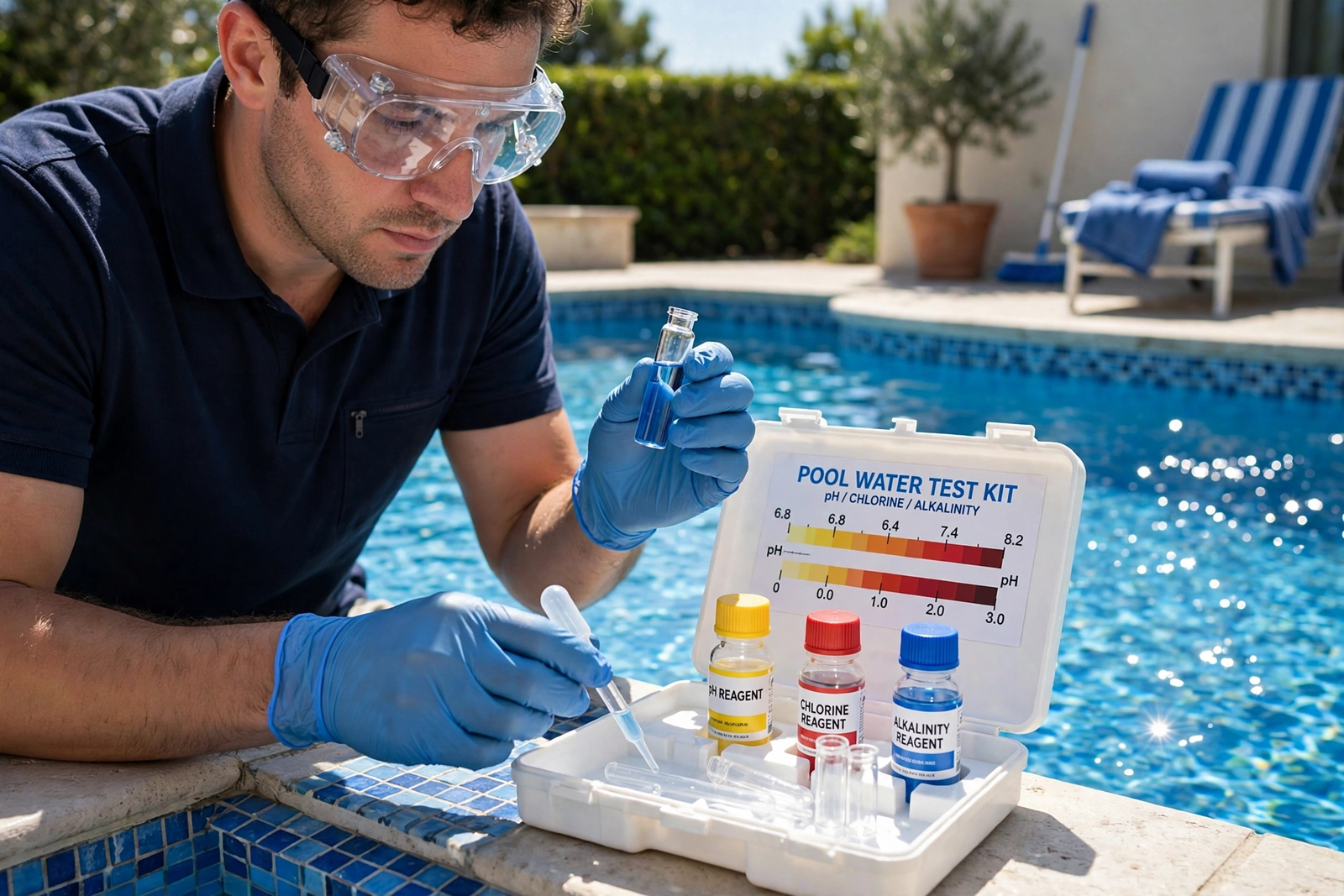
Quick Answer: To lower pH in a pool, test your water with a reliable test kit, then add a pH decreaser — either muriatic acid (liquid) or sodium bisulfate (dry acid) — following the product’s dosage chart for your pool volume. Pour the diluted chemical slowly near a return jet with the pump running, wait 4–6 hours with circulation, then retest. Aim for a pH between 7.2 and 7.8.
Pool pH is one of the most important numbers in pool care, and it drifts upward more often than most owners expect. High pH makes your water cloudy, weakens your chlorine, leaves scale on surfaces, and irritates eyes and skin. The good news is that lowering pH is one of the simplest pool maintenance tasks — as long as you test first, dose carefully, and give the water time to circulate.
Why High Pool pH Matters
The ideal pool pH range is 7.2 to 7.8, with 7.4 to 7.6 being the sweet spot for most pools. When pH climbs above 7.8, several problems start stacking up:
- Chlorine stops working well. At pH 8.0, chlorine is only about 20% effective at sanitizing compared to pH 7.5. You end up adding more chlorine for worse results.
- Cloudy water. High pH reduces sanitizer efficiency, letting algae and bacteria gain a foothold, and it can cause calcium to precipitate out as cloudiness.
- Scale buildup. Calcium scale forms on pool walls, tile lines, heaters, and salt cells when pH runs high for weeks.
- Swimmer discomfort. High pH water can cause red, itchy eyes and dry, irritated skin.
Checking pH weekly and correcting it promptly is far cheaper than dealing with an algae bloom or a scaled-up heater later. If your pool has been cloudy despite normal chlorine readings, high pH is the first thing to check.
What Causes Pool pH to Rise?
Understanding why pH climbs helps you prevent repeat problems:
- New plaster or marcite finishes — fresh plaster cures for up to a year and constantly pushes pH upward. This is normal and expected.
- Aeration — waterfalls, fountains, spillover spas, and heavy splashing drive off carbon dioxide, which raises pH.
- High total alkalinity (TA) — TA above 120 ppm buffers pH upward. Lowering TA often stabilizes pH.
- Certain sanitizers — liquid chlorine (sodium hypochlorite) and cal-hypo shock have high pH and nudge it up with each dose.
- Salt chlorine generators — the electrolysis process tends to raise pH over time.
What You’ll Need
- A reliable test kit (liquid drop test kit or digital tester — test strips are fine for quick checks but less precise)
- pH decreaser: muriatic acid (liquid, 31.45%) or sodium bisulfate (dry acid granules)
- Chemical-resistant gloves and safety goggles
- A clean plastic bucket (for pre-diluting acid)
- Your pool’s volume in gallons (length × width × average depth × 7.5 for a rectangle)
Safety first: Muriatic acid is corrosive. Always wear gloves and goggles, work in ventilated areas, and always add acid to water — never water to acid. Store chemicals away from children and pets, and never mix pool chemicals together. If acid contacts skin, rinse immediately with plenty of water.
Step-by-Step: How to Lower pH in a Pool
- Test the water. With the pump running, take a water sample from elbow-depth away from return jets. Test pH and total alkalinity. Write down both numbers — you need the starting point to dose correctly.
- Calculate your dose. Check the product label’s dosage chart for your pool volume and how far you need to lower pH. As a very rough starting point, about 1 quart of muriatic acid (31.45%) per 10,000 gallons lowers pH by roughly 0.2 — but always follow your specific product’s chart, since strength varies. If you’re unsure, dose for half the needed drop and retest; you can always add more.
- Prepare the acid safely. Put on gloves and goggles. For muriatic acid, fill a clean plastic bucket about three-quarters full with pool water, then slowly pour the measured acid into the water. For dry acid (sodium bisulfate), you can broadcast the granules directly or pre-dissolve them in a bucket of pool water — pre-dissolving is gentler on pool surfaces.
- Add it to the pool. With the pump running, slowly pour the diluted acid into the deep end in front of a return jet so it disperses quickly. Walk around the perimeter to distribute it evenly. Never pour acid near skimmers, ladders, or directly onto pool surfaces.
- Circulate for 4–6 hours. Keep the pump running so the chemical mixes thoroughly. Do not swim during this time.
- Retest and adjust. After 4–6 hours (or the time your product label specifies), retest pH. If it’s still above 7.8, repeat with a smaller dose. Small, repeated corrections beat one big overshoot — dropping pH too low (below 7.0) causes its own problems, including equipment corrosion and swimmer discomfort.
Muriatic Acid vs. Sodium Bisulfate (Dry Acid)
Both work well, but they suit different owners:
- Muriatic acid (liquid): Cheaper per dose and fast-acting. Downsides: heavy to handle, produces fumes, and is more hazardous to store. Best for larger pools and experienced owners.
- Sodium bisulfate (dry acid): Granular, easier and safer to handle and store, no fumes. Downsides: costs more per dose and can slightly raise sulfate levels over time with heavy use. Best for smaller pools and beginners.
Either one will also lower total alkalinity somewhat. If your TA is very high (above 120 ppm), that’s actually helpful — but if TA is already low, use smaller doses and retest TA too. For more on balancing the rest of your water chemistry, see how to shock a pool and how to clean a pool filter.
How Much pH Decreaser Should You Add?
There is no universal dose because it depends on your pool volume, starting pH, and total alkalinity. General label-based guidance:
- Always start from the product label’s dosage chart — it is calibrated to that product’s strength.
- Lower pH in small steps (about 0.2 at a time) rather than trying to fix a big swing in one dose.
- If your pH is above 8.2, do it in two rounds: dose, circulate, retest, then dose again.
- Keep notes on how much you added and the result — after a few rounds you’ll know your pool’s typical dose.
Never guess the dose for a pool whose volume you don’t know. An undersized dose just wastes a retest; an oversized dose can drop pH below 7.0, making water corrosive to heaters, liners, and metal fittings.
Common Mistakes to Avoid
- Dosing without testing. Guessing leads to yo-yo chemistry. A $15 test kit pays for itself in one avoided mistake.
- Adding acid with the pump off. Undiluted acid sitting on the pool floor can bleach liners and etch plaster.
- Swimming too soon. Wait until chemicals are fully mixed and levels test safe — typically 4–6 hours, or per the label.
- Ignoring total alkalinity. If TA is high, pH will keep bouncing back up. Address TA (target 80–120 ppm) for lasting stability.
- Pouring acid into the skimmer. Concentrated acid through the equipment can damage pumps, heaters, and seals.
For related water-balance topics, check how to lower chlorine in pool. The CDC also publishes practical guidance on safe recreational water chemistry through its Healthy Swimming program, and the EPA’s resources on safe handling of household chemicals provide useful background. Step-by-step pool care walkthroughs are also available at The Spruce.
Frequently Asked Questions
How long after adding pH decreaser can you swim?
Wait at least 4–6 hours with the pump running, then retest. Swim only when pH is between 7.2 and 7.8 and chlorine is at a safe level (1–3 ppm for most pools).
Can I lower pool pH naturally without chemicals?
Not effectively. Aeration raises pH rather than lowering it, and household acids like vinegar are too weak and imprecise for pool volumes — you’d need gallons of it, and it adds unwanted organics. Use a proper pH decreaser and dose by the label.
Will lowering pH also lower total alkalinity?
Yes. Both muriatic acid and sodium bisulfate reduce total alkalinity along with pH. That’s useful if TA is high, but if your TA is already at the low end (80 ppm), use smaller doses and monitor TA so it doesn’t drop too far.
Why does my pool pH keep rising after I lower it?
The most common causes are high total alkalinity, heavy aeration (waterfalls, spillovers), a new plaster finish still curing, or a salt chlorine generator. Test and correct TA first — stabilizing TA between 80 and 120 ppm usually stops the pH bounce.
Is it safe to swim in a pool with high pH?
Brief exposure to pH up to about 8.0 is generally not dangerous, but it causes eye and skin irritation and means your chlorine isn’t sanitizing properly — so the water may harbor more bacteria. Bring pH into the 7.2–7.8 range before swimming.