‘Match your belt to your shoes.’ It’s one of the oldest style rules, repeated by every men’s magazine since forever. But is it still true? And what does ‘match’ even mean — exact same color, same material, same universe? That’s why so many people ask how do I match a belt with my shoes and outfit — and why you deserve a real answer, not clichés.
The rule has softened over the years, but its core is still solid. Here’s the modern version: when it matters, when it doesn’t, and how to get it right without overthinking.
The Classic Rule (and Why It Exists)
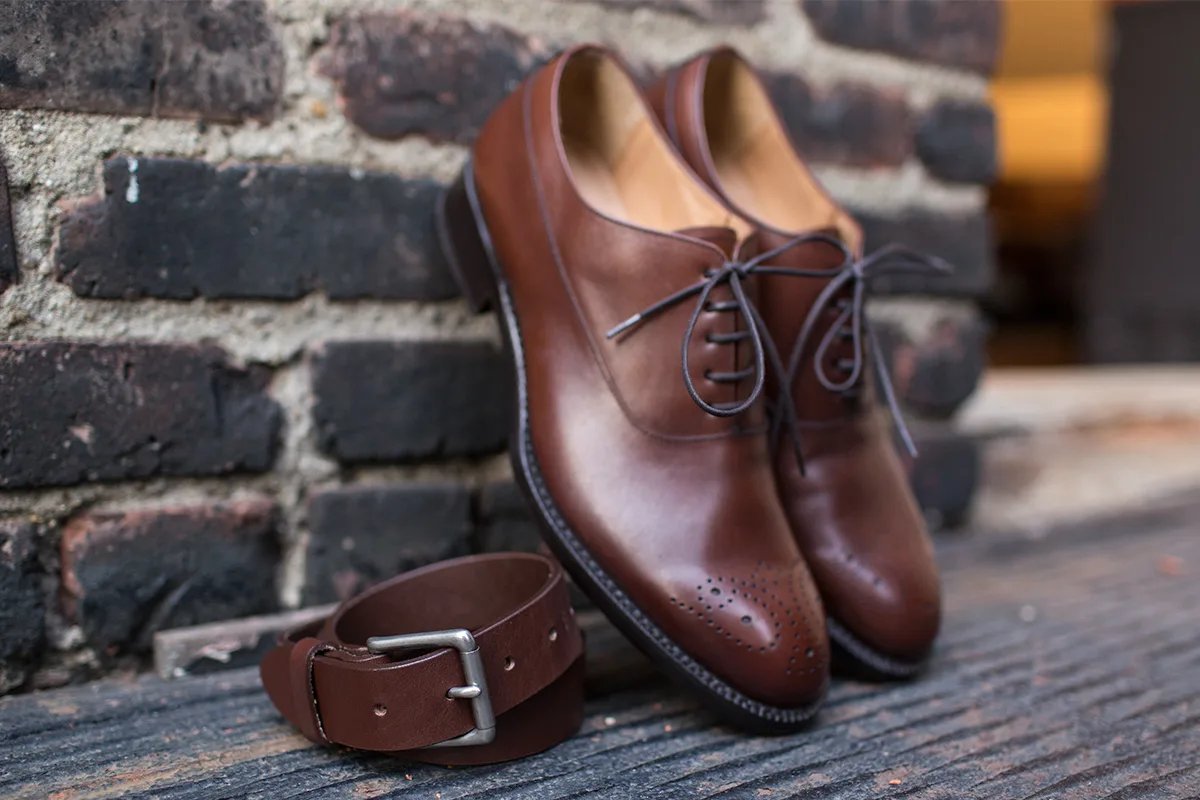
The traditional rule: belt leather should match shoe leather in color and finish. Black shoes, black belt. Brown shoes, brown belt. It exists because the eye travels around your outfit, and matching leathers create visual harmony — mismatched leathers create a subtle discord most people feel but can’t name. For formal and business settings, this rule still holds firmly.
‘Match’ means close, not identical. Your belt doesn’t need to come from the same cow — it needs to be in the same color family and finish. Dark brown belt with medium-brown shoes: fine. Black belt with dark brown shoes: noticeable clash. Matte with matte, polished with polished — finish matters as much as color. When in doubt at a wedding, interview, or client meeting, match properly. GQ men’s style and accessory guides
- Formal/business: match: black-black, brown-brown — still the rule where it counts.
- Close counts: same color family and finish, not identical leather.
- Finish matters: matte belt with matte shoes; polished with polished.
- Metal hardware can match too: belt buckle echoing watch or shoe hardware is a nice touch.
- When stakes are high, don’t improvise: weddings, interviews, formal events — match.
When You Can Break the Rule
Casual outfits have much more latitude. With jeans and casual shoes, the belt just needs to be in the same casual universe — a brown leather belt with white sneakers is fine; a black dress belt with sneakers looks confused. The real casual rule is about formality matching, not color matching: casual belt with casual shoes, dress belt with dress shoes.
Woven, braided, and fabric belts are inherently casual and exempt from matching — they coordinate with the outfit’s colors rather than the shoes. And if your belt isn’t visible (untucked shirt, sweater over), the rule is moot entirely. Nobody can judge what they can’t see. Women have even more flexibility: statement belts are accessories that coordinate with the outfit, not the shoes. The Art of Manliness style guides
- Casual = formality matching: casual belt + casual shoes; the colors can vary.
- Woven/fabric belts are exempt: they coordinate with the outfit, not the shoes.
- Invisible belt = no rule: untucked or covered, nobody can tell.
- Women: statement belts: treat as outfit accessories, not shoe-matching exercises.
- Sneakers change the game: match the belt’s casualness, not its color.
Building a Minimal Belt Collection
You need exactly three belts to cover everything: a black dress belt (simple buckle, 1-1.25 inches wide), a brown dress belt in medium brown (covers all brown shoes), and a casual brown belt (slightly wider, more rugged — works with jeans and chinos). That’s it. These three handle every outfit from suits to weekend casual.
Quality notes: full-grain leather lasts decades; bonded leather peels within a year — check the label. The belt should fit through the middle hole when new (leather stretches slightly). And width matters: dress belts are narrower (1-1.25″), casual belts wider (1.5″). A dress belt with jeans looks dainty; a wide casual belt with a suit looks clumsy. Match the belt’s width to the outfit’s formality.
- Three belts cover everything: black dress, brown dress, casual brown.
- Full-grain leather: lasts decades; bonded leather peels — check labels.
- Middle-hole fit: buy so the middle hole fits; leather stretches.
- Width = formality: narrow (1-1.25″) for dress, wider (1.5″) for casual.
- One quality belt beats three cheap: a $50 full-grain belt outlasts five $15 ones.
Common Mistakes to Avoid
A quick word on what not to do — because the fastest way to succeed at anything is to stop doing the things that guarantee failure. These five mistakes are more common than the right moves.
- Exact-match obsession: the belt needn’t come from the same cow — same color family and finish reads as matched. Close counts.
- Ignoring formality: a dainty dress belt with jeans (or a wide casual belt with a suit) clashes harder than any color mismatch.
- Wrong hole: a belt worn on the last hole looks too long; on the first, too short. Buy for the middle hole — leather stretches.
- Neglected leather: cracked, dried belts look cheap regardless of original price. Condition occasionally; it takes minutes.
- One belt for everything: a single black belt forced into casual duty looks wrong. Three belts (black dress, brown dress, casual) cover all.
Frequently Asked Questions
Do I need to match my belt to my watch strap?
It’s a nice touch, not a rule — matching leathers across belt, shoes, and watch strap creates harmony, but close coordination suffices. Nobody audits your accessories that closely; overall coherence is what registers.
What belt width should I wear?
Dress: 1-1.25 inches (narrower, refined). Casual: 1.5 inches (sturdier, relaxed). Match width to outfit formality — the wrong width reads as off even when the color is right.
Can I wear a brown belt with black shoes?
In formal settings: no — it’s the classic clash. In casual settings: a brown casual belt with black sneakers or casual shoes is fine; formality matching matters more than color there. When stakes are high, match properly.
How long should a belt last?
Full-grain leather: decades with occasional conditioning. Bonded/genuine ‘leather’ (the cheap stuff): 1-2 years before peeling. The $50 full-grain belt is cheaper per year than five $15 replacements — buy once.
Pro tip: Track the one metric that matters most for your goal (not five metrics — one) for 30 days. What gets measured gets managed, and a single number keeps you honest without overwhelming you.
How do I match a belt with my shoes and outfit: The Bottom Line
Match your belt to your shoes in formal and business settings (same color family and finish — close counts), and match formality rather than color in casual settings. Woven and fabric belts play by outfit-coordination rules, and invisible belts play by no rules. Three quality belts — black dress, brown dress, casual brown — cover every situation. It’s a small detail that people notice subconsciously; getting it right is effortless once it’s habit.