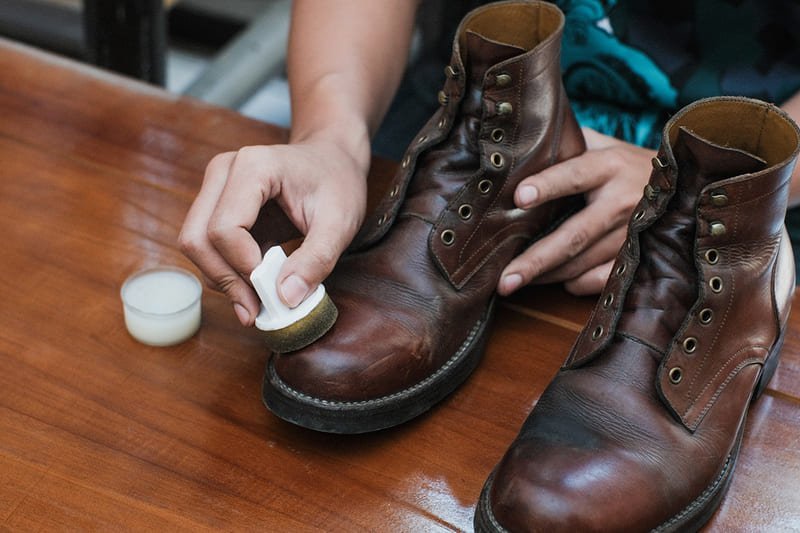
A good pair of leather boots is one of the best investments in your wardrobe — quality boots can last 10-20 years with care, while neglected ones die in two. The tragedy is that most boots don’t die of old age; they die of dehydration. Leather is skin, and like skin, it cracks when it dries out. That’s why so many people ask how do I take care of leather boots so they last for years — and why you deserve a real answer, not clichés.
Boot care isn’t complicated or time-consuming. It’s a simple routine done a few times a year, plus the right habits. Here’s everything your boots need.
The Core Routine: Clean, Condition, Protect
The routine has three steps, in order, done 2-4 times a year (more for daily-wear boots). First, clean: brush off dirt with a horsehair brush, then wipe with a damp cloth. For real grime, use saddle soap sparingly — it’s effective but drying, so it must be followed by conditioning. Never soak leather boots or put them near direct heat to dry; stuff with newspaper and let them air-dry at room temperature.
Second, condition: this is the critical step most people skip. Leather conditioner (mink oil, neatsfoot oil, or a quality cream conditioner) replenishes the oils that keep leather supple. Apply a thin layer, let it absorb, buff off excess. Dry, thirsty leather drinks it up; that’s your sign the boots needed it. Third, protect: a waterproofing spray or wax for boots that face rain and snow. Conditioner nourishes; waterproofing shields. You need both. The Boot Guy leather care guides
- Clean: brush off dirt; damp cloth for grime; saddle soap sparingly for deep cleaning.
- Condition 2-4x yearly: the critical step — replenishes oils, prevents cracking.
- Protect from weather: waterproofing spray or wax for rain/snow exposure.
- Dry naturally: newspaper stuffing + room temperature; never direct heat or radiators.
- Thin layers: condition and polish in thin coats; thick applications just sit on top.
Daily and Weekly Habits That Add Years
Rotate your boots — never wear the same pair two days in a row. Leather absorbs foot moisture, and it needs 24 hours to dry fully; wearing them daily keeps them perpetually damp inside, which breaks leather down fast. Two pairs rotated last far longer than two pairs worn sequentially. This single habit might add the most life of anything here.
Use cedar shoe trees when boots are off. They absorb moisture, hold the shape (preventing the toe curl and ankle collapse that age boots prematurely), and cedar naturally deodorizes. Brush boots after wearing in bad weather — salt and mud are leather’s enemies, and salt especially must come off promptly (wipe with a damp cloth, then condition). Store upright, not crushed under other shoes, in a cool dry place. Red Wing shoe care resources
- Rotate pairs: 24 hours of rest between wears — the highest-impact habit.
- Use cedar shoe trees: absorb moisture, hold shape, deodorize naturally.
- Clean salt immediately: road salt destroys leather; wipe off after every winter wear.
- Brush after wearing: 30 seconds with a horsehair brush removes dust and redistributes oils.
- Store upright and dry: never crushed; cool, dry place away from direct heat.
Repairs and When to See a Cobbler
Soles wear out before uppers — that’s normal and fixable. When the tread is smooth or heels wear unevenly, take them to a cobbler for resoling ($40-80 typically). Quality boots are built to be resoled multiple times; this is literally what ‘buy it for life’ means. A $200 boot resoled twice costs less per year than replacing $80 boots every two years.
For scuffs, a matching cream polish works wonders — it both colors and conditions. Deep scratches can be minimized with conditioner and polish layered. Loose stitching or separated soles need a cobbler promptly; small problems become boot-killing problems when ignored. Find a good local cobbler before you need one — they’re increasingly rare and worth their weight in gold.
- Resole, don’t replace: $40-80 resoling beats buying new; quality boots survive multiple resoles.
- Cream polish for scuffs: matching color cream both hides marks and conditions.
- Fix small problems fast: loose stitching and sole separation worsen quickly.
- Find a cobbler now: good ones are rare — locate yours before an emergency.
- Know when to retire: cracked-through leather or collapsed structure means it’s time.
Common Mistakes to Avoid
Let me save you some trial and error. These five mistakes are the reason most people’s efforts in this area stall out — and each one is completely avoidable with a minute of awareness.
- Never conditioning: the #1 boot killer. Dry leather cracks; conditioned leather lasts decades. Condition 2-4 times yearly, minimum.
- Drying boots by the heater: direct heat cooks leather — cracking, shrinking, stiffness. Room-temperature air drying only, stuffed with newspaper.
- Wearing the same pair daily: leather needs 24 hours to dry from foot moisture. Daily wear keeps boots perpetually damp inside, destroying them fast.
- Ignoring salt: road salt eats leather. Wipe it off after every winter wear — then condition. Salt left sitting causes permanent damage.
- Replacing instead of resoling: soles wear before uppers by design. A $40-80 resole beats a $200 replacement every time.
Frequently Asked Questions
How often should I condition leather boots?
2-4 times per year for regular wear; more for daily-worn or harsh-weather boots. The leather tells you — if it looks dry, dull, or thirsty, condition. Over-conditioning (soggy, darkened leather) is possible but rare compared to under-conditioning.
Can I wear leather boots in rain and snow?
Yes — that’s what they’re for — but wipe them down afterward, let them dry naturally, and keep up waterproofing treatment. Unprotected leather in repeated wet conditions suffers; protected leather thrives. They’re tools, not museum pieces.
What’s the difference between mink oil and conditioner?
Mink oil and neatsfoot oil are heavier — great for work boots, darken leather. Cream conditioners are lighter — better for dress boots where color matters. Match the product to the boot’s purpose.
How long should good boots last?
With care and resoling: 10-20 years, easily. Without care: 2-3 years. The purchase price amortized over a decade makes quality boots cheaper than replacing cheap ones — $200 boots over 10 years cost less per year than $60 boots replaced biennially.
Pro tip: Revisit this guide in 30 days. You’ll catch details you missed the first time, and the second read tends to stick because you’ve got real experience to attach it to.
How do I take care of leather boots so they last for years: The Bottom Line
Leather boots last decades with a simple system: clean, condition (2-4 times yearly — the step that prevents cracking), and waterproof; rotate pairs with 24 hours rest between wears; use cedar shoe trees; clean salt immediately; and resole instead of replacing. Total annual maintenance: maybe $20 in products and an hour of your time. For boots that cost $200+, that’s the best ROI in your closet.