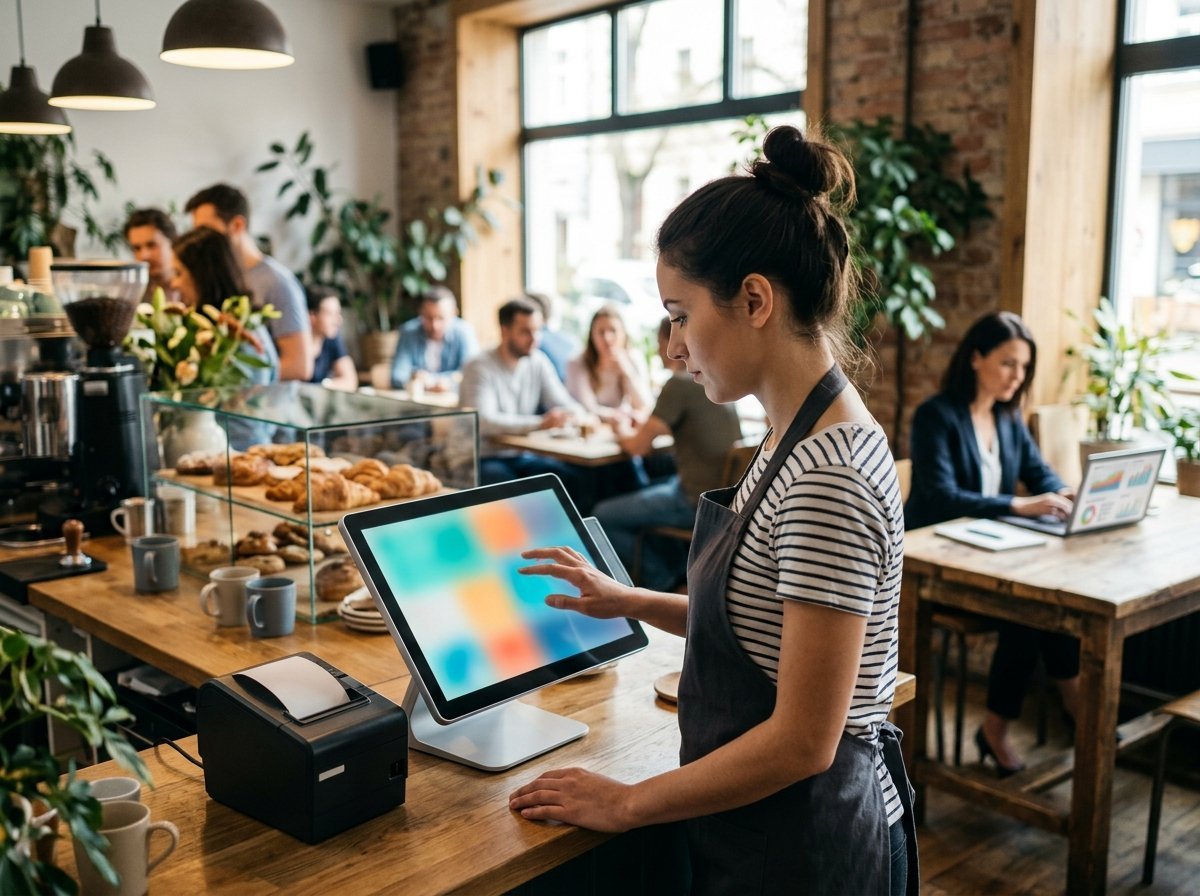
The best point of sale system for a small cafe in 2026: Square for simplicity and low startup cost, Toast for full-service food operations. Most small cafes do best with Square — free software, 2.6% + $0.10 processing, and hardware from $0 (phone reader) to $799 (register). Toast wins when you need serious restaurant features.
I’ve watched cafes choose POS systems — the right one disappears into the workflow; the wrong one fights you at every rush. Here’s the real comparison.
The Top 4 for Cafes, Compared
- Square — best for most small cafes. Software free; processing 2.6% + $0.10 in-person. Hardware: free magstripe reader to start, $299 Square Terminal, $799 Square Register. Strengths: easiest setup (hours, not days), excellent free tier, great add-ons (loyalty, gift cards, online ordering). Weaknesses: account holds/freezes happen (have a backup processor relationship); less deep on complex restaurant workflows.
- Toast — best for food-service depth. $69+/month per terminal + processing (~2.99% + $0.15). Strengths: built for restaurants — kitchen display systems, tableside ordering, payroll, scheduling, online ordering integrated. Weaknesses: pricier, contracts, overkill for a simple coffee counter.
- Clover — best hardware flexibility. Via Fiserv resellers; pricing varies (negotiate!). Strengths: slick hardware lineup, huge app market. Weaknesses: opaque pricing through resellers, long contracts common, processing rates vary by deal.
- Lightspeed — best for multi-location/retail hybrid. $89+/month. Strengths: strong inventory, good for cafes that also sell retail beans/merch. Weaknesses: pricier, learning curve.
My default recommendation: start with Square — you can be taking payments today for nearly $0 upfront, and it scales surprisingly far. Move to Toast when you’re doing table service, complex modifiers, or multi-station kitchen workflows.
The Real Cost Math (Beyond the Headline Rate)
- Processing fees dominate: at $15,000/month in card sales, the difference between 2.6% and 2.9% is $45/month, $540/year. Negotiate or choose accordingly — but don’t switch for 0.1%.
- Hardware reality: budget $300-$1,500 for a cafe setup (terminal + cash drawer + receipt printer + kitchen printer if needed). Square Terminal ($299) all-in-one is the value pick; full Register setups run $800+.
- Monthly software: Square $0-$60/month; Toast $69+/terminal; factor per-location and per-terminal carefully for multi-unit plans.
- Add-on creep: loyalty ($45/month), payroll ($35+/month), online ordering commissions (varies) — price the stack, not the base. A “free” POS with $200/month in add-ons isn’t free.
- Contract traps: some processors lock 2-3 year terms with early-termination fees ($300-$500). Square and Toast’s standard plans are month-to-month — prefer that flexibility.
Cafe-Specific Features That Matter
- Speed at rush: the POS must handle a 20-person line without lag — big buttons, saved favorites, one-tap modifiers (“oat milk,” “extra shot”). Test this in the demo with your menu.
- Offline mode: internet dies mid-rush — can you still take cards? (Square: yes, with limits; verify yours.) This feature has saved real cafes real money.
- Modifiers and combos: “large latte, oat milk, sugar-free vanilla, extra hot” — the system must handle nested modifiers without the barista doing mental math.
- Tipping flow: smooth tip prompts lift average tips 10-20% — compare the customer-facing UX, not just the back office.
- Loyalty built in: “buy 9 get 1 free” digital punch cards — Square’s is free and excellent; it drives repeat visits measurably.
- Online ordering + QR tableside: increasingly table stakes — compare commission/fees versus third-party delivery apps (which take 15-30%!).
- End-of-day reconciliation: how fast can you close out, count cash, and see the day’s numbers? Ask for a demo of this, not just the pretty sale screen.
Avoiding the Classic POS Mistakes
- Choosing on price alone: the cheapest processor with a terrible rush-hour UX costs you customers. Reliability > 0.2% rate differences.
- Not testing with real staff: have your actual baristas run the demo — the owner loving the dashboard means nothing if the team hates the sale screen.
- Ignoring the exit: can you export your data (customers, inventory, sales history)? Proprietary lock-in is the hidden cost of some systems.
- One terminal for a busy cafe: lines form at the register, not the espresso machine. Two stations (order + pickup/mobile orders) for any real volume.
- Skipping the backup plan: a $29 mobile reader + phone as emergency backup has saved cafes during outages. Cheap insurance.
- Forgetting accounting integration: the POS should feed your books automatically — manual entry is error-prone drudgery. Verify the QuickBooks/Xero integration before committing.
Implementation: Switching Without Chaos
- Time it right: switch during your slowest week, never before holidays. Allow 2 weeks of parallel running if possible.
- Migrate the menu carefully: every item, modifier, price, and tax rule — errors here cause weeks of small chaos. Photograph the old system’s setup as reference.
- Train before go-live: 2-3 practice sessions with real scenarios (rush simulation, refund, split payment, offline mode). Staff confidence on day one determines customer experience.
- Keep old hardware as backup for the first month — the safety net lets everyone relax.
- Watch the first month’s fees: compare actual processing costs against the quote — billing surprises are common; dispute promptly.
The right POS becomes invisible — staff stop thinking about it within a week. If they’re still fighting it after a month, it’s the wrong system, and switching costs only grow. Choose carefully, implement deliberately. Square’s cafe POS resources detail the cafe-specific setup.
Keep Reading
If this was useful, you might also like accounting integration and cash flow management.
The Bottom Line
Most small cafes: start with Square — free software, 2.6% + $0.10, hardware from $0, live in hours. Upgrade to Toast when you need table service, KDS, and deep restaurant workflows. Price the full stack (processing + hardware + add-ons), demand month-to-month terms, test rush-hour UX with real staff, and verify accounting integration. The best POS is the one your team forgets they’re using.
Frequently Asked Questions
How much does a POS system cost for a small cafe?
Square: ~$0-$800 hardware + 2.6% + $0.10/transaction, software free. Toast: $69+/month/terminal + hardware ($500-$1,500) + ~2.99% processing. Budget $300-$1,500 hardware plus monthly fees depending on system.
Can I use my phone as a POS?
Yes — Square, Toast, and others all run on phones/tablets with a card reader ($0-$49). Fine for markets, pop-ups, and tiny cafes; a dedicated terminal is better for daily rush volume.
What’s the cheapest way to take card payments?
Square’s free magstripe reader ($0) with 2.6% + $0.10 per swipe — no monthly fee. For very low volume, that’s unbeatable. Costs scale with volume, which is exactly right for starting out.