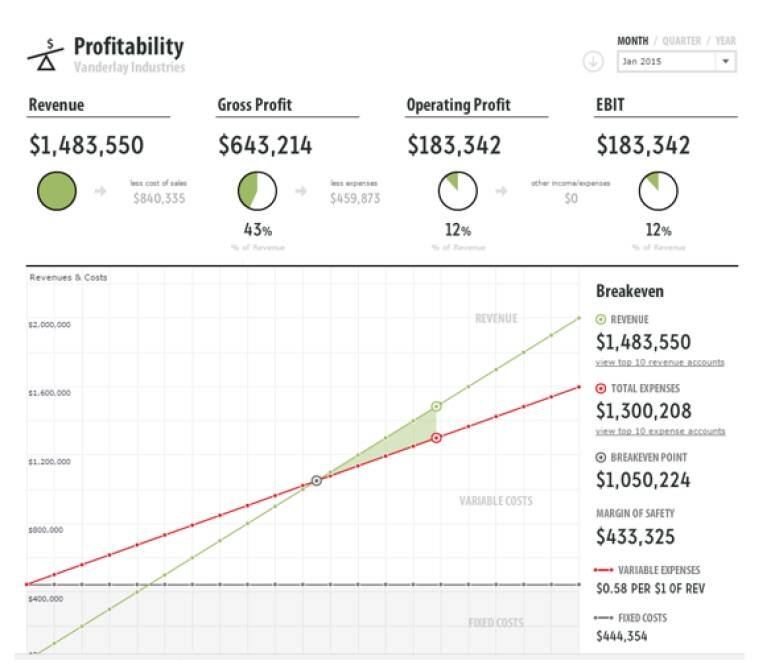
What is the difference between gross profit and net profit? Every new business owner hits this confusion, usually while staring at numbers that don’t make sense: “We made $200,000! So where is it all?” The answer is almost always hiding in the gap between these two numbers. Understanding that gap is one of the most important financial skills you’ll ever develop.
Let’s make this concrete with real numbers, because abstract definitions are where most explanations lose people.
Gross Profit: What You Keep From Each Sale
Gross profit is revenue minus the direct cost of what you sold (called Cost of Goods Sold, or COGS). If you sell handmade candles for $25 each and each candle costs $8 in wax, wicks, jars, and packaging, your gross profit is $17 per candle.
Formula: Revenue − COGS = Gross Profit
Gross profit tells you whether your product itself is viable. Healthy gross margins vary by industry — restaurants might run 60-70%, retail 40-50%, grocery stores under 30% — but the principle is universal: if gross profit is thin or negative, you have a pricing or cost problem that no amount of sales volume will fix. Selling more of a money-losing product just loses money faster.
Net Profit: What the Business Actually Keeps
Net profit is what’s left after everything — COGS plus all operating expenses (rent, salaries, insurance, marketing, software), plus interest and taxes. This is the bottom line, the number that determines whether your business is actually making money.
Formula: Revenue − All Expenses = Net Profit
Here’s where the candle example gets real: you sell $200,000 worth of candles with $64,000 in COGS (gross profit: $136,000 — looks great!). But then rent is $36,000, your salary is $50,000, marketing is $18,000, insurance and misc are $12,000, and taxes are $8,000. Net profit: $12,000. That’s the difference between gross profit and net profit — $136,000 versus $12,000. Same business, same year. One number feels like success; the other tells the truth.
What Is the Difference Between Gross Profit and Net Profit in Practice?
The two numbers answer different questions, and you need both:
- Gross profit answers: “Is my product priced right relative to its costs?” Use it for pricing decisions, product mix, and supplier negotiations.
- Net profit answers: “Is my business actually working?” Use it for hiring decisions, expansion plans, and deciding what to pay yourself.
Watch both as margins (percentages), not just dollars. Gross margin = gross profit ÷ revenue. Net margin = net profit ÷ revenue. Margins let you compare months, years, and competitors regardless of size. A shrinking net margin while revenue grows is the classic warning sign of a business scaling its costs faster than its income. The Investopedia guide to gross profit has more worked examples if you want to drill deeper.
The Traps That Confuse Owners
Trap 1: Confusing revenue with profit. “We did $500K this year!” means nothing without the cost side. Always talk profit, never just revenue.
Trap 2: Ignoring your own labor. If you work 60 hours a week for a $30,000 net profit, your real hourly rate is under $10. Include a fair salary for yourself in expenses before declaring victory.
Trap 3: One-time distortions. A big equipment purchase or a tax refund can make any single month misleading. Look at trailing twelve months for the real picture.
Trap 4: Uncollected revenue. Invoiced isn’t collected. If clients owe you $40,000, your P&L might show profit while your bank account shows panic — which is why collecting overdue payments systematically matters as much as earning them.
A Simple Monthly Routine
On the first of every month, review three numbers: revenue, gross margin, net margin. Compare to last month and the same month last year. If gross margin slipped, investigate costs or pricing. If net margin slipped while gross held, investigate overhead. Fifteen minutes, once a month, prevents almost every financial surprise that kills small businesses.
Gross vs. Net in Service Businesses (It’s Trickier)
For product businesses, COGS is obvious — materials and manufacturing. For service businesses, it’s murkier: is your own labor COGS or overhead? The standard approach: labor directly tied to delivering client work counts toward COGS (or “cost of services”), while admin, marketing, and management time is overhead. A freelancer whose only cost is their time might show a 90% gross margin — which looks amazing until you realize the “business” is just a job with extra steps.
The honest service-business calculation includes a market-rate salary for your delivery time in costs. If you’d pay a contractor $75/hour to do the client work and you bill $150/hour, your true gross margin is 50%, not 100%. This is the math that tells you whether you have a scalable business or just well-paid self-employment — both fine, but very different things.
Putting Both Numbers to Work: Three Decisions They Drive
Decision 1: Pricing. When gross margin slips below your target, you have three levers — raise prices, cut direct costs, or change the product mix toward higher-margin items. Most owners underuse the first lever; a 5% price increase with stable volume flows almost entirely to profit.
Decision 2: Hiring. Net margin tells you what you can afford. A business with 8% net margins hiring ahead of revenue is gambling; one with 25% margins has room to invest in people. Never hire based on revenue alone.
Decision 3: Knowing when to quit a product line. If a product’s gross margin can’t cover its share of overhead after honest allocation, it’s subsidized by your winners. Sometimes that’s strategic (a loss leader that drives traffic); usually it’s just a habit nobody questioned. Run the numbers product by product once a year and prune ruthlessly.
The Practical Takeaway
The difference between gross profit and net profit is simple: gross is revenue minus direct product costs (is my product viable?), net is revenue minus everything (is my business viable?). Track both as margins monthly, include your own salary in the math, and never confuse invoiced revenue with money in the bank. Master this distinction and you’ll make better decisions than most business owners ever do. Next, make sure your business idea is actually profitable from the start — and pay yourself from real net profit, not wishful revenue.