
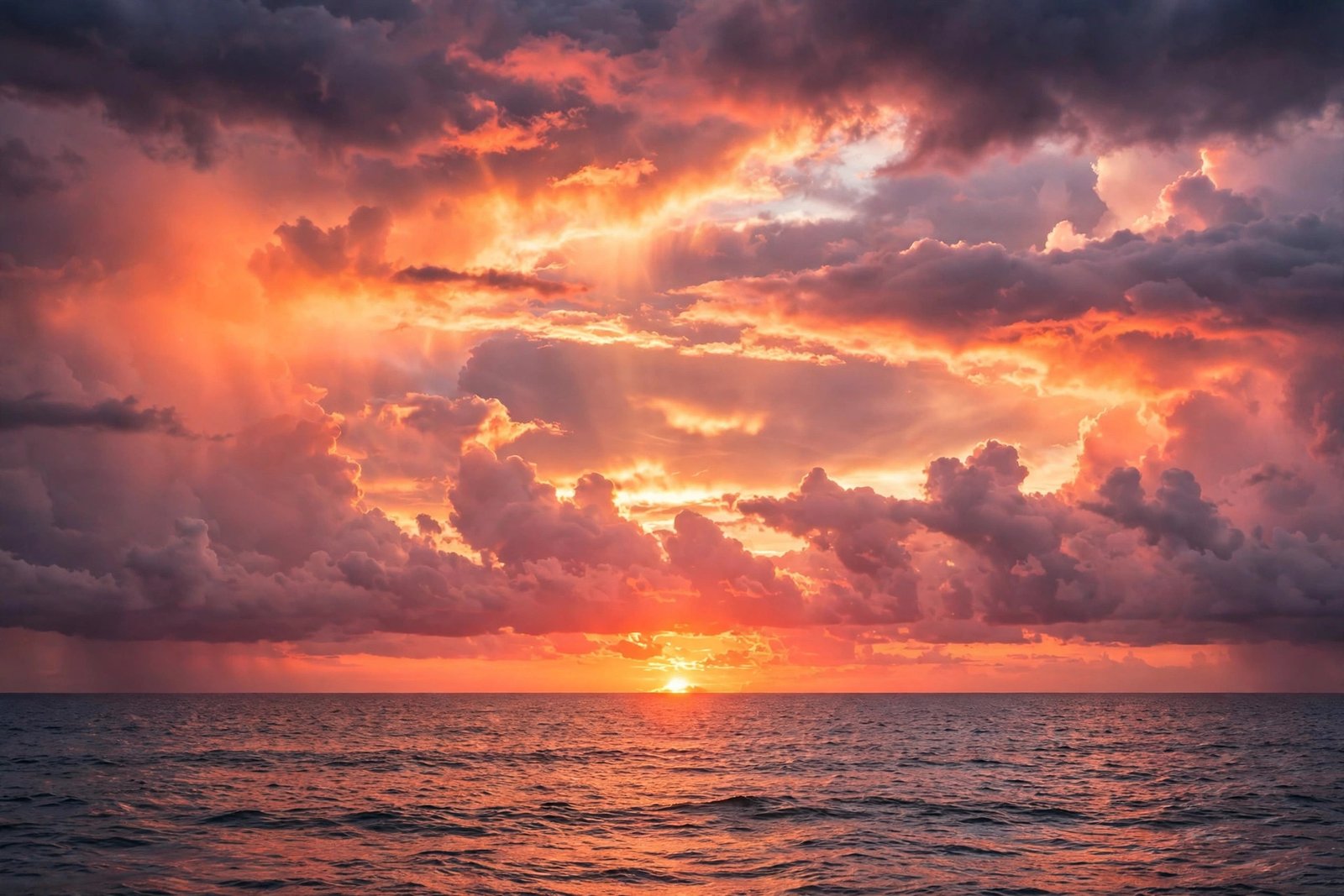
Two everyday sky mysteries share one culprit: sunlight colliding with air. The sky is blue at noon and blazes orange at sunset for the same physical reason — but the different geometry of noon versus sunset changes which colors survive the trip to your eyes. It’s one of those explanations that sounds too simple to be true, yet it falls straight out of 19th-century physics, confirmed by everything from laboratory experiments to NOAA’s atmospheric observations. NOAA’s SciJinks weather education site offers a great visual explainer of the scattering process for the curious. And once you understand it, you’ll never look at a sunset the same way — you’ll be watching physics perform.
The Noon Sky: Why Blue Wins
Sunlight looks white, but it’s a blend of all visible colors — the rainbow hidden in plain sight. When sunlight enters Earth’s atmosphere, it collides with nitrogen and oxygen molecules, which are much smaller than the wavelength of visible light. This triggers Rayleigh scattering, named for Lord Rayleigh, who worked out the mathematics in the 1870s: tiny particles scatter short wavelengths far more efficiently than long ones, with scattering intensity scaling roughly as the inverse fourth power of wavelength.
Blue light (~450 nanometers) is scattered about five times more strongly than red light (~650 nanometers). So as sunlight streams down, blue light gets bounced in every direction — including toward your eyes from every patch of sky — while reds, oranges, and yellows mostly continue straight down toward the ground. The sky glows blue because you’re seeing scattered blue light arriving from all directions at once. Violet is scattered even more strongly, but two things save us from a purple sky: the sun emits less violet light, and human eyes are far less sensitive to violet than to blue.
Why space is black
The contrast proves the mechanism: from the Moon or the ISS, with no atmosphere, the sky is pitch black even at “noon” — sunlight streams past unscattered, and you see stars alongside the sun. Blue sky is entirely an atmospheric effect; no air, no blue.
The Sunset: Why Orange Takes Over
At sunset, the sun sits near the horizon, so its light travels a much longer path through the atmosphere to reach you — up to 30–40 times the distance of the noon path. Along that extended journey, scattering keeps working: blue light gets scattered away, and then scattered again, progressively depleted from the beam. By the time the light arrives, the blues and greens have been scattered out almost entirely, leaving the longer wavelengths — oranges, reds, pinks — that scatter least.
The vivid colors around the sun come from the light that survived plus forward-scattered warm tones near the solar disk. Higher clouds catch the red light and reflect it dramatically, which is why sunsets with some cloud cover are the most spectacular — the clouds act as a projection screen. Particles in the air amplify everything: dust, pollution, and especially volcanic aerosols intensify reds, which is why sunsets after major eruptions (like Pinatubo in 1991) were famously spectacular worldwide for months.
The Variations: Pink Skies, Blue Moons, and Green Flashes
Once you know the mechanism, the oddities decode themselves. Pink “Belt of Venus” skies opposite the sunset: backscattered red light mixing with the blue of Earth’s shadow rising in the east. Blue moons (the optical kind, not the calendar kind): after forest fires or volcanic eruptions, particles around one micron in size scatter red light preferentially (Mie scattering), letting blue through — a genuinely blue moon was reported after Krakatoa. The green flash: at the exact moment of sunset over a clear ocean horizon, atmospheric refraction separates colors like a prism, and for a second the sun’s upper rim flashes green — real, photographable, and worth watching for.
Why Mars has butterscotch skies and blue sunsets: Martian dust is larger than air molecules, so scattering works in reverse — red dust scatters red light everywhere (butterscotch daytime sky), while around the setting sun, blue light penetrates the dust best, giving Mars blue sunsets. NASA’s rovers have photographed them: alien, beautiful, and perfectly explained by the same physics. Photography enthusiasts chasing these moments should know the right camera gear basics — and even documenting skies without a fancy camera is entirely doable with a phone and the right timing.
The Sky Through the Day: A Color Timeline
The sky isn’t one blue — it’s a gradient that shifts all day as the sun’s angle changes the atmospheric path length. At sunrise, the long path gives soft pinks and golds. By mid-morning, the path shortens and blue deepens. At solar noon, with the shortest path, the blue is at its most saturated — the “blue hour” photographers love is actually the opposite end of the day, when the sun is below the horizon and the upper atmosphere still catches sunlight, scattering blue across the darkening sky in that famous deep indigo.
Altitude changes the show too: from a mountaintop or airplane at 35,000 feet, you’re above much of the scattering atmosphere, so the sky looks a deeper, darker blue — and the horizon curves against the blackness of space. Climbers on Everest describe a sky that’s nearly violet-black at midday. It’s the same Rayleigh physics with less air in the way. Even your location’s latitude matters subtly: tropical noon skies, with the sun directly overhead and the shortest possible path, produce the most intense blues on Earth.
Frequently Asked Questions
Why isn’t the sky violet if violet scatters most?
Two reasons: sunlight contains less violet energy than blue, and human eyes are much less sensitive to violet. The scattered light reaching us peaks in our blue sensitivity — so blue dominates our perception. Our eyes simply don’t register violet well, so blue wins the perception contest outright.
Why are some sunsets more colorful than others?
It depends on what’s in the air and where the clouds are. Clean air gives softer pastels; particles (dust, pollution, volcanic aerosols) intensify reds; mid-level clouds catch and reflect the colored light best. The most spectacular sunsets often follow storms that washed the lower air clean while leaving dramatic clouds.
Does pollution make sunsets prettier?
Partly — particles enhance red scattering, so hazy sunsets can be vivid. But heavy pollution more often just dulls everything into murk. Volcanic eruptions produce the legendary sunsets; everyday smog mostly just dims them.
Why is the sky paler near the horizon at noon?
Near the horizon you’re looking through more atmosphere even at midday, so more scattering and more haze wash out the deep blue into pale whitish-blue. The deepest blue is always directly overhead, where the air path is shortest.
Can the sky ever be a different color on Earth?
Temporarily, yes — after major volcanic eruptions or massive wildfires, skies can turn orange, red, or eerily dim at midday from stratospheric particles. It’s the same scattering physics, just with unusual particles in unusual quantities.
Blue noon skies and orange sunsets are the same phenomenon seen from different angles: sunlight scattered by air molecules, with blue scattered most and surviving least over long paths. It’s 150-year-old physics that still performs daily, free of charge, everywhere on Earth. Look up — you’re watching Rayleigh scattering in real time, an elegant explanation performing its daily show above your head.