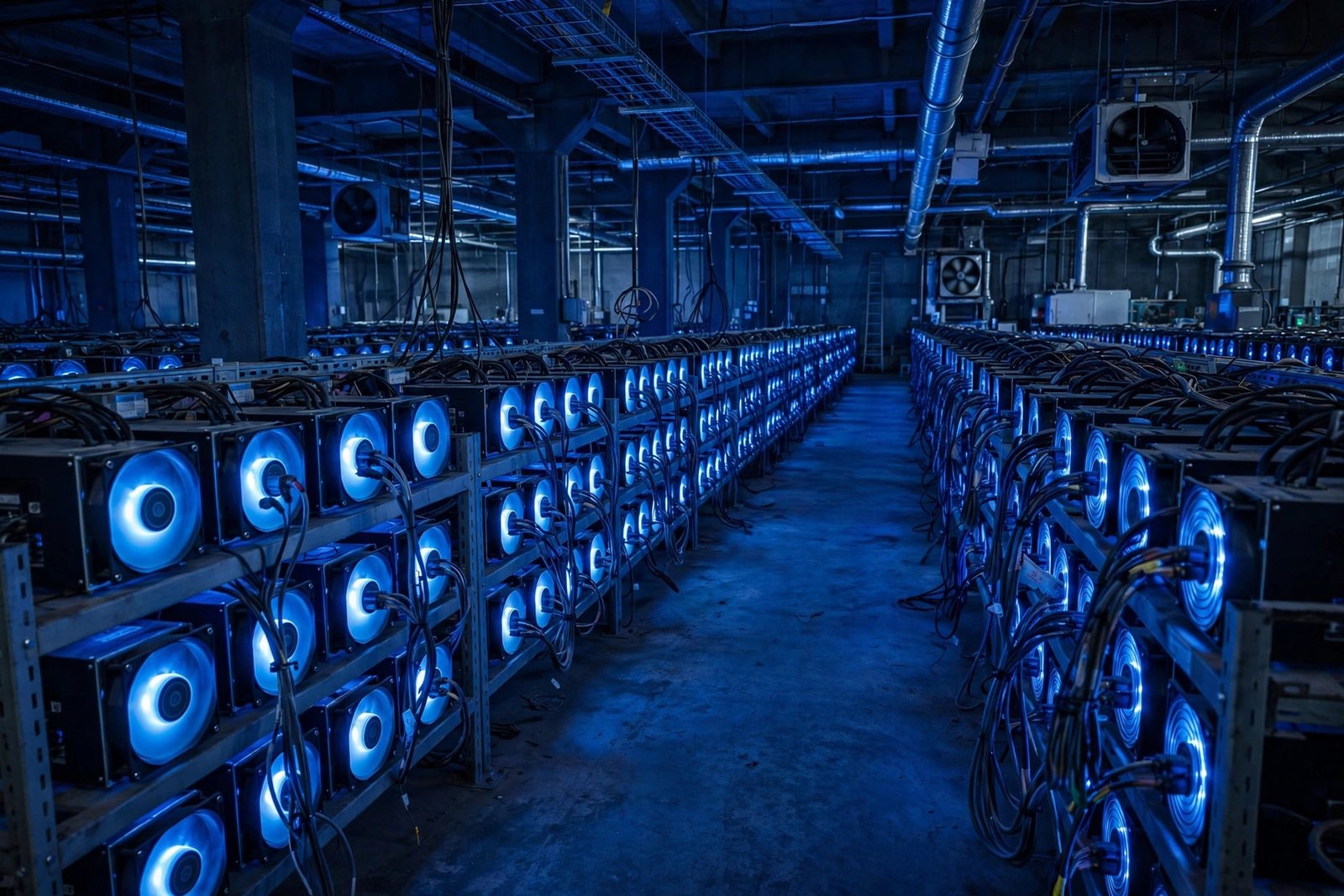
Every few years, someone declares crypto mining dead — and every few years, a new wave of miners proves them half-wrong. In 2026, the reality is more nuanced than the headlines. Bitcoin’s fourth halving cut block rewards in 2024, electricity prices remain elevated across much of the US, and industrial-scale operations now dominate the network. Yet mining persists, adapts, and in the right conditions still pays. Whether it’s profitable for you depends on three variables most articles gloss over: your power price, your hardware efficiency, and whether you’re mining bitcoin or something else entirely. Let’s run the real math.
How Mining Actually Makes Money in 2026
Miners earn revenue two ways: the block subsidy (newly minted coins, currently 3.125 BTC per block after the 2024 halving) plus transaction fees from the block’s transactions. Every ten minutes or so, one miner wins that reward. Your share of winnings is proportional to your share of the network’s total computing power (hashrate).
The network’s total hashrate now sits in the hundreds of exahashes per second — a scale that makes solo mining with a single machine statistically hopeless. Practically everyone mines through a pool, which smooths payouts: you contribute hashrate, the pool wins blocks regularly, and you get paid proportionally minus a 1–3% pool fee. Your profit equation is brutally simple: (your hashrate share × block rewards × coin price) − (electricity + hardware + overhead). When the left side stops exceeding the right, machines get unplugged.
The Three Variables That Decide Everything
1. Your electricity price (the king variable)
Electricity is 60–80% of a miner’s operating cost. At the US residential average of roughly $0.17/kWh in 2026, most home mining loses money — full stop. Profitable operations cluster where power costs $0.03–$0.06/kWh: parts of Texas with stranded wind, hydro-rich regions of the Pacific Northwest, and areas with flared-gas capture. Before buying any hardware, check your actual all-in rate (generation + delivery + taxes + fees) on your utility bill. A miner that prints money at $0.05/kWh bleeds cash at $0.15/kWh. There is no hardware efficient enough to overcome expensive power.
2. Hardware efficiency (joules per terahash)
Modern ASIC miners are marvels — and depreciating assets. A current-generation machine might deliver 200+ terahashes per second at around 3,500 watts (roughly 17.5 joules per terahash). Older units at 30+ J/TH simply can’t compete after the halving; they cost more in electricity than they earn. The trap: new ASICs cost $3,000–$6,000+, and by the time they’ve “paid for themselves,” the next generation has arrived. Buying used previous-gen hardware cheaply can work, but only with cheap power — and only if you verify the seller, since the resale market is full of burned-out units. Our guide to telling whether a website is safe to shop on applies double to peer-to-peer hardware deals.
3. Coin price and network difficulty
Mining revenue is denominated in crypto but costs are denominated in dollars — so profitability swings with price. Worse, success is self-defeating: when mining is profitable, more machines join, difficulty rises, and everyone’s share shrinks. The network automatically retargets difficulty every 2,016 blocks to keep block times near ten minutes. This is why mining margins compress over time and why the halving (which cut rewards in half overnight in April 2024) forced inefficient miners offline.
Bitcoin Mining vs. Altcoin Mining in 2026
Bitcoin mining is an industrial game now. The realistic paths for individuals are narrower:
- Bitcoin via ASICs: Profitable mainly with sub-$0.07/kWh power and current-gen hardware. Home miners in average-cost states generally can’t compete.
- Litecoin/Dogecoin merged mining: Scrypt ASICs let you mine both simultaneously, and the math occasionally beats bitcoin for small operators — but you’re exposed to two volatile prices.
- GPU mining: Ethereum’s 2022 move to proof-of-stake killed the biggest GPU-mining market. Remaining GPU coins (like Kaspa, Ravencoin, or Ergo) are far more speculative — profitable some months, worthless others. Only mine what you’d be willing to hold.
- Cloud mining contracts: Overwhelmingly, these are bad deals or outright scams. If a company could mine profitably with your money, it would mine with its own. The CFTC’s advisory flags mining “investment programs” as a classic fraud pattern.
A Worked Example: The Honest Math
Take a modern ASIC: 200 TH/s at 3,500W, costing $4,000. At $0.06/kWh, it burns about $15/day in electricity (3.5 kW × 24h × $0.06 ≈ $5/day — wait, 3.5 × 24 = 84 kWh/day × $0.06 = $5.04/day). If the network pays roughly $45–$55 per petahash per day (a figure that moves with price and difficulty), 0.2 PH/s earns ~$9–$11/day. That’s $4–$6/day profit — a 400–600 day payback before difficulty rises, which it will. At $0.15/kWh, the same machine costs $12.60/day in power and loses money daily.
Now add reality: difficulty historically trends upward, hardware fans fail, summer heat throttles output, and your time has value. The honest conclusion for most Americans: mining is a fascinating hobby or a viable business only with structural power advantages — not a passive income hack for a suburban garage. If your goal is simply owning bitcoin, buying it directly on a reputable platform is the far cheaper path — our guide to How can i tell if eggs are still safe to eat shows how to vet one.
The Hidden Costs Beginners Forget
Beyond electricity and hardware: the noise (ASICs sound like a vacuum cleaner running 24/7 — neighbors and spouses notice), the heat (3.5 kW is like running three space heaters constantly; cooling in summer doubles costs), electrical upgrades (most home circuits can’t safely run multiple miners), pool fees, firmware maintenance, and taxes. Yes, taxes — the IRS treats mined coins as ordinary income at fair market value when received, per the IRS digital assets guidance. Many hobby miners discover this at tax time and owe more than their “profit.”
When Mining Still Makes Sense
Mining isn’t dead — it’s specialized. It makes sense if: you have access to genuinely cheap power (under ~$0.07/kWh all-in); you can monetize waste heat (heating a workshop, greenhouse, or home in winter effectively rebates your power cost); you’re mining speculatively with hardware you’d own anyway; or you’re operating at industrial scale with negotiated power purchase agreements. Some miners also treat it as a dollar-cost-averaging machine: converting electricity into bitcoin automatically, without exchange KYC or timing decisions.
It doesn’t make sense as: a get-rich-quick scheme, a use for an old gaming PC (CPU/GPU mining of major coins is long dead), or anything involving “cloud mining contracts” sold on social media. If someone DMs you guaranteed mining returns, read our guide to spotting scams and fake reviews before sending a cent.
Conclusion
Is crypto mining still profitable in 2026? For industrial operations with cheap power and current hardware: yes, modestly, with real business risk. For the average American paying residential electricity rates: almost certainly not — you’d earn more buying and holding the coins directly. The halving, rising difficulty, and energy costs have turned mining from a garage gold rush into an infrastructure business where power price is destiny. Run your own numbers with your real utility rate before buying hardware, budget for noise/heat/taxes, and treat anyone selling “guaranteed mining profits” as a scammer. Mining rewards the prepared and punishes the hopeful; make sure you know which one you are before the machines arrive.
Frequently Asked Questions
How much does it cost to start mining bitcoin at home?
A single current-generation ASIC costs $3,000–$6,000, plus electrical work, ventilation, and networking. Realistic all-in startup for one machine is $4,000–$8,000 — and profitability hinges entirely on your electricity rate.
Can I mine crypto with my regular computer?
Not profitably for major coins. CPU mining has been obsolete for a decade; GPU mining survives only for smaller altcoins with thin margins. Your laptop will earn pennies while wearing out its hardware.
Is crypto mining legal in the US?
Yes, at the federal level, though some states and municipalities have restrictions or moratoriums (New York notably limited certain fossil-fuel mining operations). Always check local regulations and your utility’s terms before scaling up.
How does the bitcoin halving affect mining profits?
Each halving cuts the block subsidy in half — the April 2024 halving dropped it from 6.25 to 3.125 BTC. Unless price doubles to compensate, miner revenue per unit of hashrate falls, squeezing out the least efficient operators.
Are cloud mining contracts ever legitimate?
Almost never worth it. Legitimate large miners sell hashrate through established marketplaces, not via social-media “investment plans” promising fixed returns. Fixed-return mining offers are a hallmark of Ponzi schemes.