
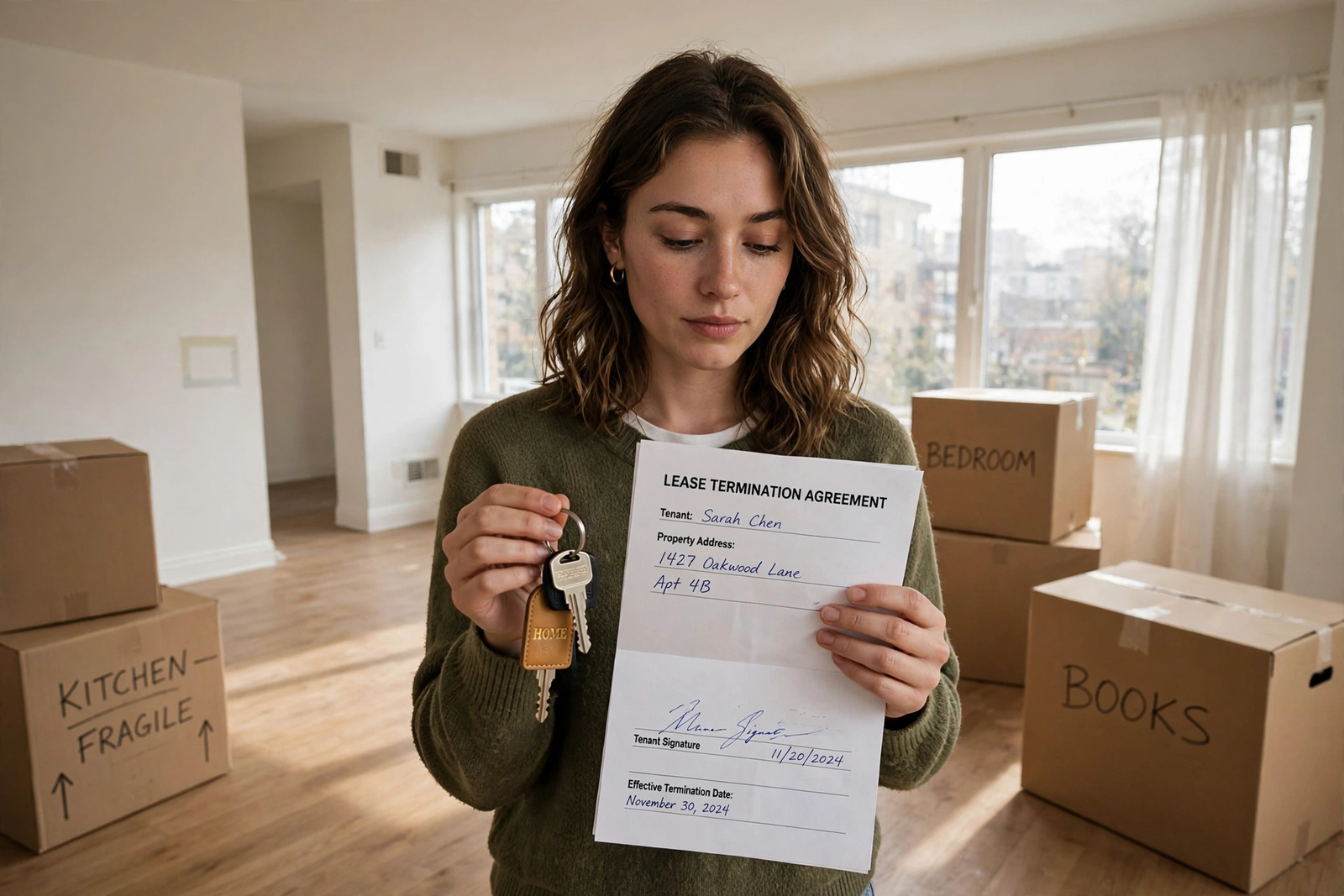
Quick answer: Breaking a lease typically costs 1 to 3 months’ rent, depending on your state laws and lease terms. Common charges include an early termination fee (often 1-2 months’ rent), rent until a new tenant is found, and reletting/advertising fees ($200-$500). Some states require landlords to mitigate damages by finding a replacement tenant quickly, which can significantly reduce what you owe.
Life happens: a job relocation, a breakup, a home purchase. When you need out of your lease early, the question is not just can you break it, but how much it will cost. The answer varies enormously by state, lease language, and how you handle the exit. This guide covers every cost, your legal rights, and strategies to minimize the damage.
Typical Costs of Breaking a Lease
| Cost Type | Typical Amount |
|---|---|
| Early termination fee | 1-2 months’ rent |
| Rent until re-rented | Varies (see mitigation laws) |
| Reletting / admin fee | $200-$500 |
| Advertising costs | $100-$300 |
| Lost security deposit | Up to full deposit |
On a $1,500/month apartment, a typical lease break costs $1,500 to $4,500 all-in. In the worst case, where the landlord cannot re-rent for months and your state lacks mitigation protections, you could owe rent through the end of the lease term.
Read Your Lease First: The Early Termination Clause
Your lease is the starting point. Look for:
- Early termination clause: Many modern leases spell out exactly what you owe, often a flat fee of 1-2 months’ rent plus notice. If your lease has one, that clause usually controls.
- Notice requirements: Most require 30-60 days’ written notice. Missing the notice window can add another month of rent.
- Subletting/assignment terms: Some leases allow you to sublet or assign the lease to someone else, which can eliminate most costs.
- Buyout option: A few leases let you pay a set fee and walk away cleanly.
State Laws That Protect You
Even if your lease is harsh, state law may help:
Duty to mitigate
Most states require landlords to make reasonable efforts to re-rent the unit after you leave, rather than sitting back and billing you for months. In these states, you generally owe rent only for the vacant period plus reasonable reletting costs. States with strong mitigation duties include California, Texas, Florida, New York, and Illinois, among most others.
Special protected situations
Federal and state laws allow penalty-free lease termination for:
- Active military duty: The Servicemembers Civil Relief Act (SCRA) lets active-duty servicemembers break a lease with 30 days’ notice after deployment or PCS orders.
- Domestic violence: Nearly every state allows survivors to terminate early with proper documentation.
- Uninhabitable conditions: If the landlord fails to maintain essential services (heat, water, safety) after proper notice, you may have the right to vacate under the implied warranty of habitability.
- Landlord harassment or privacy violations: Repeated illegal entry can justify termination in many states.
Check your state’s tenant rights guide; the U.S. Department of Housing and Urban Development (HUD) links to state resources.
6 Ways to Reduce the Cost of Breaking a Lease
- Talk to your landlord first. Many landlords prefer a clean, negotiated exit over a legal fight. Propose a specific deal: 60 days’ notice plus one month’s rent, for example.
- Find your own replacement tenant. Advertise the unit yourself, screen candidates, and present a qualified renter. A landlord who can re-rent in days has little left to charge you for.
- Offer to sublet. If your lease allows it, subletting keeps you technically on the lease while someone else pays the rent. Get everything in writing.
- Time your exit. Breaking a lease in May in a college town is far cheaper than in December, because demand makes re-renting fast.
- Document the unit’s condition. Take dated photos at move-out so the landlord cannot inflate damage claims against your deposit.
- Get the agreement in writing. Any deal, fee waiver, or payment plan must be documented and signed. Verbal promises are worthless in disputes.
What Happens If You Just Walk Away?
Simply disappearing is the worst option:
- The landlord can sue for all unpaid rent through the lease term (subject to mitigation duties).
- Unpaid balances sent to collections will damage your credit for up to 7 years.
- Future landlords will see the eviction or collection on tenant screening reports.
- You lose all leverage to negotiate.
If you are moving because you are buying a home, budget the lease-break cost into your plans alongside how much are closing costs on a home“>closing costs so there are no surprises.
Lease Break vs. Eviction on Your Record
A negotiated lease break where you pay what you owe generally does not appear as an eviction. It may show as an account closed with a balance if sent to collections, which is bad but far less damaging than an eviction judgment. Always aim for a written mutual termination agreement stating the account is settled.
If you are apartment hunting after a lease break, knowing how long does apartment approval take“>how long apartment approval takes and how long do apartment tours take“>how long tours take helps you plan the transition.
FAQs
Can my landlord charge me rent for the entire remaining lease?
They can claim it, but in most states the duty to mitigate means they must try to re-rent, and you owe only for the actual vacancy period plus reasonable costs. A few states are landlord-friendlier, so check your local law.
Will breaking a lease hurt my credit score?
Not directly if you pay what you owe. It hurts only if the unpaid balance goes to collections or results in a court judgment. A negotiated, paid-in-full termination leaves your credit intact.
Can I break a lease if I buy a house?
Buying a home is not a legally protected reason to break a lease in any state. You will need to negotiate, use an early termination clause, or find a replacement tenant. Budget for it as part of your home purchase costs.
How much notice do I need to give?
Check your lease; 30-60 days is standard. Even where not required, generous notice helps your negotiation and gives the landlord time to find a replacement, reducing your bill.
Can I get my security deposit back after breaking a lease?
Possibly, minus legitimate deductions for unpaid rent, fees, and damages beyond normal wear. Document everything and request an itemized statement, which most states require landlords to provide within 14-30 days.
Should I hire a lawyer?
For straightforward lease breaks, usually not. Consider a tenant-rights attorney or legal aid clinic if the landlord demands an unreasonable sum, ignores mitigation duties, or threatens illegal actions like lockouts.






One Comment