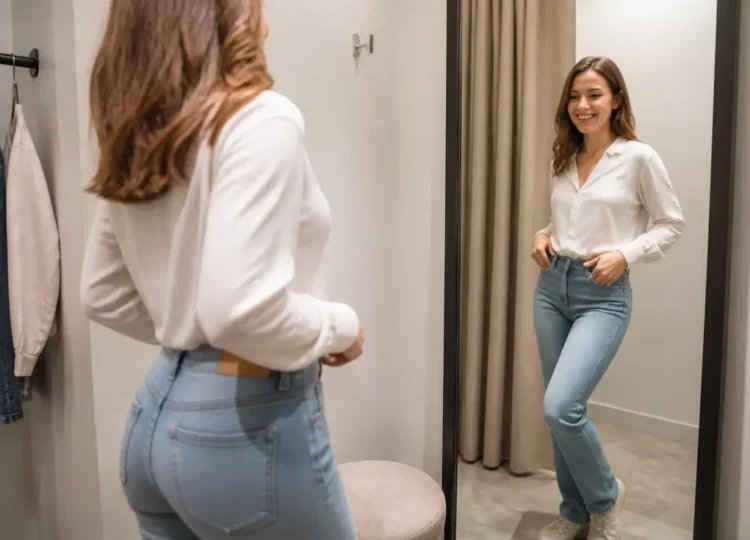
Jeans shopping is uniquely miserable. You try on 15 pairs, each failing in a new and creative way: waist gaps while thighs strangle, perfect hips with ankles swimming in fabric, the dreaded back-gap you only discover when you sit. It’s not your body — it’s that jeans are graded on standardized patterns that fit almost nobody perfectly. That’s why so many people ask how do I find jeans that actually fit my body type — and why you deserve a real answer, not clichés.
Finding jeans that fit is a learnable skill with three variables: rise, stretch content, and cut. Get those right for your body and the misery ends. Here’s how.
Know Your Rise: The Most Important Variable
Rise — where the waistband sits — determines everything about fit and comfort. High-rise (10 inches and up) sits at or above the navel: best for curvy figures, long torsos, and anyone tired of bending over anxiously. It eliminates back-gap and muffin top by containing everything. Mid-rise (8 to 10 inches) sits at the hip bones: the safe middle ground for average builds. Low-rise is largely dead for good reason — it fits very few bodies comfortably.
Here’s my strong opinion: most women who hate jeans are wearing the wrong rise. If you constantly tug your jeans up, size up in a higher rise instead of sizing up overall. For men, the equivalent insight is that ‘regular’ rise varies wildly by brand — try the same waist in two rises and feel the difference. Rise is personal anatomy, not fashion. Levi’s fit guide and denim resources
- High-rise (10″+): best for curves, long torsos — eliminates gap and contains the midsection.
- Mid-rise (8-10″): the versatile middle; suits average builds and most men.
- Constant tugging = wrong rise: go higher, not bigger, when jeans slide down.
- Sit-test every pair: stand, sit, bend — the fitting room chair is your truth-teller.
- Back-gap fix: curvy figures: try ‘curvy fit’ lines designed with a smaller waist-to-hip ratio.
Stretch Content and Fabric: The Secret Spec
Flip the tag and read the fabric content — this tiny label predicts fit better than the size. 100% cotton (rigid denim) doesn’t give: buy your true size and expect a break-in period, but they mold to your body beautifully and last years. 1-2% elastane: the sweet spot for most people — comfort with shape retention. Over 3% elastane (jeggings territory): super comfortable, but they bag out by day’s end and lose shape faster.
For athletic builds with big thighs and smaller waists, look for ‘athletic’ or ‘curvy’ cuts — they’re graded with more thigh room relative to waist. For tall people, check inseam options (many brands now offer short/regular/long free). For petite frames, cropped or ankle lengths avoid the bunching that makes legs look shorter. The fabric spec plus the right cut line solves 80% of fit problems. Good Housekeeping denim fit testing
- 100% cotton: no give, molds to you over time, longest-lasting — size true, expect break-in.
- 1-2% elastane: the sweet spot — comfort plus shape retention through the day.
- 3%+ elastane: comfy but bags out; fine for casual, bad for polished looks.
- Athletic/curvy cuts: more thigh room, less waist gap — made for real proportions.
- Check inseam options: tall and petite lines eliminate the most common length problems.
The Fitting Room Strategy That Works
Try every pair in two sizes — your usual and one up. Sizes vary so wildly between brands that the number is meaningless; the fit is everything. Do the full movement test: sit, squat slightly, walk, bend over. Check the back view (bring a friend or use the mirror) for gaping, pulling, or pocket placement — pockets set too low or wide visually widen hips.
And know when to walk away. If the waist fits but thighs are painted on, or hips fit but the waist gaps two inches, that’s not your pair — no amount of wanting it works. The right jeans need zero convincing. When you find them, note the brand, cut name, rise, and fabric content; that’s your formula. Buy two.
- Try two sizes always: brand sizing is fiction; fit is fact.
- Full movement test: sit, squat, bend, walk — jeans must work in motion, not just standing.
- Check the back view: gaping, pulling lines, and pocket placement all show from behind.
- Zero-convincing rule: if you’re negotiating with the mirror, they’re not your jeans.
- Record your formula: brand + cut + rise + fabric = rebuy without the misery next time.
Common Mistakes to Avoid
Most people don’t fail for lack of effort — they fail because of a handful of predictable mistakes. Sidestep these five and you’re already ahead of the vast majority of people tackling this.
- Buying your ‘usual size’ blindly: vanity sizing varies wildly by brand. The number is meaningless; the fit is everything.
- Skipping the sit test: jeans that work standing can gap, pinch, or slide when you sit. The fitting-room chair is the truth-teller.
- Ignoring fabric content: the tag predicts fit better than the size. 1-2% elastane is the sweet spot; rigid denim needs break-in.
- Settling for ‘close enough’: jeans that need convincing in the mirror won’t get better at home. Zero-convincing rule: walk away.
- Forgetting rise matters most: most fit complaints are rise problems. Tugging jeans need higher rise, not a bigger size.
Frequently Asked Questions
Should jeans be tight when you first buy them?
Rigid (100% cotton) jeans: snug but not painful — they stretch and mold with wear. Stretch jeans (1-2% elastane): comfortable from the start; if they’re tight now, they’ll bag later. Never buy painful hoping for miracles.
Why do my jeans gap at the waist?
Waist-to-hip ratio — standard jeans assume a proportional difference that curvy figures exceed. Solutions: ‘curvy fit’ lines (smaller waist relative to hip), higher rise, or a tailor taking in the waistband ($15-20, worth every penny).
How long should jeans last?
Quality jeans: 2-5 years of regular wear with proper care (wash rarely, cold, inside out, hang dry). Cheap fast-fashion jeans: often under a year. Cost-per-wear almost always favors the better pair.
What jeans are best for petite women?
Cropped and ankle lengths (no bunching), high-rise to elongate legs, and petite-specific lines for correct knee placement and inseam. Dark washes with no distressing look longest and most polished.
Pro tip: Put a recurring monthly reminder on your phone to revisit the key habits in this guide. Most good practices fade not from failure but from forgetting — a simple nudge keeps them alive.
How do I find jeans that actually fit my body type: The Bottom Line
Jeans that fit come from three decisions: the right rise for your torso (high-rise solves most women’s fit problems), the right stretch content (1-2% elastane is the sweet spot; rigid denim for longevity), and the right cut line (athletic/curvy fits for proportional differences). Try two sizes, movement-test everything, and walk away from pairs that need convincing. When you find your formula — brand, cut, rise, fabric — write it down and buy two. Future you will be grateful.