
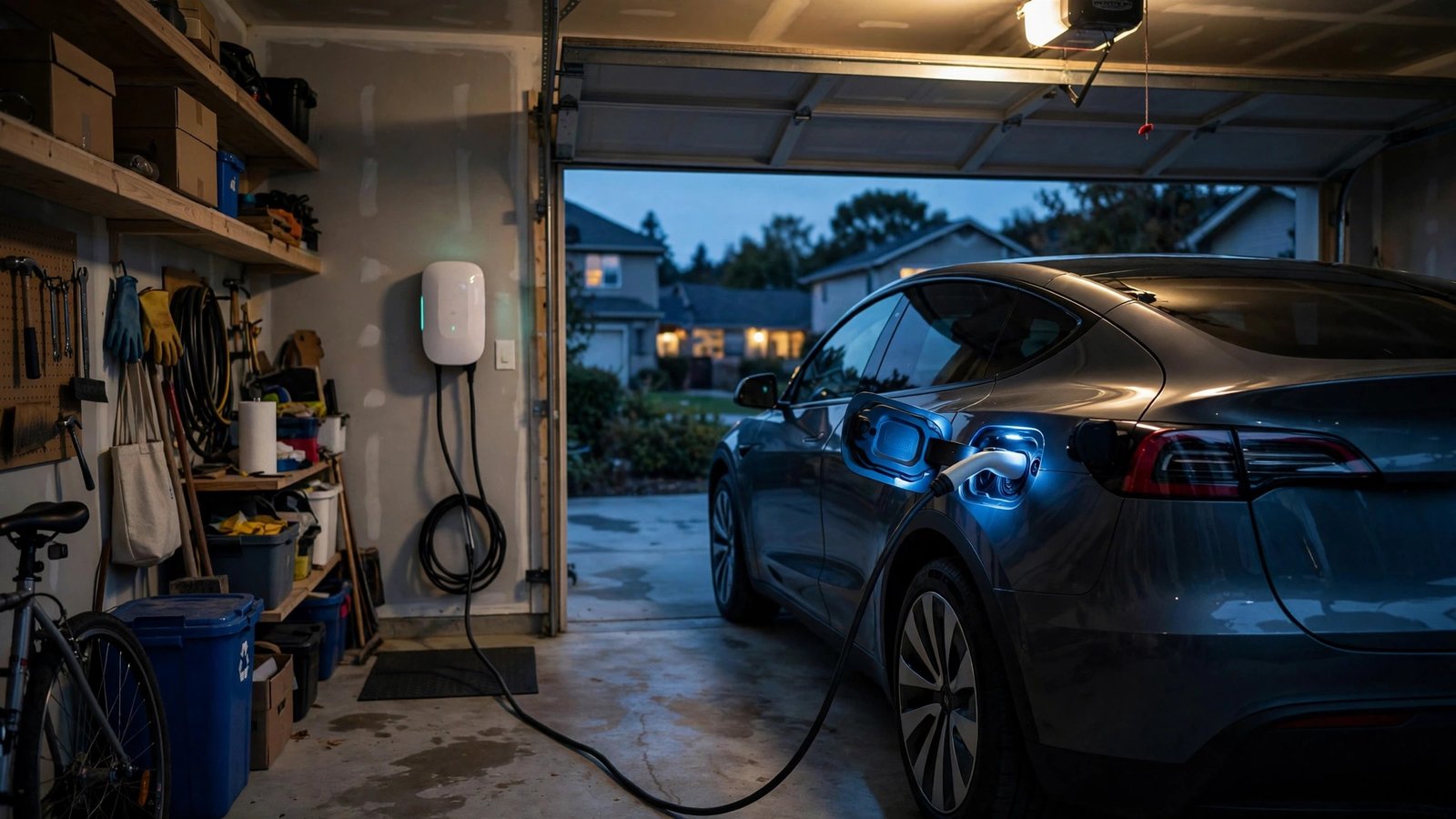
Home charging is the EV owner’s superpower: wake up every morning with a “full tank” at a fraction of gasoline prices. But “cheap” is vague, and actual costs depend on your electricity rates, driving habits, charger type, and installation needs. This guide breaks down the real numbers so you know exactly what home charging costs and how to minimize it.
The Per-Mile Math: Home Charging vs. Gasoline
The fundamental comparison is cost per mile. An efficient EV uses roughly 0.25 to 0.35 kWh per mile; at the U.S. average residential electricity rate of around 16 to 17 cents per kWh, that is roughly 4 to 6 cents per mile. A 30-mpg gasoline car at $3.50 per gallon costs nearly 12 cents per mile, more than double. For 12,000 miles yearly, home charging typically costs $500 to $700 versus $1,400 for gasoline, saving $700 to $900 annually. Your actual numbers depend on local rates, which range from under 10 cents in parts of the Northwest to over 30 cents in California and Hawaii. The FuelEconomy.gov calculator lets you compare specific EV models against gasoline equivalents using your local rates. Time-of-use plans, charging overnight at off-peak rates as low as 5 to 10 cents, can cut costs further dramatically.
Level 1 vs. Level 2: Equipment and Speed
Level 1 charging uses a standard 120V outlet and the portable cord included with most EVs, adding 3 to 5 miles of range per hour. It costs nothing to start and suffices for drivers covering under 40 miles daily who can charge overnight. Level 2 charging uses 240V, adding 20 to 60 miles per hour depending on the charger and car, fully charging most EVs overnight. Level 2 chargers cost $300 to $700 for the unit plus installation. Most daily drivers find Level 2 transformative: plug in after dinner, wake to a full battery, never think about range. If your panel and parking support it, Level 2 is the single best EV ownership upgrade. Renters and apartment dwellers face harder choices; some manage on Level 1 plus occasional public charging, but evaluate your situation honestly before buying. Your home’s electrical capacity matters too, which connects to energy-efficient upgrades for older homes that often accompany charger installation.
Installation Costs: What to Budget
Installation is the wild card, ranging from a few hundred to several thousand dollars. Simple installs, panel near the parking spot with spare capacity, run $500 to $1,000 including the charger. Complex installs requiring panel upgrades, long wire runs, or trenching can reach $2,000 to $5,000. Get multiple electrician quotes and ask specifically about EV charger experience; permits and inspections are typically required. Federal tax credits have covered 30% of charger and installation costs up to caps in recent years; check current availability plus state and utility rebates, which in some areas cover most of the cost. Some utilities offer discounted installation or free chargers with enrollment in managed charging programs. Budget the installation as part of the vehicle’s total cost when comparing EVs to gasoline cars; even a $2,000 install pays back quickly through fuel savings. And factor charging into household budgeting with a budget based on actual spending so the new electricity line item holds no surprises.
Rate Plans and Smart Charging Strategies
Your electricity rate plan significantly affects costs. Time-of-use (TOU) plans charge less overnight when demand is low; EV owners who shift charging to off-peak hours often cut charging costs 30 to 50%. Some utilities offer EV-specific rates with super-off-peak windows designed for charging. Smart chargers and most EVs allow scheduled charging, automatically starting at cheap-rate hours without your involvement. Solar owners can charge essentially free during daytime production, though most charging happens overnight; pairing solar with home batteries maximizes self-consumption. Avoid demand charges if your utility imposes them; simultaneous high-draw appliances during peak windows can spike bills. Call your utility before buying an EV; their EV programs, rebates, and rate options are the highest-leverage phone call in electric car ownership. The Department of Energy’s EV resources explain charging options and current incentives comprehensively.
Total Cost Comparison: Five-Year Outlook
Zoom out to total ownership. A typical EV buyer spends roughly $500 to $800 yearly on home electricity for 12,000 miles, plus amortized charger installation of maybe $200 yearly over a decade. Compare $1,200 to $1,800 yearly for gasoline in an efficient car, plus oil changes and more frequent brake service that EVs largely avoid. Over five years, fuel and maintenance savings of $4,000 to $8,000 are typical, often offsetting much of the EV price premium. These savings grow if gasoline prices rise or if you drive more than average; high-mileage drivers benefit most dramatically. Factor in your specific rates, mileage, and available incentives rather than national averages. For most homeowners with reasonable electricity rates, home charging makes EV economics compellingly favorable.
Workplace and Public Charging Economics
Home charging is cheapest, but workplace and public options shape total costs. Many employers offer free or subsidized workplace charging, an employee benefit worth thousands yearly that effectively makes commuting fuel-free. If yours does, size your home setup accordingly; you may need less charging capacity than assumed. Public charging splits into Level 2 (slow, cheap, good for shopping stops) and DC fast charging (quick, pricier, for road trips). Fast charging typically costs two to four times home rates per kWh, making it an occasional tool rather than a daily strategy. Charging networks use varied pricing: per-kWh, per-minute, or session fees, plus idle fees that punish lingering. Membership plans reduce frequent users’ costs. Map your regular routes’ charging options before relying on public infrastructure; coverage varies enormously by region. The hierarchy is clear: home first, workplace second, public as needed.
Battery Health and Home Charging Habits
How you charge affects long-term battery health. For daily use, charging to 80-90% rather than 100% reduces battery stress and extends lifespan; save full charges for road trips. Similarly, avoid regularly draining below 10-20%. Level 2 home charging is gentler than frequent DC fast charging, another reason home charging wins. Heat is batteries’ enemy; park in shade or garages during extreme heat when possible. Most EVs include battery management systems handling much of this automatically, plus battery health displays to monitor degradation. Real-world data shows modern EV batteries degrading slowly, typically retaining 85-90% capacity after 100,000 miles with normal care. Your charging habits are a minor factor compared to chemistry and thermal management, so follow the 80% guideline without anxiety and enjoy the car.
Conclusion
Charging an electric car at home typically costs 4 to 6 cents per mile, roughly half to a third of gasoline costs, with Level 2 equipment and smart rate plans pushing costs even lower. Installation ranges from a few hundred to a few thousand dollars, often offset by credits and rebates. Choose the right charger level for your driving, enroll in time-of-use rates, schedule charging overnight, and check utility programs before buying. Home charging is not just cheaper than gas; it is more convenient than gas stations ever were.
Frequently Asked Questions
How much does it cost to fully charge an EV at home?
A typical 60-75 kWh battery at 16 cents per kWh costs $10 to $12 for a full charge delivering 200-300 miles. Off-peak rates can cut this substantially.
Do I need a Level 2 charger?
Not strictly; Level 1 suffices for under ~40 miles daily. But Level 2’s overnight full charges transform the ownership experience and are worth it for most drivers.
How much does home charger installation cost?
Typically $500 to $1,000 for simple installs, up to $2,000-$5,000 for complex ones requiring panel upgrades. Tax credits and utility rebates often offset much of the cost.
Will charging an EV raise my electric bill a lot?
Expect $30 to $60 monthly for typical driving, far less than gasoline spending. Time-of-use rates and scheduled overnight charging minimize the impact.