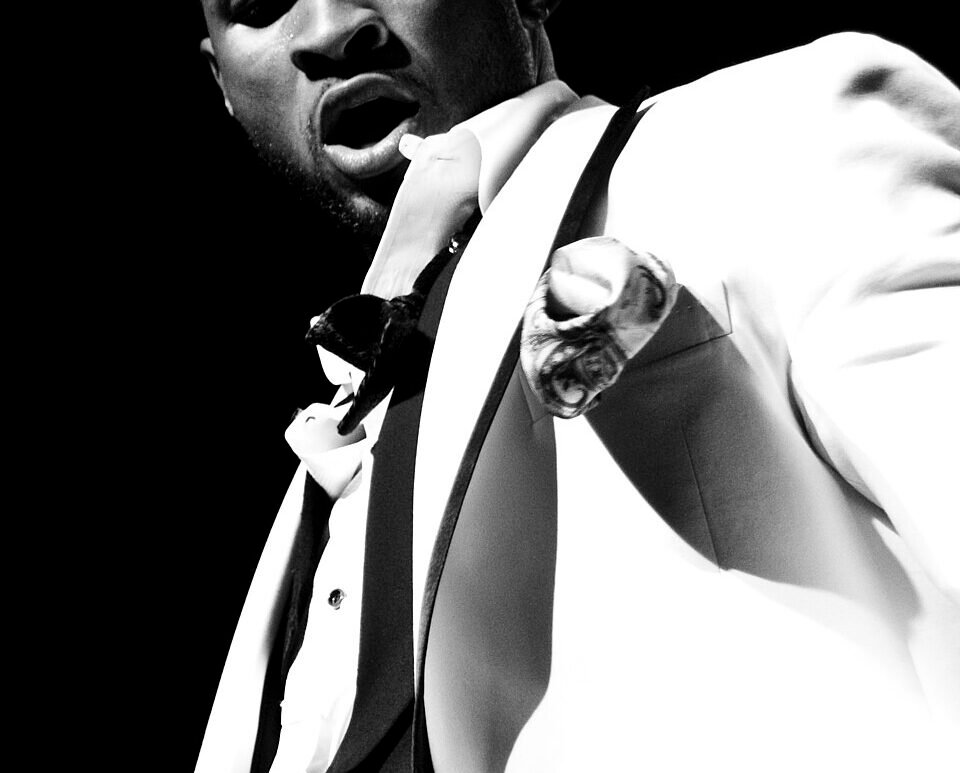
Usher’s $180 Million: Three Decades of R&B Money, Explained
The Short Version
Usher Raymond IV has sold more than 80 million records, headlined a Super Bowl halftime show, and mentored the biggest pop star of the following generation — and he built all of it on a voice and a work ethic that a talent scout spotted in a thirteen-year-old. Celebrity Net Worth puts his fortune at $180 million, and the tracker stands alone behind the figure: Forbes publishes no net-worth total for Usher, a fact this profile states plainly rather than papering over. His Confessions album holds diamond certification in the United States, a level only a handful of R&B albums have ever reached, and his Past Present Future tour grossed $88.5 million across 49 concerts in 2024 by Billboard’s count. That gross counts ticket revenue, not personal income, and the profile labels it accordingly. He is 48, married Jennifer Goicoechea in Las Vegas in February 2024 only hours after he headlined the Super Bowl halftime show, and remains one of the defining male vocalists of his era — an artist whose catalog, stagecraft, and business moves compounded quietly for thirty years.
How They Got There
1994–2001: The Prodigy Grows Up
A talent scout caught Usher at thirteen on the Star Search programme and a deal followed; his debut album, Usher, arrived in 1994 while he still attended school. The industry nearly shelved him as his voice changed, and he fought through the danger years with a discipline that became his trademark. My Way in 1997 made him a star outright, and 8701 in 2001 made him a global one, stacking hit singles and establishing the blueprint — silky vocals, precision choreography, romantic confidence — that male R&B still follows. He worked constantly: recording, touring, drilling his stage show until the dancing looked effortless, which of course it never was.
2004: Confessions and the Diamond Tier
Confessions arrived in 2004 and detonated. The album sold more than a million copies in its first week in the United States, produced a run of number-one singles, and eventually earned diamond certification for United States shipments above ten million. It remains the commercial peak of 2000s R&B and the cornerstone of Usher’s fortune: an album that size pays its artist for decades through sales, streaming, licensing, and the touring premium it permanently attaches to his name. Here I Stand in 2008 and Raymond v. Raymond in 2010 kept the chart run alive, and Looking 4 Myself in 2012 showed him absorbing electronic dance music without losing his core audience.
2016–2026: Vegas, the Super Bowl, and Coming Home
Hard II Love in 2016 closed a quieter commercial stretch, and Usher pivoted to the asset that never depreciates: the stage. A Las Vegas residency reminded the industry that his live show outclasses nearly every peer’s, and on 11 February 2024 he headlined the Super Bowl halftime show, the most-watched stage in entertainment, delivering a performance that critics ranked among the event’s finest. He released Coming Home on 9 February 2024, two days before the game, and launched the Past Present Future tour in August 2024; Billboard counted $88.5 million across its first 49 concerts. At 48 he works like an athlete in a contract year, and the grosses say the audience agrees.
The Craftsman’s Method
Usher’s longevity rests on a method he never abandoned: he trains like an athlete and rehearses like a dancer because his show demands both at once. Vocal coaches, choreographers, and band directors who worked with him across the decades describe a performer who treats preparation as the performance’s foundation rather than its preamble. That discipline protected his instrument. Voices in his genre often fray by forty; his carried a Super Bowl halftime show at forty-five with its range and power intact. The method also shaped his business judgment. He learned the industry’s economics young, watched mentors build ownership positions, and structured his later deals — residencies, tours, brand work — around retaining control of his name and his masters of the stage.
Chattanooga to Atlanta
The move to Atlanta placed a teenage Usher inside the most productive R&B ecosystem of its decade. The city’s studios paired young singers with elite writers, choreographers, and producers, and Usher treated the environment as a conservatory: he studied the greats on video, drilled footwork until it disappeared into instinct, and learned how a record takes shape from the board outward. His mother Jonetta guarded the business side through those years, shielding a minor’s earnings and schooling while the industry circled. That protection shows in his career’s unusual continuity — no lost years to bad contracts in the public record, no desperate comeback narrative, just a steady accumulation of craft and catalog. Atlanta also gave him his peer group and his competitive standard; the city produced stars in batches during his rise, and Usher outlasted nearly all of them by treating the work as a discipline rather than a lottery win.
His halftime performance also demonstrated the catalog’s strange durability in the streaming era. Within days of the broadcast, his decades-old hits climbed charts again as younger listeners discovered them through the show, and his monthly streaming audience expanded by millions. Catalogs that behave this way — dormant at full value, then surging on a single televised night — function like appreciating land: the owner simply holds them while culture cycles back. Usher holds his with a performer’s added advantage, because he can still sing the songs at their original standard and sell the tour that follows each surge.
Where It Began
Usher Raymond IV arrived on 14 October 1978 in Dallas, Texas, and grew up mainly in Chattanooga, Tennessee, and Atlanta, Georgia. His mother, Jonetta Patton, née O’Neal, raised him with a focus that doubled as management: she guided his early career, ran his business affairs until 2007, and kept the family grounded while fame arrived early and fast. His father, Usher Raymond III, died in 2008. Church singing shaped the voice first — Chattanooga congregations heard the instrument before the industry did — and local talent shows carried him to the Star Search stage and the scout who changed his life. Atlanta then gave him the finishing school: a city building an R&B empire, producers and choreographers at the top of their craft, and a teenager disciplined enough to absorb all of it.
The Fortune in Full
Celebrity Net Worth values Usher at $180 million, and this profile attributes the figure to that single source every time it appears, because no second permitted source publishes a total for him. The components show clearly enough. Confessions and its diamond-scale catalog anchor the recording income; more than 80 million records sold worldwide across his career keep publishing and master revenue flowing; the Las Vegas residency paid headline fees; and the Past Present Future tour’s $88.5 million gross across 49 shows in 2024 demonstrates a live premium that few artists from his era still command. That gross is revenue before costs, and this profile treats it as earning power, not wealth. His mentorship of a young Justin Bieber — Usher championed the teenager, helped arrange his path to a deal, and stood as the industry’s proof that the kid was real — built no direct fortune line that any source quantifies, and this profile claims none; it built reputation, and reputation in his business converts to fees eventually.
The residency chapter deserves a final note on structure. Las Vegas residencies pay guaranteed fees against minimal travel, and for an artist with Usher’s production values they convert directly into margin: one stage, one crew, audiences who fly to him. The Super Bowl appearance then repriced everything — his catalog streams surged, his tour routing expanded, and promoters bid against a halftime headliner’s leverage. Sequence matters in fortune-building, and Usher sequenced his forties nearly perfectly.
Cars
Reporting on his garage names a Mercedes-Benz SLS AMG — Mercedes-Benz publicized his 2013 visit to Affalterbach, where he helped assemble an engine — plus a CLS 63 AMG, an A45 AMG, a Porsche Carrera GT, a Ferrari 458 Spider, a Cadillac Escalade, a Ford Mustang GT, and a Bac Mono. The list comes from reporting; no source totals the collection’s value, and this profile invents none.
His catalog’s composition strengthens the figure further. Usher wrote and co-wrote across his albums, so publishing income supplements the performer’s share on a catalog that streaming keeps in constant rotation; Confessions alone generates the kind of perennial activity that funds estates. Add his eye for talent — the Bieber mentorship burnished a reputation that younger artists pay, in access and collaboration value, to stand near — and the $180 million reads as the sum of many disciplined streams rather than one era’s windfall. No second permitted source confirms the total, and this profile repeats that caveat deliberately: single-sourced, clearly attributed, and consistent with every gross the public record documents.
Life Away from the Job
Usher married Jennifer Goicoechea on 11 February 2024 in Las Vegas, hours after his halftime performance closed, and the marriage continues. The couple’s relationship began in 2019. His earlier marriages belong to the record: he married Tameka Foster in 2007 and their divorce closed in 2009; he married Grace Harry in September 2015, the couple announced their separation in March 2018, and their divorce followed in 2018. He has four children: Usher Raymond V, born in November 2007, and Naviyd Ely, born in December 2008, with Foster; Sovereign Bo, born in September 2020, and Sire Castrello, born in September 2021, with Goicoechea. One further name belongs in any honest family account: Kile Glover, Foster’s son and a child Usher helped raise, died in July 2012 aged eleven after an accident on Lake Lanier, and Usher has honored his memory publicly ever since. His mother Jonetta remains a central figure in his life, and his bond with Justin Bieber — the teenager he mentored into stardom, now a peer — shows the generous side of his competitive nature; readers can trace that story’s other half in Justin Bieber’s net worth profile. Usher shares performances, family milestones, and tour life with his followers on Instagram at @usher.
And Finally
Usher’s career arc now reads like a masterclass in asset management: build a diamond catalog young, protect the live show like an athlete protects his body, take the legacy stages — Vegas, the Super Bowl — at the moment they pay most, and keep recording on his own schedule. The $180 million from Celebrity Net Worth prices that discipline, single-sourced but consistent with every documented gross around it.
At 48, with his voice intact and his choreography still the genre’s benchmark, Usher holds the rarest asset in R&B: a thirty-year career with no lost decade. The fortune follows the same curve as the reputation — steady, earned, and still rising.
The Scoop File
| The Scoop File | Details |
|---|---|
| Born | 14 October 1978, Dallas, Texas |
| Age | 48 |
| Height | 5 ft 8 in (1.73 m) |
| Net Worth | $180 million (Celebrity Net Worth) |
| Weight | No reliable published figure exists |
| Wife | Jennifer Goicoechea (married 11 February 2024) |
| Children | Four: Usher Raymond V, Naviyd Ely, Sovereign Bo, Sire Castrello |
| Parents | Jonetta Patton, née O’Neal, and Usher Raymond III (d. 2008) |
| @usher |