
Texas is one of the most popular states for new businesses — no state income tax, huge market, straightforward rules. So how much does it cost to start an LLC in Texas? The headline number: a $300 state filing fee, plus a few optional-but-smart extras that bring the realistic total to $350-$600 for a proper DIY setup.
I’ve walked several friends through Texas LLC formation, and the process is refreshingly simple compared to states like California ($800/year franchise tax — Texas has no equivalent). Here’s every cost, what’s optional, and where people waste money.
The Mandatory Costs (What Texas Actually Requires)
- Certificate of Formation filing fee: $300. This is the big one — filed with the Texas Secretary of State (Form 205). It’s a one-time fee, not annual. File online via SOSDirect for fastest processing (typically 2-3 business days; expedited options exist).
- Registered agent: $0-$150/year. Texas requires every LLC to have a registered agent with a Texas address. Be your own agent for free if you have a Texas address and are available during business hours — the address becomes public record, which is the main reason people pay for a service ($100-$150/year from Northwest Registered Agent, LegalZoom, etc.).
- EIN (Employer Identification Number): $0. Free from the IRS at irs.gov — takes 10 minutes. You need it to open a business bank account and hire employees. Never pay for an EIN — sites charging $75 for this are selling you a free government service.
True minimum DIY total: $300 (filing fee + self as agent + free EIN). That’s it — Texas doesn’t layer on publication requirements (like New York’s $1,000+ newspaper rule) or annual LLC fees.
The Smart Extras (Strongly Recommended)
- Operating agreement: $0-$200. Texas doesn’t legally require one for single-member LLCs, but get one anyway — it defines ownership, profit splits, and what happens if you add partners or sell. Free templates from LegalTemplates or Rocket Lawyer cover basics; a lawyer-drafted one runs $200-$500. For multi-member LLCs, this isn’t optional in practice — it’s essential.
- Business bank account: $0-$25/month. Many online banks (Novo, Bluevine) offer free business checking. Non-negotiable: mixing personal and business finances can destroy your liability protection — the whole point of the LLC.
- DBA (assumed name) filing: ~$25. Only if you’ll operate under a name different from your LLC’s legal name. Filed with the county clerk where you do business.
- Business licenses/permits: $0-$500+. Texas has no general state business license, but your city and industry might — food, construction, professional services all have specific permits. Check your city’s website; this is the cost people forget.
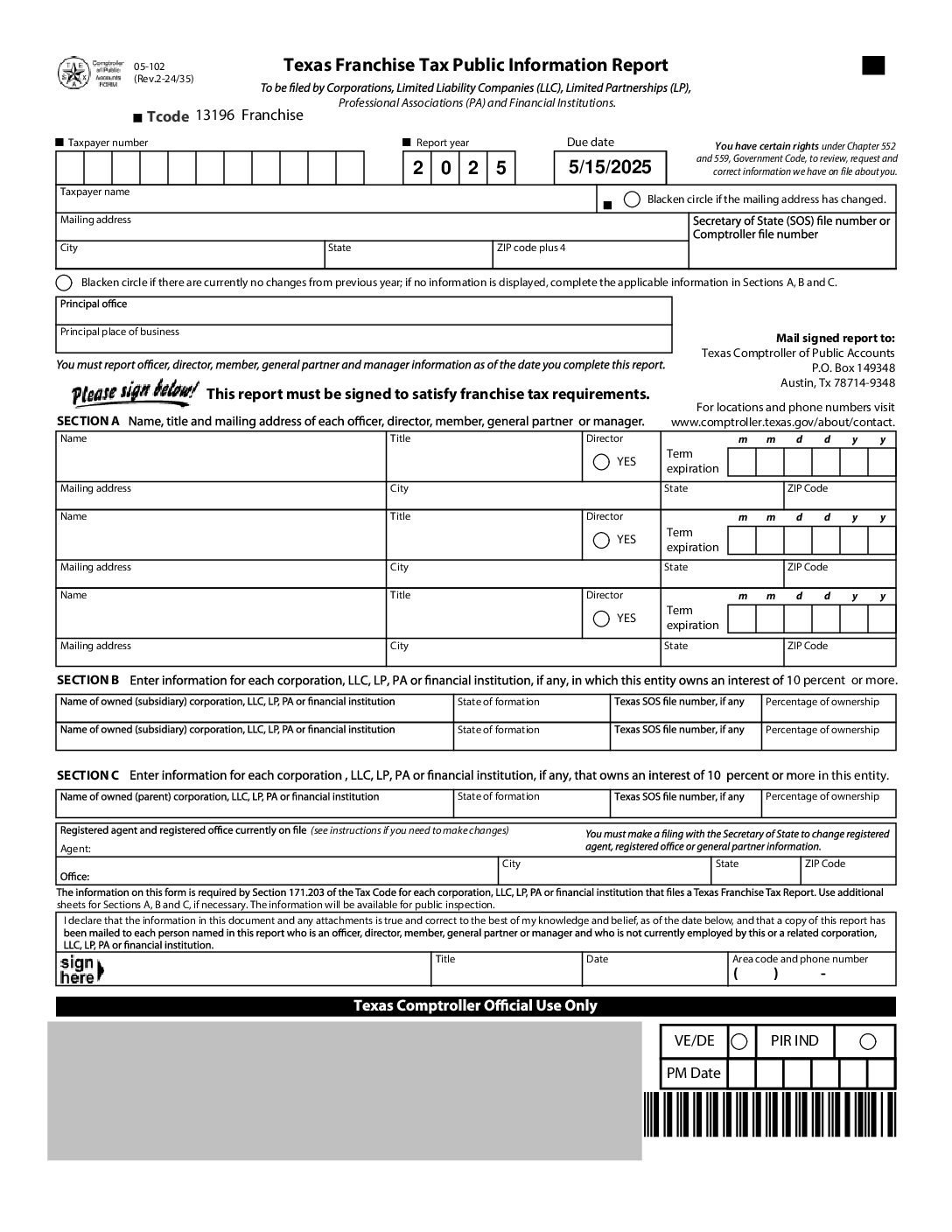
- Texas franchise tax: $0 for most small LLCs. Texas has no annual LLC fee, but LLCs owe franchise tax reports — with no tax due under $2.47 million in revenue (2026 threshold). You still file the “No Tax Due” report annually — free, but don’t forget it.
Where People Waste Money (Avoid These)
- $500-$1,500 “LLC formation packages.” LegalZoom, IncFile/Bizee upsells — the $300 state fee plus $200+ in “service fees” for 15 minutes of form-filling. The Texas Form 205 is genuinely simple; DIY it unless your situation is complex (multiple members, foreign owners, regulated industry).
- Paying for an EIN. Said above, saying again: irs.gov, free, 10 minutes. Anyone charging for this is a middleman.
- Unnecessary expedited filing. Standard online filing takes 2-3 days. Paying $100+ extra to save 48 hours is rarely worth it.
- Registered agent upsells you don’t need. If you work from a Texas home office and don’t mind the public address, self-agent is free and fine. Pay for privacy, not because someone scared you.
- Skipping the operating agreement to “save” $0. Free templates exist. Having no agreement when a dispute arises costs thousands. Penny-wise, pound-foolish.
Realistic smart total: $300 (state) + $0-$150 (agent) + $0 (EIN) + $0 (free operating agreement template) = $300-$450. Anyone quoting you $1,000+ for a basic Texas LLC is selling, not advising.
Texas LLC vs. Other States (Why Texas Wins for Many)
- No state income tax: Texas LLC profits aren’t taxed at the state level (federal still applies). Compare California’s $800 minimum franchise tax every year — Texas saves you $800/year from day one.
- No annual LLC fee: many states charge $50-$500 yearly just to exist. Texas: $0 (just the no-tax-due franchise report).
- $300 filing is mid-range: cheaper than Massachusetts ($500) or Illinois ($150 + $75 annual), pricier than Kentucky ($40). But total cost of ownership favors Texas heavily.
- Should you form in Delaware/Wyoming instead? The internet loves this advice; for most Texas businesses it’s wrong. If you operate in Texas, you must register as a foreign entity in Texas anyway — paying two states’ fees. Form where you actually do business unless you have specific legal reasons (seeking VC funding → Delaware).
Bottom line: for a Texas-based small business, a Texas LLC is the straightforward, economical choice. Don’t overthink the state-shopping unless your lawyer tells you to. The Texas Secretary of State’s forms page is the official starting point.
After Filing: the First-Week Checklist
- Get your EIN at irs.gov (10 minutes, free).
- Open a business bank account — bring your filed Certificate of Formation and EIN letter. Fund it with your initial capital.
- Draft/sign the operating agreement — even single-member. Keep it with your records.
- Check license requirements for your city/county and industry — business licenses for online stores have their own specifics.
- Set up bookkeeping from day one — handling bookkeeping without an accountant is very doable with modern tools. Future tax-season you will be grateful.
- Calendar the franchise tax report — due May 15 annually. No tax due under the threshold, but the report itself is mandatory.
- Consider an S-corp election later — once profits exceed ~$60k-$80k/year, electing S-corp taxation can save thousands in self-employment tax. Not day-one stuff, but know it’s an option — talk to a CPA when you get there.
Keep Reading
If this was useful, you might also like LLC vs sole proprietorship and EIN for small business.
The Bottom Line
A Texas LLC costs $300 to file — that’s the real number. Add $0 (self as registered agent) to $150/year (agent service), $0 for the EIN, and a free operating-agreement template, and a proper DIY setup runs $300-$450 total. Skip the $1,000 formation packages, never pay for an EIN, open a separate bank account immediately, and calendar the annual franchise tax report. Texas’s lack of income tax and annual LLC fees makes it one of the cheapest states to run a small business.
Frequently Asked Questions
How long does it take to form an LLC in Texas?
Online filing via SOSDirect typically processes in 2-3 business days. Mail filings take 2-4 weeks. Expedited service (additional fee) can do it in 1 business day, but most people don’t need it.
Do I need a lawyer to start an LLC in Texas?
For a simple single-member LLC, no — the Form 205 is straightforward. Consider a lawyer for multi-member LLCs (operating agreement complexity), regulated industries, or unusual ownership structures. A $200-$500 legal review is cheap insurance in those cases.
Can I be my own registered agent in Texas?
Yes — if you’re a Texas resident with a physical Texas address (no PO boxes) and available during business hours to receive legal documents. The address becomes public record, which is the main reason people hire a service.






One Comment