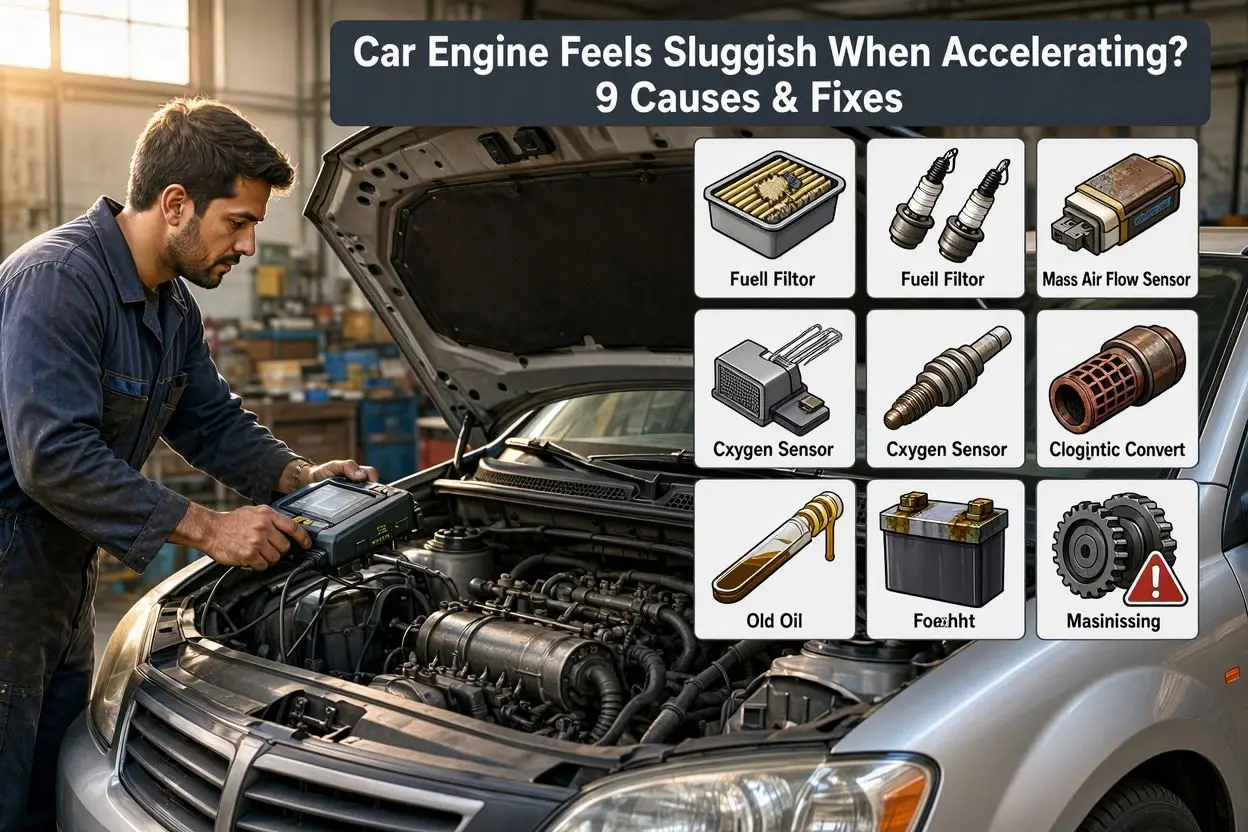
You press the pedal, expecting that familiar push, and the car just… thinks about it. The engine revs, but the speed builds slowly. It’s not dramatic, and there’s no warning light yet, but you can feel something is off.
That “a little sluggish” stage is actually the best time to act. Small problems are cheap to fix. Ignored ones turn into expensive repairs.
This guide walks you through why it happens, what you can check yourself, and when it’s time to hand the keys to a professional.
What Does “Sluggish Acceleration” Actually Mean?
Sluggish acceleration means your car responds slower than it normally does when you press the gas. Every engine needs three things to make power: clean air, the right amount of fuel, and a good spark. It also needs a clear path to push exhaust gases out. If any one of these is weak, the engine loses its punch.
Common signs to watch for
- A delay between pressing the pedal and the car moving
- Engine revs rising but speed not matching
- Struggling on hills or while overtaking
- Slight jerking or hesitation
- Worse fuel mileage than usual
- A rough or shaky idle
If you notice two or more of these, keep reading.
9 Common Reasons Your Car Engine Feels Sluggish
1. A Dirty Air Filter
This is the first thing to check because it’s the easiest and cheapest. A clogged filter chokes the engine’s air supply, so it can’t burn fuel efficiently.
How to check it
Open the airbox, pull the filter out and hold it against a light. If you can barely see light through it, or it’s full of dust and bugs, replace it. Driving on dusty roads makes this a more frequent job than the service book suggests.
2. Worn Spark Plugs
Old spark plugs create a weak spark. That leads to incomplete combustion, which you feel as hesitation or slight misfires, especially when you demand more power.
Typical lifespan
Copper plugs often need changing around 30,000 km, while iridium plugs can last much longer. Check your owner’s manual for the exact interval.
3. Fuel Delivery Problems
Your engine can only make power from the fuel it actually receives. Three parts usually cause trouble here:
Clogged fuel filter
It restricts flow, and the engine starves when you accelerate hard.
Weak fuel pump
The car may feel fine at idle but lose power under load or going uphill.
Dirty fuel injectors
They spray fuel unevenly, which hurts combustion and smoothness.
4. A Dirty or Faulty Mass Air Flow (MAF) Sensor
The MAF sensor tells the car’s computer how much air is entering the engine. When it’s dirty, it sends wrong readings, and the computer mixes the wrong amount of fuel. The result is a car that feels flat and lazy.
A can of proper MAF sensor cleaner (never ordinary spray cleaners) often solves this in minutes.
5. Carbon Buildup on the Throttle Body
The throttle body controls how much air enters when you press the pedal. Carbon deposits slowly build up around it and make the response slow and uneven. Cleaning it often brings back that crisp pedal feel.
6. A Failing Oxygen Sensor
Oxygen sensors monitor the exhaust and help the computer adjust the air-fuel ratio. When one gets lazy or fails, the engine can run too rich or too lean. You may also notice poor mileage and, eventually, a check engine light.
7. A Clogged Catalytic Converter or Restricted Exhaust
An engine has to breathe out as well as in. If the catalytic converter is blocked, exhaust gases get trapped and power drops, sometimes with a rotten-egg smell or excess heat under the car.
8. Vacuum Leaks
A cracked hose or loose connection lets unmetered air into the engine. This confuses the fuel mixture and can cause hesitation, a rough idle and a hissing sound from the engine bay.
9. Transmission or Clutch Issues
Sometimes the engine is perfectly healthy but the power isn’t reaching the wheels properly.
In automatic cars
Delayed shifts, slipping gears or low transmission fluid can make the car feel slow.
In manual cars
A worn clutch lets the engine rev while the car barely speeds up.
Simple Things to Check Before Visiting a Mechanic
You don’t need to be a car expert to rule out the basics. Try this quick routine:
- Check the dashboard for a check engine light or any warning.
- Inspect the air filter for dirt and clogging.
- Check tire pressure. Low pressure makes the car feel heavy.
- Check engine oil and transmission fluid levels.
- Think about your last fuel fill-up. Poor or contaminated fuel can cause sudden sluggishness.
- Remove unnecessary weight from the boot and roof carrier.
- Get the codes scanned. An OBD-II scanner is cheap and often points straight to the problem.
Don’t Forget the “Non-Engine” Causes
Not every sluggish feeling comes from a faulty part. A few everyday factors can mimic engine trouble.
Using the AC heavily
The air conditioner puts extra load on the engine, particularly on smaller engines. A slight drop in pickup is normal.
High altitude or very hot weather
Thinner or hotter air carries less oxygen, so the engine makes a little less power.
Overdue maintenance
Old engine oil, neglected services and worn belts all add up over time.
When Should You Worry?
A tiny dip in pickup isn’t an emergency. But take the car to a workshop soon if you notice any of these:
- The check engine light is on or flashing
- The car jerks, stalls or shakes badly
- You smell fuel or burning
- The problem keeps getting worse
- Overtaking feels unsafe
Sluggish acceleration isn’t only annoying. It can be dangerous when you’re merging onto a highway or overtaking, since you need power right when you ask for it.
How to Prevent Sluggish Acceleration
Prevention is almost always cheaper than repair.
Follow your service schedule
Change oil, filters and spark plugs on time.
Use good-quality fuel
Cheap or contaminated fuel clogs filters and injectors faster.
Clean the intake system occasionally
A throttle body and MAF cleaning once in a while keeps airflow smooth.
Drive it properly
Short trips and constant low-speed driving let carbon build up. An occasional steady highway drive helps burn some of it off.
Don’t ignore small changes
If the car feels different, trust your instinct. You know your car better than anyone.
Final Thoughts
When your car engine feels a little sluggish when accelerating, it’s your car’s way of saying something needs attention. Most of the time the cause is simple: a dirty filter, tired spark plugs, or a dirty sensor. Start with the cheap checks, scan for codes, and don’t wait for the problem to get serious.
A few minutes of attention today can save you a big repair bill and a stressful roadside breakdown later.
Frequently Asked Questions (FAQs)
Why does my car feel slow when I press the gas pedal?
Usually the engine isn’t getting the right mix of air, fuel or spark. A dirty air filter, worn spark plugs, a clogged fuel filter or a faulty sensor are the most common reasons.
Can a dirty air filter really make a car sluggish?
Yes. It limits the air reaching the engine, which reduces power and hurts fuel economy. It’s one of the easiest things to check and replace.
Why is my car sluggish only when going uphill?
Hills put the engine under heavy load. A weak fuel pump, clogged fuel filter or blocked exhaust often shows up first in these situations.
Will the check engine light always come on?
No. Many early problems, like a slightly dirty filter or ageing spark plugs, can reduce performance without triggering any light.
Can bad fuel cause slow acceleration?
Absolutely. Water, dirt or low-quality fuel can lead to poor combustion, hesitation and reduced power, sometimes right after a fill-up.
Is it safe to keep driving with a sluggish engine?
For short distances and minor symptoms, usually yes. But get it checked soon, because poor acceleration can be risky when overtaking or merging, and small faults can grow.
How much does it cost to fix sluggish acceleration?
It varies a lot. An air filter or MAF cleaning is inexpensive, while a fuel pump or catalytic converter costs much more. A proper diagnosis first saves money.
Can the AC make my car feel sluggish?
Yes. The AC compressor draws power from the engine, so you may notice slightly slower pickup, especially in smaller-engine cars.
How often should I replace spark plugs and filters?
It depends on the car and plug type. Generally, air filters every 10,000 to 15,000 km (sooner on dusty roads) and spark plugs per your manual’s recommended interval.