America is huge, and getting across it costs wildly different amounts depending on how you go. A $49 budget airline ticket, a $200 Amtrak roomette upgrade, a 14-hour drive, or a $89 Greyhound — the “cheapest” option depends on your route, your tolerance for discomfort, and whether you value your time. So what is the cheapest way to travel between US cities? Let’s compare every option honestly, with real price ranges, so you can pick the right trade-off.
The Contenders (Cheapest to Most Expensive, Roughly)
1. Budget airlines: Often the cheapest AND fastest
This surprises people, but on competitive routes, budget carriers (Spirit, Frontier, Allegiant, Southwest) routinely sell $29–89 one-way fares. At those prices, flying beats everything on both cost and time. The catches:
- Fees: Budget base fares assume a personal item only. Carry-on bags ($35–65 each way), checked bags, seat selection — do the all-in math.
- Route limitations: Budget airlines serve specific city pairs; if your route isn’t one, prices jump.
- Reliability: Fewer daily flights = fewer rebooking options when things go wrong. Build buffer time for important trips.
Strategy: search with legitimate cheap-flight tactics (Google Flights, flexible dates, price alerts). Booked 3–6 weeks out on off-peak days, budget airlines are almost unbeatable.
2. Buses: The true budget floor
- Megabus / FlixBus: $1–50 for regional routes booked early. The famous $1 fares are real (limited seats, off-peak). Even regular fares run $20–60 for 3–6 hour trips.
- Greyhound: $30–120 depending on route and timing. More extensive network, more variable experience.
- Chinatown/regional buses: On Northeast Corridor and other dense routes, independent bus lines undercut everyone ($15–25 NYC–DC).
Buses win on: short-to-medium routes (under 6 hours), last-minute travel (fares don’t spike like airlines), and city-center to city-center convenience (no airport time). They lose on: comfort over long distances, speed, and schedule reliability. For trips under 4 hours, the bus is often the rational choice — total travel time rivals flying once you count airport overhead.
3. Amtrak: Sometimes cheap, always civilized
- Coach fares: $30–150 for regional routes; cross-country $100–300+ booked early. Northeast Regional NYC–DC can be $49–99 off-peak.
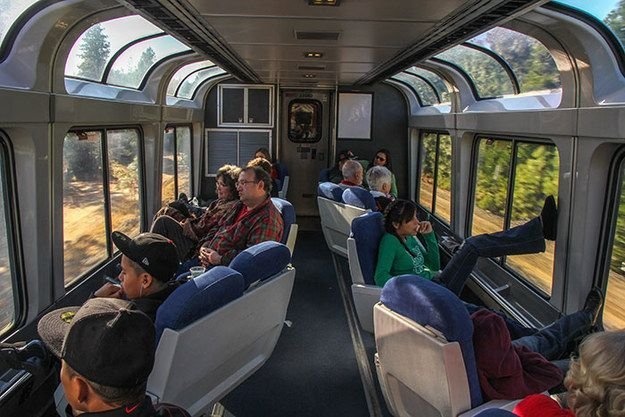
- The catch: Long-distance routes are slow (Chicago to Seattle: 46 hours) and prone to freight-train delays. But coach seats are spacious, there’s Wi-Fi (spotty), big windows, and a café car.
- When Amtrak wins: Scenic routes (Coast Starlight, Empire Builder), city-center convenience, comfort for the price, and travelers who hate flying. Book 2+ weeks ahead for the lowest fare buckets — Amtrak uses airline-style dynamic pricing.
4. Driving: Cheapest for groups, flexible for all
The math: IRS mileage rate (~$0.70/mile in 2026) suggests true driving cost, but marginal cost (gas + tolls) is what matters for the decision — roughly $0.15–0.25/mile for most cars. A 500-mile trip: $75–125 in gas/tolls. Split among 3–4 people? $20–40 each — unbeatable.
- Driving wins when: 3+ travelers, lots of luggage, flexible schedule, scenic route desired, or destination needs a car anyway.
- Driving loses when: Solo traveler (can’t split costs), very long distances (hotel nights add up), or you hate driving.
- Don’t forget: Tolls (budget $20–50 for Northeast Corridor), parking at the destination (downtown parking can erase all savings — research first).
5. Rideshares and carpooling: The middle path
Long-distance rideshare matching is thin in the US (unlike Europe’s BlaBlaCar), but worth checking for college-town and corridor routes. Splitting gas with friends heading the same direction is the informal version — post in local groups.
What Is the Cheapest Way to Travel Between US Cities? The Decision Framework
For any given trip, compare total cost AND total time:
- Under 3 hours driving: Drive or bus. Flying’s airport overhead makes it slower and pricier.
- 3–6 hours: Bus (cheapest), budget flight (fastest if cheap fare exists), drive (best for groups).
- 6–12 hours: Budget flight usually wins if fares are low; Amtrak for comfort; driving for groups/flexibility.
- 12+ hours / cross-country: Budget flight almost always cheapest AND fastest. Driving becomes a multi-day trip (see road trip planning if you go that route — it’s a vacation, not just transit).
The group multiplier: Solo → lean bus/budget flight. 2 people → compare carefully. 3–4 people → driving usually wins. 5+ → driving wins by a mile (or consider that you need two cars).
Total time math: A “1-hour flight” is really 4 hours door-to-door (airport arrival, security, boarding, deplaning, transit). A 4-hour drive is 4.5 hours. Always compare door-to-door, not just wheels-up to wheels-down.
Money-Saving Tactics Across All Modes
- Book early for buses/trains (fares rise), strategically for flights (3–6 weeks domestic).
- Travel off-peak: Tuesday/Wednesday/Saturday for flights; midday midweek for buses.
- Pack food: Road trip snacks apply to bus and train travel too — station food is a budget killer.
- Check all airports/stations: Secondary options are often dramatically cheaper.
- Loyalty programs: Amtrak Guest Rewards, bus company programs — free to join, points accumulate.
Sample Price Comparisons (Real Routes)
Theory is nice; numbers are better. Typical off-peak prices for popular routes (one-way, per person):
- NYC → DC (225 miles): Bus $15–25 (2–4 hrs door-to-door ~4.5 hrs) | Amtrak $49–99 (~3.5 hrs, ~4.5 hrs door-to-door) | Budget flight $59–99 (1 hr flight, ~4 hrs door-to-door) | Drive $30–45 gas/tolls (~4 hrs). Winner: Bus on price; Amtrak on comfort; it’s a toss-up on total time.
- NYC → Chicago (790 miles): Bus $40–70 (~13 hrs) | Amtrak $80–150 (~19 hrs) | Budget flight $49–89 (~2.5 hrs flight, ~5.5 hrs door-to-door) | Drive $90–130 (~12 hrs). Winner: Budget flight, usually — faster AND often cheaper than the bus.
- LA → SF (380 miles): Bus $25–40 (~7 hrs) | Amtrak Coast Starlight $60–100 (~12 hrs, spectacular) | Budget flight $39–79 (~1.5 hrs flight, ~4.5 hrs door-to-door) | Drive $50–70 (~6 hrs). Winner: Budget flight for speed; driving for flexibility; the train for the experience.
- Chicago → Denver (920 miles): Bus $60–90 (~16 hrs) | Amtrak $100–180 (~18 hrs) | Budget flight $59–109 (~2.5 hrs flight) | Drive $110–150 (~14 hrs). Winner: Budget flight by a mile.
The pattern: under 4 hours, ground transport competes. Over 6 hours, budget flights usually win on both price and time — if you book 3+ weeks out on off-peak days. Last-minute flips the math toward buses, whose fares barely move. Always compare your specific dates; these are starting points, not gospel.
For bus and train comparison in one place, Wanderu searches Greyhound, Megabus, Amtrak, and regional carriers side by side — the fastest way to find the genuinely cheapest option.
The Takeaway
The cheapest way to travel between US cities is usually a budget airline fare ($29–89) on competitive routes, a $1–50 Megabus/FlixBus ticket on shorter corridors, or driving split among 3–4 people. Compare total door-to-door cost and time (not just sticker price), factor in the group multiplier, and book with the right timing for each mode. There’s no single cheapest option — but for any specific trip, 10 minutes of comparison will find it. Start with Google Flights for air and Wanderu for bus/train comparison — the answer is usually obvious once you see the numbers side by side.