There’s a special misery to overnight flights: the lights dim, everyone reclines, and you sit there wide awake at 2 a.m., neck aching, knees against the seat, watching the flight map crawl. Arriving destroyed ruins your first day (or two) at the destination. But sleeping comfortably on a long overnight flight isn’t luck — it’s a system. Frequent flyers have this dialed, and every element is learnable. Here’s the complete playbook.
I’ve slept through flights I once would’ve suffered through, using exactly the method below. It’s not about one magic product — it’s about stacking small advantages until sleep becomes the path of least resistance.
The Seat: Your Biggest Lever
Where you sit matters more than any gadget:
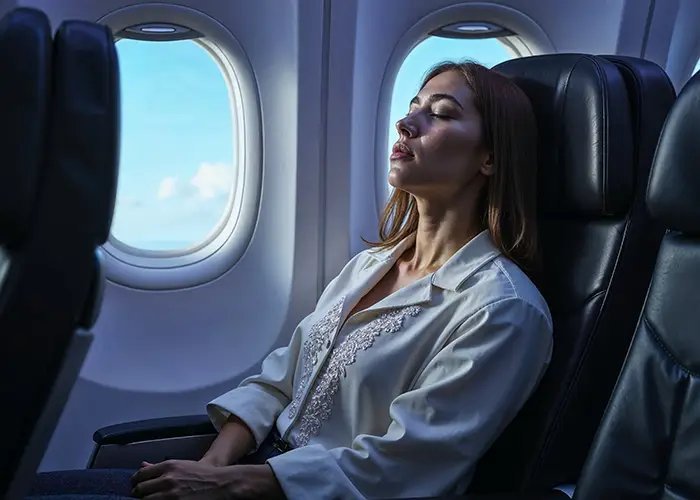
- Window seat, always. You get the wall to lean on, control of the shade, and nobody climbing over you. The wall-lean alone is worth more than any pillow for side sleepers.
- Front of your cabin section. Quieter (engines are rearward), deplanes faster, and you’re further from galley noise and bathroom traffic.
- Avoid: Last rows (don’t recline, near bathrooms), seats near galleys (light + noise + crew chatter), bulkhead if you’re tall (fixed armrests narrow the seat).
- Exit rows: Legroom is glorious, but seats often don’t recline and they’re colder. Trade-off to consider.
- Check SeatGuru for your specific aircraft — “good” and “bad” seats vary by plane, and 10 minutes of research prevents 10 hours of regret.
How Can I Sleep Comfortably on a Long Overnight Flight? The Sleep Kit
Assemble this once, keep it in your personal item forever:
- Neck pillow — but the right kind. The U-shaped inflatables are mostly useless (your head still falls forward). What works: wraparound memory-foam designs (like the Trtl, which supports the chin laterally) or compressible down pillows you can wedge between head and window. Test before the trip.
- Eye mask: Contoured/cups style that doesn’t press on eyelids. Total darkness is non-negotiable — cabin “dim” is still bright enough to suppress melatonin.
- Earplugs + noise-canceling headphones: Foam earplugs for sleeping (32dB reduction), headphones for the movie-then-sleep transition. White noise or brown noise through the headphones masks the irregular sounds that wake you.
- Warm layers: Cabins run cold. A packable down layer or large scarf doubles as blanket reinforcement. Warm feet matter — compression socks keep feet warm AND reduce swelling.
- Lip balm and moisturizer: Cabin humidity is ~12% (drier than most deserts). Discomfort wakes you; address it preemptively.
- Water: Buy after security. Dehydration causes headaches that fragment sleep.
The Pre-Flight Setup (Starts Before Boarding)
- Tire yourself appropriately. A workout the morning of, a full day — don’t board wired. But don’t exhaust yourself into wired-tired either.
- Eat strategically: Have a real meal before boarding or right after takeoff, then stop. Heavy eating at odd hours disrupts sleep; light is better.
- Limit alcohol and caffeine. Alcohol feels sedating but fragments sleep architecture — you’ll wake at 3 a.m. unable to return to sleep. Caffeine after mid-afternoon is sleep sabotage on an overnight flight.
- Consider melatonin (0.5–1mg): Low-dose melatonin 30 minutes before desired sleep time helps shift your clock, especially eastbound. It’s a timing signal, not a sedative — small doses work better than large. (Check with your doctor if you have conditions or take medications.)
- Set your watch to destination time at boarding and start living on it mentally.
The In-Flight Routine
- Settle immediately: Stow bags, arrange your kit, recline as soon as allowed. Don’t wait for “sleep time” — start the wind-down right after the meal service.
- Do your mini bedtime routine: Brush teeth, wash face, change into the comfortable layer you packed. The ritual signals your brain — the same principle as a bedtime routine at home, compressed.
- Deploy the kit: Earplugs in, eye mask on, neck support positioned, blanket tucked. Make yourself a sensory-deprivation cocoon.
- Breathing: Slow exhales, 4-7-8 pattern. Boring by design — you’re trying to bore yourself to sleep.
- If you wake up: Don’t check the time obsessively. Keep the mask on, breathe, and give it 20 minutes. Most mid-flight wake-ups pass if you don’t fully activate.
Position tips: window-leaners should pad the wall (jacket, pillow). Aisle sleepers: keep elbows in and valuables secured. Recline considerately — full recline on overnight flights is expected and normal; that’s what the seat does.
Arrive Functional: The Morning Protocol
How you wake matters as much as how you sleep:
- Wake 60–90 minutes before landing: Enough time to de-grog without rushing.
- Hydrate aggressively: Water + electrolytes if you have them. You’re dehydrated; that’s half the grogginess.
- Light exposure: Open the shade. Light is the strongest wake signal — start the destination-time adjustment immediately.
- Move: Walk the aisle, stretch in the galley area. Blood flow beats coffee for the first 30 minutes.
- Then caffeine, strategically: One coffee on arrival, none after 2 p.m. local time. You’re setting up tonight’s sleep, not just surviving today.
For the days after, handling jet lag is the essential sequel — good flight sleep makes jet lag dramatically milder.
The Red-Eye Survival Kit Checklist
Assemble once, keep packed in your personal item permanently. The complete kit:
- ☐ Neck support: Wraparound memory foam (Trtl-style) or compressible down pillow — NOT the floppy U-shaped inflatable
- ☐ Eye mask: Contoured cups style, total blackout, adjustable strap
- ☐ Earplugs: Foam, 32dB+ (pack 2 pairs — they get lost)
- ☐ Headphones: Noise-canceling + downloaded white/brown noise or sleep playlist
- ☐ Warm layer: Packable down jacket or large scarf/wrap
- ☐ Compression socks: Warmth + circulation on long flights
- ☐ Lip balm + moisturizer: Travel sizes, applied before sleep
- ☐ Water bottle: Filled past security — hydrate before sleeping
- ☐ Melatonin 0.5–1mg: For eastbound/timezone shifts (consult your doctor first)
- ☐ Toothbrush + face wipes: The mini bedtime routine that signals sleep
- ☐ Pen + customs form: Fill it out before sleeping so landing isn’t a scramble
Total kit weight: under 2 lbs. Total cost: $60–100 once. It lives in your personal item between trips, always ready. The travelers sleeping peacefully in 34B while you’re suffering in 34C? They have this kit. Now you do too.
The Takeaway
Sleeping comfortably on a long overnight flight means: window seat in a quiet row, a proper sleep kit (supportive neck pillow, contoured eye mask, earplugs, warm layers), smart pre-flight choices (meal timing, limited alcohol/caffeine, low-dose melatonin), an in-flight wind-down routine, and a deliberate wake-up protocol. No single item does it — the stack does. Assemble the kit once, use it for every overnight flight, and red-eyes stop being endurance events. For more on the science, the Sleep Foundation covers travel sleep extensively.