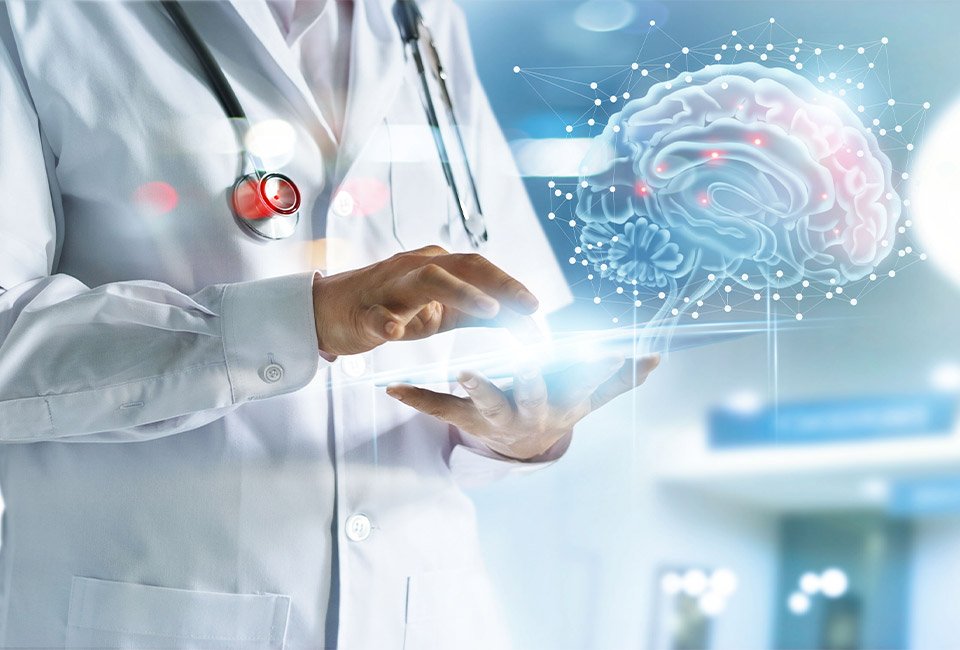
How is AI changing the way doctors diagnose patients? Behind the headlines about robot doctors, a quieter revolution is actually happening in clinics and hospitals: AI systems are reading medical images, flagging early disease, predicting patient risk, and catching subtle patterns that even experienced physicians miss. It’s not replacing doctors — it’s changing what being a doctor looks like, much like AI has quietly woven itself into everyday life. Here’s the real state of play in 2026.
Medical Imaging: Where AI Already Excels
The biggest success story is radiology and pathology. AI systems trained on millions of scans now match or exceed human specialists at detecting certain conditions: diabetic retinopathy in eye scans, skin cancer in dermatology photos, lung nodules in chest X-rays, and early signs of breast cancer in mammograms. The FDA has cleared hundreds of AI-powered medical devices, most in imaging.
The key word is assist: in practice, AI acts as a tireless second reader, flagging suspicious areas for the radiologist’s attention. Studies consistently show the combination of AI plus doctor outperforms either alone — the AI catches things humans overlook through fatigue or subtlety, while the doctor provides context, judgment, and accountability. It’s augmentation, not automation, and radiologists describe it as the most significant workflow change of their careers.
How Is AI Changing the Way Doctors Diagnose Patients? Beyond Images
- Early warning systems: Hospital AI monitors vital signs, lab results, and clinical notes continuously, predicting sepsis, cardiac arrest, or deterioration hours before obvious symptoms — when intervention works best. These silent guardians are saving lives daily.
- Rare disease diagnosis: For patients on years-long diagnostic odysseys — including those with persistent unexplained symptoms like constant fatigue even after a full night of sleep — AI that cross-references symptoms against vast medical literature is cracking cases human doctors couldn’t. Pattern-matching across millions of case reports finds connections no individual physician could hold in memory.
- Risk prediction: Models estimate individual risk for heart disease, diabetes complications, or hospital readmission, letting doctors intervene preventively rather than reactively.
- Clinical documentation: AI scribes transcribe and summarize patient visits, giving doctors their time back — and better notes mean better diagnosis downstream.
- Drug interaction checking: Instant cross-referencing of complex medication regimens catches dangerous interactions humans might miss.
The FDA’s database of AI-enabled medical devices shows just how broad this has become — and it’s growing monthly.
The Limits and the Concerns (Take These Seriously)
AI diagnosis has real problems. Bias in training data is the biggest: models trained mostly on certain populations perform worse on others, potentially worsening health disparities. Dermatology AI trained mainly on light skin is the textbook example. Over-reliance worries physicians too — if doctors defer to AI reflexively, they lose the skills to catch AI errors. And accountability remains murky: when AI contributes to a misdiagnosis, who’s responsible?
There’s also the human dimension: diagnosis isn’t just pattern-matching, it’s communication. Delivering difficult news, understanding a patient’s values and fears, navigating uncertainty together — these remain profoundly human. The best implementations use AI to handle the computational work so doctors have more time for the human work, not less.
What This Means for You as a Patient
Practically speaking: your scans are increasingly likely to get an AI second opinion, which is good news — it means fewer missed findings. Don’t be alarmed if your doctor mentions AI assistance; be more concerned if a practice seems stuck in 2010. Ask questions: “How does this AI tool work? What data was it trained on? What’s the human oversight?” Good providers welcome these questions.
And maintain perspective: AI is a powerful tool in your doctor’s kit, not a replacement for medical judgment — just as understanding the difference between AI and machine learning helps you evaluate any health-tech claim critically. The future of diagnosis is human expertise amplified by machine intelligence — which, for patients, should mean earlier detection, fewer errors, and doctors with more time to actually talk to you — which, in the end, is what good medicine has always been about, technology or no technology.
AI in Drug Discovery: Faster Cures
Beyond diagnosis, AI is transforming what doctors can prescribe. Machine learning models now predict how proteins fold — the breakthrough that won the 2024 Nobel Prize in Chemistry — which accelerates drug discovery from years to months. AI screens millions of molecular combinations to find promising drug candidates, predicts which patients will respond to which treatments, and designs personalized cancer therapies based on a tumor’s genetic profile.
For patients, this means the pipeline from lab to pharmacy is speeding up, and treatments are getting more personalized. Oncology is furthest along: AI-matched therapies based on tumor genomics are already improving outcomes for certain cancers. It’s diagnosis and treatment converging into one data-driven continuum.
The Doctor’s Job Is Changing — Mostly for the Better
Talk to physicians about AI and you’ll hear cautious optimism. The administrative burden — the documentation, the inbox, the prior authorizations — is what burns doctors out, and AI is absorbing exactly that work. What remains is the part most doctors went into medicine for: solving puzzles, guiding patients through fear and uncertainty, making judgment calls where data runs out.
Medical education is adapting too. Tomorrow’s doctors will need AI literacy alongside anatomy: knowing when to trust the algorithm, when to overrule it, and how to explain AI-assisted decisions to patients. The stethoscope didn’t replace doctors; it extended their senses. AI is the stethoscope of pattern recognition — a tool that makes good doctors better, not a replacement for the doctor herself.
The Practical Takeaway
AI is changing medical diagnosis primarily through imaging assistance, early warning systems, rare disease pattern-matching, and risk prediction — consistently working best as a doctor’s partner rather than a replacement. The benefits (earlier detection, fewer missed findings) are real, and so are the concerns (training bias, over-reliance, accountability). As a patient, welcome the AI second opinion, ask how it’s overseen, and remember that the goal is more human medicine, not less.