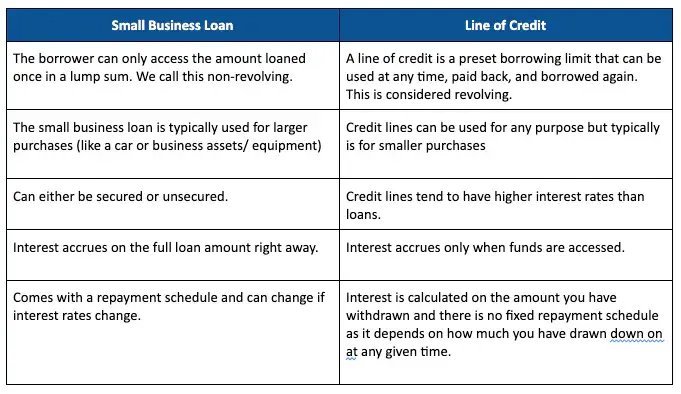
The difference between a business loan and a line of credit: a loan gives you a lump sum you repay on a fixed schedule (best for one-time investments); a line of credit gives you revolving access you draw as needed (best for cash-flow gaps and flexibility). Same toolbox, different tools — using the wrong one is expensive.
I’ve seen businesses take loans for cash-flow problems (overpaying massively) and credit lines for equipment (never paying it down). Here’s how to choose right.
How Each One Works
- Term loan: borrow $50,000 → receive $50,000 → repay over 3-5 years at fixed monthly payments, fixed interest rate. Interest accrues on the full amount from day one. Typical rates: 6-12% (bank/SBA) to 15-30%+ (online lenders). Best for: equipment, expansion, renovations — specific, one-time, revenue-generating investments.
- Line of credit (LOC): approved for $50,000 → draw $8,000 when needed → repay → draw again. Interest accrues only on what you’ve drawn. Typical rates: 7-15% variable. Best for: bridging cash-flow gaps — seasonal dips, waiting on receivables, inventory before a busy season. The seasonal business essential.
- The core distinction: loans are for things; credit lines are for timing. Buying an oven? Loan. Covering payroll while a big client pays late? Line of credit.
- SBA versions: SBA 7(a) loans (up to $5M, best rates, slow approval) and SBA CAPLines (credit lines up to $5M for seasonal/contract/working-capital needs) — the gold standard if you qualify.
Cost Comparison: Real Numbers
Borrow $30,000 for a year at 10%:
- Term loan: ~$2,750/month × 12 = ~$33,000 total. Interest paid: ~$1,650 (roughly — amortization front-loads interest). You pay for the full $30k all year.
- Line of credit (drawn $10k average): interest on $10,000 average balance ≈ ~$1,000/year. Plus possible annual maintenance fees ($100-$250) and draw fees on some lines.
- The lesson: for intermittent needs, the LOC costs far less — you only pay for what you use. For a lump investment you deploy immediately, the loan’s structure fits better.
- Hidden costs to compare: origination fees (1-5% on loans), annual LOC fees, draw fees, prepayment penalties on loans (some charge for paying early!), and variable-rate risk on LOCs (rates rise with the market).
When to Choose Which (Decision Rules)
- Choose a TERM LOAN when: buying equipment or property; funding a specific expansion (new location, renovation); you need a large amount disbursed at once; you want predictable fixed payments for budgeting; the investment has a clear multi-year payoff.
- Choose a LINE OF CREDIT when: managing cash-flow timing (seasonal gaps, late-paying clients); covering short-term needs you’ll repay within months; you want a safety net for surprises; inventory purchases before peak seasons; bridging to a known incoming payment.
- Many healthy businesses carry BOTH: a term loan for the oven, a credit line for the slow months. They’re complementary, not competitors.
- Never use for: covering persistent operating losses (that’s a business-model problem — debt just delays the reckoning); either product from predatory online lenders at 30%+ without reading every term.
Qualifying: What Lenders Actually Want
- Credit score: 680+ opens bank/SBA options; 600-680 lands online lenders at higher rates; under 600 means secured options or building first (business credit building).
- Time in business: banks typically want 2+ years; online lenders 6-12 months; SBA microloans work for newer businesses.
- Revenue: most lenders want $100k+/year for LOCs, $50k+ for small loans. Debt-service coverage ratio (can cash flow cover payments 1.25x?) is the key metric.
- Collateral: secured loans/lines (backed by equipment, property, receivables) get better rates; unsecured costs more. Read personal-guarantee terms — most small-business lending requires one regardless.
- Pro tip: apply for the line of credit when you don’t need it — strong financials, peak season. Lenders lend to people who don’t desperately need it. Arrange the umbrella before the rain.
Mistakes That Cost Real Money
- Using a loan for cash-flow gaps: paying interest on the full amount for a timing problem — the LOC exists for this.
- Using a credit line for long-term investments: revolving debt that never revolves down becomes very expensive permanent debt. If the balance never drops, convert to a term loan.
- Ignoring the fine print: prepayment penalties, variable-rate clauses, covenant requirements (maintain X cash balance), and confession-of-judgment clauses (some online lenders — never sign these).
- Stacking online loans: multiple high-interest online loans compound into a death spiral — the #1 small-business debt trap. If you’re stacking, stop and talk to an SBA lender or nonprofit counselor (SCORE, SBDCs — free).
- Borrowing without a repayment plan: every dollar borrowed needs a named repayment source and date. “We’ll figure it out” is how businesses die indebted.
The disciplined approach: term loans for assets, credit lines for timing, both arranged from strength, neither used to mask a broken model. And build the business credit that earns you better terms over time. The SBA’s loan programs page details government-backed options.
Keep Reading
If this was useful, you might also like business credit building and seasonal cash flow.
The Bottom Line
Loan = lump sum for one-time investments (equipment, expansion), fixed payments, interest on everything from day one. Line of credit = revolving access for timing gaps (seasonality, late receivables), interest only on what’s drawn. Healthy businesses often carry both. Apply for credit when strong (not desperate), read every clause (especially prepayment penalties and personal guarantees), and never borrow to mask a broken business model.
Frequently Asked Questions
Can I get a business line of credit with bad credit?
Difficult from banks (usually 680+). Options: secured lines (collateral-backed), online lenders (higher rates, 600+), or build first — 6-12 months of business credit building plus improving personal credit opens real options.
How much line of credit can a small business get?
Typically 10-20% of annual revenue for unsecured lines — a $500k-revenue business might qualify for $50k-$100k. SBA CAPLines go higher with stronger financials and collateral.
Is a business line of credit better than a credit card?
Usually yes for larger needs: lower rates (7-15% vs 18-25%+), higher limits, and interest-only payment options. Cards win for small purchases with rewards and grace periods. Use each for its strength.