
Four years, six figures of debt, and a diploma of uncertain value — the traditional college pitch is losing its monopoly. Meanwhile, trade schools quietly produce electricians earning $70,000+, welders in six-figure demand, and plumbers who’ll never worry about AI taking their jobs. In 2026, with skilled trades facing massive worker shortages and college costs still climbing, the question isn’t whether trade school is “settling” — it’s whether it’s the smartest educational investment available. Here’s the complete, hype-free breakdown.
What Trade Schools Actually Are
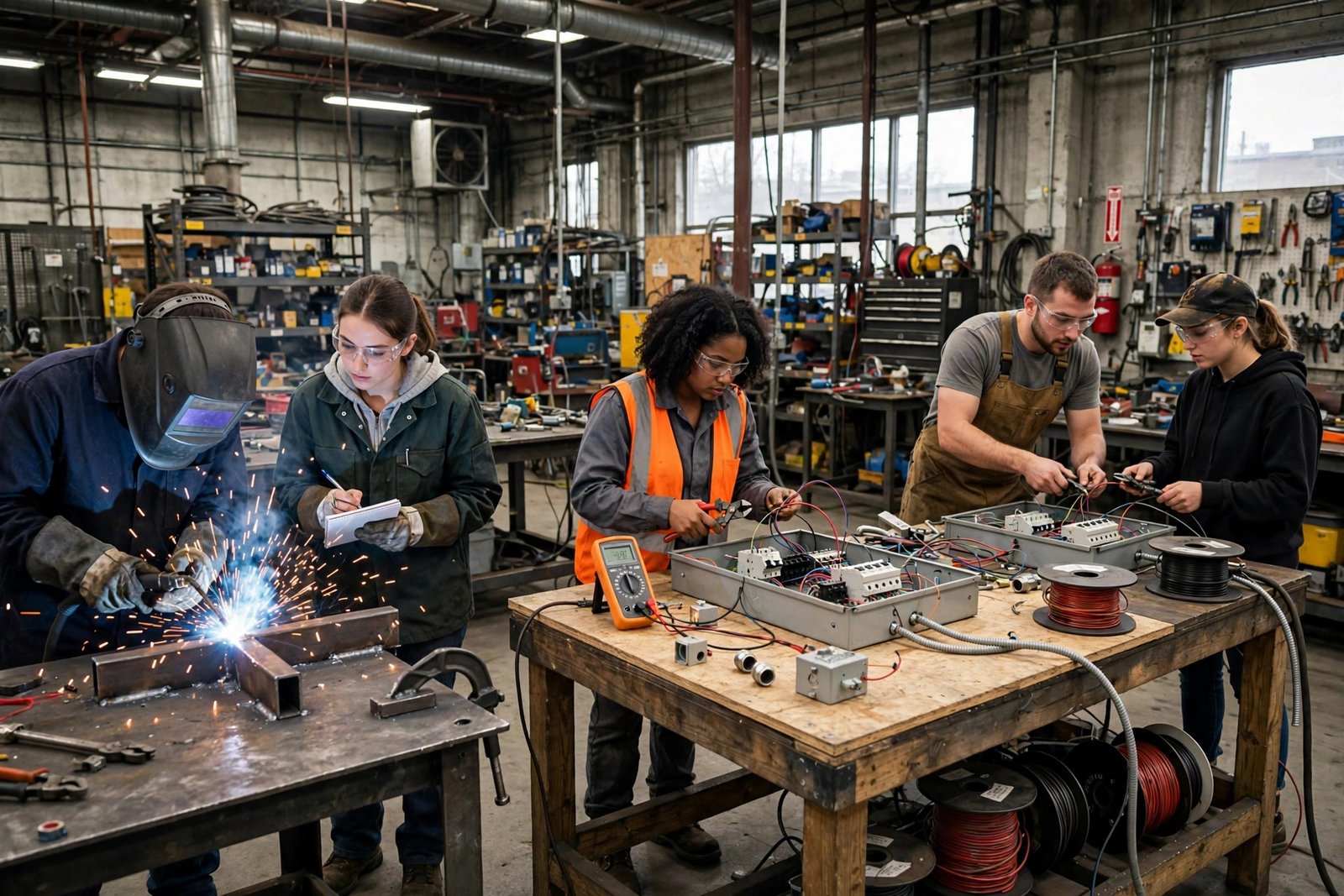
Trade schools (vocational/technical schools, community college career programs) provide focused, hands-on training for specific skilled occupations — typically 6 months to 2 years, not 4. The major trades: electrical, plumbing, HVAC, welding, automotive/diesel technology, carpentry, and construction trades. Plus allied paths: dental hygienist, radiologic technologist, licensed practical nurse, commercial driving, aviation maintenance, and cosmetology.
The training model differs fundamentally from college: you learn by doing, in shops and labs mirroring real workplaces, often with apprenticeship components where you earn while learning. There’s no “general education” filler — every hour targets employable skill. Class sizes are typically smaller, instructors are working tradespeople rather than career academics, and the curriculum updates with industry practice rather than academic fashion. Programs typically cost $5,000–$20,000 total (community college programs often less), versus $100,000+ for a four-year degree. Many are eligible for federal financial aid, and union apprenticeships frequently pay you from day one.
Apprenticeships: The Best-Kept Secret
Registered apprenticeships — through unions (IBEW for electricians, UA for plumbers/pipefitters) or employers — combine paid on-the-job training with classroom instruction over 3–5 years. You earn while you learn, graduate with zero debt and a journeyman credential, and enter a trade with negotiated wages. The Department of Labor’s apprenticeship portal at apprenticeship.gov lists programs by location and trade — it’s the single most underused career resource in America.
The Economics: The Numbers Favor the Trades
Let’s do honest math. Trade school graduate: $15,000 in training costs, earning $45,000–$60,000 by age 21–22, reaching $70,000–$100,000+ as a journeyman/master within 5–8 years — with zero or minimal debt. College graduate: $100,000+ in costs (often debt), earning $0 until age 22, starting at $50,000–$65,000 in many fields, reaching comparable wages years later while servicing loans.
The Bureau of Labor Statistics’ Occupational Outlook Handbook at bls.gov/ooh confirms the demand side: electricians, plumbers, HVAC technicians, and wind turbine technicians all show strong projected growth, driven by retirements (the skilled trades workforce is aging out fast), infrastructure spending, and the green energy transition. Median pay for electricians exceeds $60,000 nationally, with experienced tradespeople in high-demand markets clearing six figures. And the work is AI-resistant in a way desk jobs aren’t — robots aren’t rewiring houses anytime soon.
The Shortage Premium
America faces a shortage of hundreds of thousands of skilled tradespeople, and it’s worsening as experienced workers retire. Shortages mean leverage: signing bonuses, overtime availability, entrepreneurial opportunity (the plumber who starts their own shop), and wage growth outpacing many white-collar fields. When everyone goes to college, the scarce skill commands the premium — basic economics working in trades’ favor for the first time in generations.
When Trade School Beats College (and When It Doesn’t)
Trade school wins when: you want hands-on work, you value earning sooner with less debt, your target trade shows strong local demand, you like the idea of eventual self-employment (trades are among the easiest paths to owning a business), or college’s cost-benefit math doesn’t work for your intended major. It’s also the better choice for students who learn by doing rather than by lecture — forcing a kinesthetic learner through four years of lectures is educational malpractice.
College wins when: your target career legally requires a degree (medicine, law, engineering licensure, teaching), you’re drawn to fields with no trade equivalent (research science, academia, many tech roles), or you genuinely want the broad education and network. The mistake isn’t choosing college — it’s choosing expensive college for a low-paying field without doing the ROI math.
The hybrid path: Many successful people do both sequentially — trade first (earning and debt-free by 22), degree later (paid for by trade earnings, pursued with mature focus). The electrician who becomes an electrical engineer at 28 has practical knowledge no classroom-only peer possesses. There’s no rule saying education happens once, in order, at 18.
Choosing a Good Program (Avoiding the Traps)
Not all trade schools are equal, and the for-profit sector has a checkered history. Vet programs ruthlessly: accreditation (check the Department of Education database), job placement rates (demand specific numbers, not vague claims), employer partnerships (good programs have waiting employers), hands-on hours (more shop time = better), total cost vs. expected starting wage (never borrow $30,000 for a $35,000 starting wage), and licensing preparation (the program should prepare you for required state licenses).
Prefer community college programs and union apprenticeships — they’re cheaper, better regulated, and carry stronger employer relationships than most for-profit alternatives. Visit the shop facilities in person; the equipment quality tells you everything about the program’s seriousness. Ask to speak with recent graduates about their job placement experience — programs confident in their outcomes connect you willingly. And start building employability early: a strong resume and solid interview preparation matter as much for trade jobs as for office roles — skilled trades hire the professional, not just the hands.
Conclusion
Trade schools are a good alternative to college — often a better one — when the math favors them: 6–24 months of focused training, $5,000–$20,000 in costs, strong wages by your early twenties, massive worker shortages creating leverage, and genuine AI resistance. They’re not “settling”; they’re a different, often superior investment for hands-on learners and anyone who values earning over credentialing. Do the ROI math for your specific situation, vet programs ruthlessly, seriously consider apprenticeships — and choose the path that builds the life you want, not the one the culture defaulted to. The best career decision is an informed one, whichever direction it points.
Frequently Asked Questions
How much does trade school cost?
Typically $5,000–$20,000 total for the full program — far less than a four-year degree. Community college programs are often cheapest, and union apprenticeships frequently pay you while you train, resulting in zero net cost.
How long does trade school take?
Most programs run 6 months to 2 years. Apprenticeships run longer (3–5 years) but you’re earning wages throughout, graduating as a journeyman with experience and no debt.
Do trade school graduates earn good money?
Yes — median pay for electricians and plumbers exceeds $60,000 nationally, with experienced tradespeople in high-demand markets earning $80,000–$100,000+. The skilled trades shortage gives workers unusual wage leverage.
Is trade school better than college?
It depends on the person and the field. Trade school wins on cost, speed to earnings, and debt avoidance for hands-on careers; college wins for fields requiring degrees and for students wanting broad academic education. Many people ultimately benefit from understanding both paths before committing. Do the ROI math for your specific situation.
Can AI replace trade jobs?
Not meaningfully in the foreseeable future. Electrical work, plumbing, HVAC, and welding require physical dexterity, on-site problem-solving, and adaptation to unique environments — capabilities far beyond current robotics. Trades are among the most automation-resistant careers, and the physical world isn’t getting any simpler to work in.