Inside Robbie Williams’s $300 Million Fortune
The Short Version
Robbie Williams stands as one of the biggest-selling solo artists of his era, and Celebrity Net Worth values Robbie Williams’s net worth at $300 million, a figure a live re-read in November 2026 confirmed. Williams joined Take That at sixteen, left in a blaze of headlines in 1995, and then outsold his old band many times over as a solo act, stacking era-defining singles and stadium tours across three decades. His sixteenth UK number-one album, BRITPOP, arrived in January 2026, and he toured it through the year, playing Sydney as recently as mid-November 2026. He married Ayda Field in 2010, renewed his vows with her in 2024, and raises four children with her. The fortune rests on record sales above 75 million, songwriting royalties, and some of the largest live grosses any performer from his home country has ever generated.
A sterling estimate derived from the Sunday Times Rich List puts him near £230 million, roughly $290 million, and this profile shows it as a broadly comparable second reading rather than averaging the two. His famous 2002 EMI deal carried an £80 million headline, and that number measures a multi-album contract value, not a payment and not net worth. The sections below keep each figure in its box.
How They Got There
1990–1995 — Take That and the Exit
Williams auditioned for a new boy band in 1990 at sixteen and won the final place in Take That. The group conquered the pop charts with Pray, Back for Good, and a run of number-one singles, and Williams played the cheeky joker of the five. Creative frustration and a lifestyle spinning out of control pushed him out in July 1995, weeks before the band’s tour ended, and newspapers treated the exit as career suicide. He spent a year in the wilderness of headlines and parties, then resurfaced with a cover of “Freedom” in 1996 that hinted at the solo career to come. The band he left split within a year; the singer everyone wrote off had barely started.
1997–2002 — Life Thru a Lens to Escapology
Life Thru a Lens arrived in 1997 slowly, then “Angels” — a ballad he co-wrote with Guy Chambers — turned the album into a phenomenon and gave him a signature song for life. I’ve Been Expecting You followed in 1998 with “Millennium” and “No Regrets,” Sing When You’re Winning in 2000 with “Rock DJ,” and Swing When You’re Winning in 2001, a big-band album that sold enormously and filled arenas with a Rat Pack show. Escapology closed the run in 2002 with “Feel” and “Something Beautiful,” and Williams signed the famous EMI contract that year. Across six years he moved from boy-band escapee to the country’s biggest star, and the songwriting partnership with Chambers produced a catalogue that still pays him daily.
2003–2012 — Knebworth, Rudebox, and the Reunion
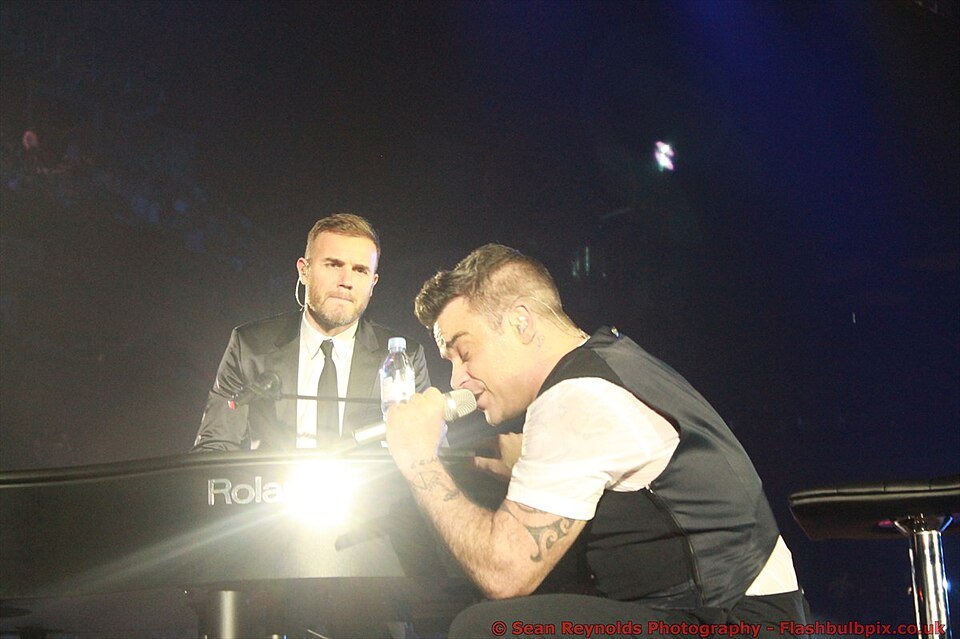
Williams played Knebworth in August 2003 across three nights to 375,000 people, a live peak few acts from his home country have ever matched. Intensive Care arrived in 2005, and Rudebox in 2006 divided critics and slowed his momentum for the first time. Reality Killed the Video Star in 2009 steadied the ship, and then came the reunion nobody predicted: Take That regrouped with Williams for Progress in 2010, the fastest-selling album of the century in Britain at that point, and a stadium tour that broke box-office records. He played the returning hero perfectly, sharing stages with the four men he had left fifteen years earlier, and his bandmate Gary Barlow shared writing credits with him again as the old partnership thawed. Solo album Take the Crown followed in 2012 with “Candy,” another number-one single.
2013–2026 — The Elder Statesman of Pop
Swings Both Ways arrived in 2013, The Heavy Entertainment Show in 2016, and a festive album in 2019, each debuting high and each feeding a touring machine that sells out arenas and stadiums on multiple continents. His XXV collection in 2022 reworked the catalogue with an orchestra and returned him to number one. BRITPOP, released in January 2026, became his sixteenth UK number-one album, a solo-artist record, and the Guardian and the Financial Times both marked the milestone. He toured the album through 2026 and played Sydney concerts on 15 and 16 November. At 52 he occupies a position closer to a national institution than a pop star, and the catalogue earns like one too.
The Chambers partnership deserves its own examination, because it generated the catalogue at the centre of the fortune. Williams and Guy Chambers wrote quickly, often finishing songs in a day, and their run from 1997 to 2002 produced “Angels,” “Let Me Entertain You,” “Millennium,” “No Regrets,” “Rock DJ,” and “Feel” — a hit rate few writing pairs in pop history match. Williams owned a strong share of his publishing from those years, and “Angels” alone earns like a small company: weddings, talent shows, radio staples, and cover versions keep the song in permanent rotation three decades on. The pair reunited for later projects, and their early catalogue anchors his streaming numbers today, introducing his voice to listeners who never saw the Knebworth era. When accountants model his fortune, the publishing column usually leads the spreadsheet, ahead of even the touring machine — a quiet fact that explains the $300 million better than any single headline deal.
Where It Began
Robert Peter Williams arrived on 13 February 1974 in Stoke-on-Trent. His father, Peter Williams, performed as a comedian under the name Pete Conway and later ran pubs as a licensee, and his mother, Janet Farrell, raised the children through the couple’s separation during his early years. Stage blood ran in the family, and young Robbie performed in school productions and local theatre, chasing laughs and applause from an early age. He left school with modest results, sold double glazing briefly, and answered the audition call that produced Take That. Stoke claims him proudly, and he returns the affection, supporting local causes and speaking of the city as the making of his humour and his drive. The pub-stage childhood explains the performer: he learned timing in rooms where audiences owed him nothing.
The Fortune in Full
Houses
Property reporting tracks several major transactions, all at reported prices: Woodland House in London, bought in 2016 for a reported £17 million; Compton Bassett House in Wiltshire, bought in 2009 for a reported £8.5 million and sold about a year later; a Beverly Crest home in Los Angeles, sold in 2022 for a reported $75 million; and a Holmby Hills property, sold in 2024 for a reported $65 million. This profile claims no combined property total, because the transactions span decades and currencies.
The $300 million from Celebrity Net Worth gathers record sales, the Chambers-era songwriting catalogue, Knebworth-scale touring, the Progress reunion grosses, and decades of licensing into one estimate. The Sunday Times-derived figure near £230 million lands in the same territory once currency conversion enters the calculation, and the agreement between the two methods strengthens confidence in the range. The EMI contract figure belongs in neither column: it valued a multi-album commitment in 2002, and journalists who quote it as wealth misread a contract as a bank balance.
His live operation runs like a touring institution. Williams employs a long-serving band and crew, rehearses productions to arena scale months ahead, and sells tickets across Europe, Australia, and Latin America at prices his audience pays without blinking. The Britpop tour of 2026 extended that run into a fourth decade of headline touring, and promoters report demand holding at levels most of his contemporaries lost years ago. He also monetised his catalogue cleverly without surrendering it: the XXV orchestral reworkings created new masters he controls, and licensing income from his standards flows steadily from advertising, talent shows, and sporting events. Merchandise at his shows sells at volumes closer to a football club than a concert act, a detail his Stoke upbringing would appreciate. Taken together — publishing, touring, licensing, merchandise — the fortune’s structure explains its durability: four engines, any two of which could sustain the headline figure alone.
Life Away from the Job
Williams married Ayda Field on 7 August 2010 at their Los Angeles home, and the couple renewed their vows in 2024. They raise four children: Theodora, who arrived in 2012; Charlton, who arrived in 2014; Colette, who arrived in 2018 with a surrogate carrying her; and Beau, who arrived in 2020, also with a surrogate carrying him, a family-building route the couple discuss openly. His Take That years still shape his friendships, and his bandmate Gary Barlow, the group’s principal songwriter, shares a bond with him that survived the split, the feud years, and the reunion — readers can trace the other side of that story in Gary Barlow’s net worth profile. Williams speaks candidly about addiction, anxiety, and recovery, and his honesty on those subjects forms a large part of his public standing now. He posts as @robbiewilliams on Instagram, mixing tour photographs, family moments, and self-deprecating humour for millions of followers.
His candour about his own history shapes the fortune’s protection, oddly enough. Williams discusses addiction and mental health with a frankness that once risked his commercial standing and now anchors it: audiences trust him, broadcasters book him, and brands that fear scandal read his honesty as stability. He also built guardrails — a settled family life, a long-serving team, and business structures that separate the man’s money from the performer’s impulses. The teenage star who burned through his first peak’s earnings in public learned the lesson completely, and the second half of the career shows the discipline in every line of the account: assets bought, catalogue kept, tours delivered, family provided for across generations.
And Finally
Williams’s career arc reads like a dare: leave the biggest band in the country at its peak, survive the wilderness, outsell everyone, burn out, reunite, and then outlast the entire era. The $300 million fortune prices that arc honestly. Songwriting royalties and the live machine keep it growing even as the industry around him transforms.
Sixteen number-one albums and a 2026 stadium calendar say the story continues. Promoters already discuss the next touring cycle while the current one still runs, and his catalogue’s streaming growth shows a catalogue still recruiting new listeners rather than merely retaining old ones.
The entertainer from Stoke built one of pop’s great fortunes, and he built it the old way — on stage, in front of people, night after night.
The Scoop File
| The Scoop File | Details |
|---|---|
| Born | 13 February 1974, Stoke-on-Trent |
| Age | 52 |
| Height | 5 ft 11 in (listings vary up to 6 ft 1 in) |
| Net Worth | $300 million (Celebrity Net Worth) |
| Weight | No reliable published figure exists |
| Wife | Ayda Field (married 7 August 2010) |
| Children | Theodora, Charlton, Colette and Beau |
| Parents | Peter Williams and Janet Farrell |
| @robbiewilliams |