Phil Collins and the $350 Million Fortune Behind the Drums
The Short Version
Phil Collins drummed, sang, and wrote his way to one of the largest fortunes in popular music. Celebrity Net Worth puts Phil Collins’s net worth at $350 million, and the site confirmed that figure again in a live re-read in November 2026. Collins joined Genesis as drummer in 1970, took over lead vocals in 1975, and then ran two giant careers at once: Genesis frontman through the 1980s and solo star with a run of hits that few artists in history match. He lives mainly in Switzerland now, manages serious health problems with round-the-clock care, and still makes headlines — he entered the Rock & Roll Hall of Fame in person as a solo artist on 14 November 2026, arriving with his family and walking with two canes. Five children, three marriages, and one of the great songwriting catalogues of the rock era fill out the story below.
Two big numbers in his orbit need careful labels. A 2022 catalogue transaction with Concord carried a reported $300 million price, but that deal covered a joint Collins, Tony Banks, and Mike Rutherford catalogue package, so this profile never presents it as Collins’s personal wealth. Forbes also counted $45 million for him in 2020, and that figure measures one year’s earnings, not net worth. The $350 million headline stands on Celebrity Net Worth’s estimate alone, attributed every time.
How They Got There
1970–1975 — The Drummer Arrives
Collins answered a newspaper advertisement in 1970 and won the drummer’s seat in Genesis, a young progressive rock band building a cult following. He drummed on albums including Nursery Cryme, Foxtrot, and Selling England by the Pound, and he sang backing vocals that producers increasingly pushed forward. Peter Gabriel left the band in 1975, and the remaining members auditioned singer after singer before they turned to their own drummer. Collins stepped to the microphone for A Trick of the Tail in 1976, and the band survived a transition that critics expected to kill it. His voice, warmer and more direct than his predecessor’s, opened the band to a wider audience.
1980–1985 — Face Value and the Solo Explosion
Collins released his first solo album, Face Value, in 1981, and “In the Air Tonight” announced a solo star of the first rank. Hello, I Must Be Going! followed in 1982, and Genesis released their self-titled album in 1983 with “Mama” and “That’s All” riding high. He produced other artists, drummed for friends across the industry, and seemed to appear on every major record of the era. No Jacket Required arrived in 1985 and sold enormously on the strength of “Sussudio,” “One More Night,” and “Take Me Home.” That summer he played Live Aid on two continents in one day, performing his own set at Wembley, joining Sting’s set at the same stadium, then flying to Philadelphia to play again. The schedule sounds impossible now, and it fixed his reputation as the hardest-working man in rock.
1986–1996 — Invisible Touch and the Peak Years
Genesis released Invisible Touch in 1986, and the album made the band stadium giants in America, with the title track giving them their only American number-one single. Collins balanced the band with solo albums …But Seriously in 1989, which carried “Another Day in Paradise,” his biggest solo single and a Grammy winner. We Can’t Dance arrived in 1991 as his final studio album with Genesis, and Both Sides in 1993 showed him writing and playing nearly everything himself. He left Genesis in 1996 to focus on solo work and big-band projects, closing a 26-year run that had carried him from club drummer to global frontman. The earnings across those sixteen peak years — albums, tours, songwriting, production — built the bulk of the $350 million.
2007–2026 — Reunions, Farewells, and Honours
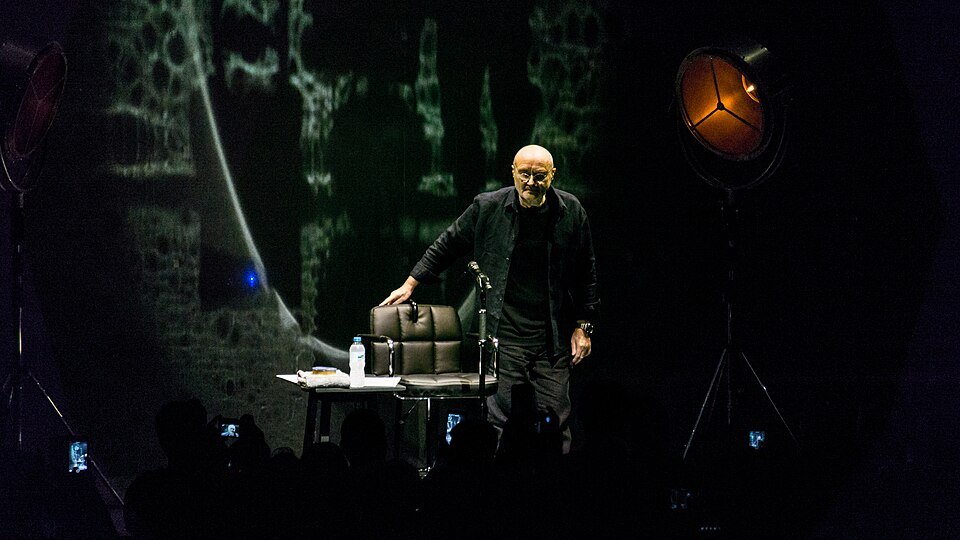
Genesis reunited for the Turn It On Again tour in 2007, and Collins drummed until a spinal injury from that tour damaged the nerves in his hands. He announced a retirement from drumming, returned with the Not Dead Yet tour in 2017, and sang seated while his son Nicholas drummed behind him. Genesis played their final shows on The Last Domino? tour, ending in London in March 2022, with Collins singing from a chair and the audience carrying him through every chorus. He sold his Miami Beach home in 2021, lives principally in Switzerland, and manages his health with a live-in nurse, a fact he discussed openly with the BBC in January 2026. The Hall of Fame induction in November 2026 gave the story a fitting late chapter: the industry honoured the solo career in person, and he attended with family around him.
His drumming alone would fill a career. Collins reshaped the sound of 1980s records with the gated-reverb drum effect he stumbled into during a Peter Gabriel session, and producers across the industry chased that sound for a decade. He drummed on records by Brian Eno, Robert Plant, and Eric Clapton, played with the jazz-fusion outfit Brand X on the side, and still found hours to write the solo material that became Face Value. Session fees and production work from those years added a working musician’s income beneath the star income, and his reputation as the drummer other drummers studied kept the calls coming. When Genesis inducted him into the Rock & Roll Hall of Fame as a band member in 2010, the citation recognised the group; the solo induction in November 2026 recognised the full span — drummer, singer, songwriter, producer — and few musicians in history hold both honours as the central figure of each story.
Where It Began
Philip David Charles Collins arrived on 30 January 1951 in Chiswick, London. His father, Greville Philip Austin Collins, worked in insurance, and his mother, Winifred June Collins, née Strange, worked as a theatrical agent, and the household mixed ordinary jobs with stage connections. Young Phil acted on stage as a child, played the Artful Dodger in a London production of Oliver!, and received a toy drum kit at five that redirected his life. He practised obsessively, played in school bands, and chose music over acting while still a teenager. His father died in 1972, just as Genesis began to climb, and his mother lived until 2011, long enough to watch her son conquer the industry twice over. Chiswick gave him his start, but the drum kit gave him his trade, and he never really left it.
The Fortune in Full
Houses
Collins bought a Miami Beach home in 2015 for a reported $33 million and sold it in 2021 for a reported $40 million, and those reported prices bookend his American years. His principal home sits in Switzerland near Lake Geneva, and he keeps his life there deliberately quiet. This profile claims no combined property total, because reliable reporting covers individual transactions only.
The fortune itself rests on four pillars. Songwriting royalties lead the list: Collins wrote or co-wrote dozens of standards, and radio, streaming, and licensing pay him every year. Record sales follow, across solo albums that sold in the tens of millions and Genesis releases that still move steadily. Touring added enormous grosses in the 1980s and 1990s, when he played stadiums with Genesis and arenas under his own name in the same years. The 2022 Concord transaction converted part of the catalogue into capital, though the joint structure of that deal means nobody should read its $300 million headline as his personal bank balance. Celebrity Net Worth’s $350 million estimate gathers all of this into one number, and this profile attributes it to them throughout.
The songwriting catalogue deserves its own paragraph in any account of the fortune. Collins wrote “In the Air Tonight,” “Against All Odds,” “Another Day in Paradise,” and “You’ll Be in My Heart” — the last of those won him an Academy Award — and he co-wrote the Genesis standards that stadiums still sing back at tribute acts nightly. Songs of that durability generate income in every format the industry invents: radio, streaming, licensing for advertisements and dramas, and cover versions by younger artists. His publishing position on the solo catalogue stayed strong through his career, which means the royalties flow to him rather than to a company that bought him cheaply in 1970. The Concord transaction monetised part of that catalogue at a joint headline of $300 million, and even shared three ways among the Genesis principals and their structures, a transaction of that scale underlines why Celebrity Net Worth holds its estimate at $350 million rather than lower.
Life Away from the Job
Collins married three times, and his family spans two generations. He married Andrea Bertorelli in 1975, and they raised Joely, whom he adopted, and their son Simon before the marriage ended in 1980. He married Jill Tavelman in 1984, and their daughter Lily arrived in 1989 before the marriage ended in 1996. He married Orianne Cevey in 1999, and their sons Nicholas and Matthew arrived in 2001 and 2004; that marriage ended in a 2008 settlement, the couple reconciled in 2016, and they split finally in 2020. A relationship with Dana Tyler ran from about 2007 to 2016. No confirmed current partner exists in the verified record, and his assistant Lindsay Evans holds a professional role only. His Live Aid partner that famous day in 1985 still draws comparisons with him, and readers can explore Sting’s net worth profile for the other half of that Wembley moment. Nicholas now drums professionally, Lily works as an actor, and Collins speaks of all five children with open pride whenever interviewers ask.
His influence reaches beyond the balance sheet, and it feeds the catalogue’s value. Drummers across three generations cite his Genesis and solo playing as foundational, singers cover his ballads in every talent-show season, and his songs anchor wedding playlists and drama soundtracks worldwide. Each cover, each sync placement, each talent-show performance pays the writer again, which is why catalogues like his command nine-figure transaction prices. Younger artists sample his drum sounds and interpolate his melodies, introducing the catalogue to audiences who never bought a Genesis record. The Hall of Fame induction in November 2026 formalised what the royalty statements already said: this body of work sits in the permanent collection of popular music, and permanent collections keep earning.
And Finally
Collins stands almost alone in rock history: a drummer who became a frontman, a frontman who ran two superstar careers in parallel, and a songwriter whose work fills both the Genesis catalogue and a solo catalogue of equal weight. The $350 million figure reflects that double achievement, and it also reflects forty years of relentless work before his body forced a slower pace.
His health limits him now, and he performs no longer, but the honours keep arriving and the catalogue keeps earning. The boy from Chiswick with the toy drum kit built one of music’s great fortunes, and he built it from the back of the stage, one song at a time.
The Scoop File
| The Scoop File | Details |
|---|---|
| Born | 30 January 1951, Chiswick, London |
| Age | 75 |
| Height | 5 ft 6 in |
| Net Worth | $350 million (Celebrity Net Worth) |
| Weight | No reliable published figure exists |
| Partner | No confirmed current partner |
| Children | Joely, Simon, Lily, Nicholas and Matthew |
| Parents | Greville Philip Austin Collins and Winifred June Collins (née Strange) |
| @officialphilcollins |