
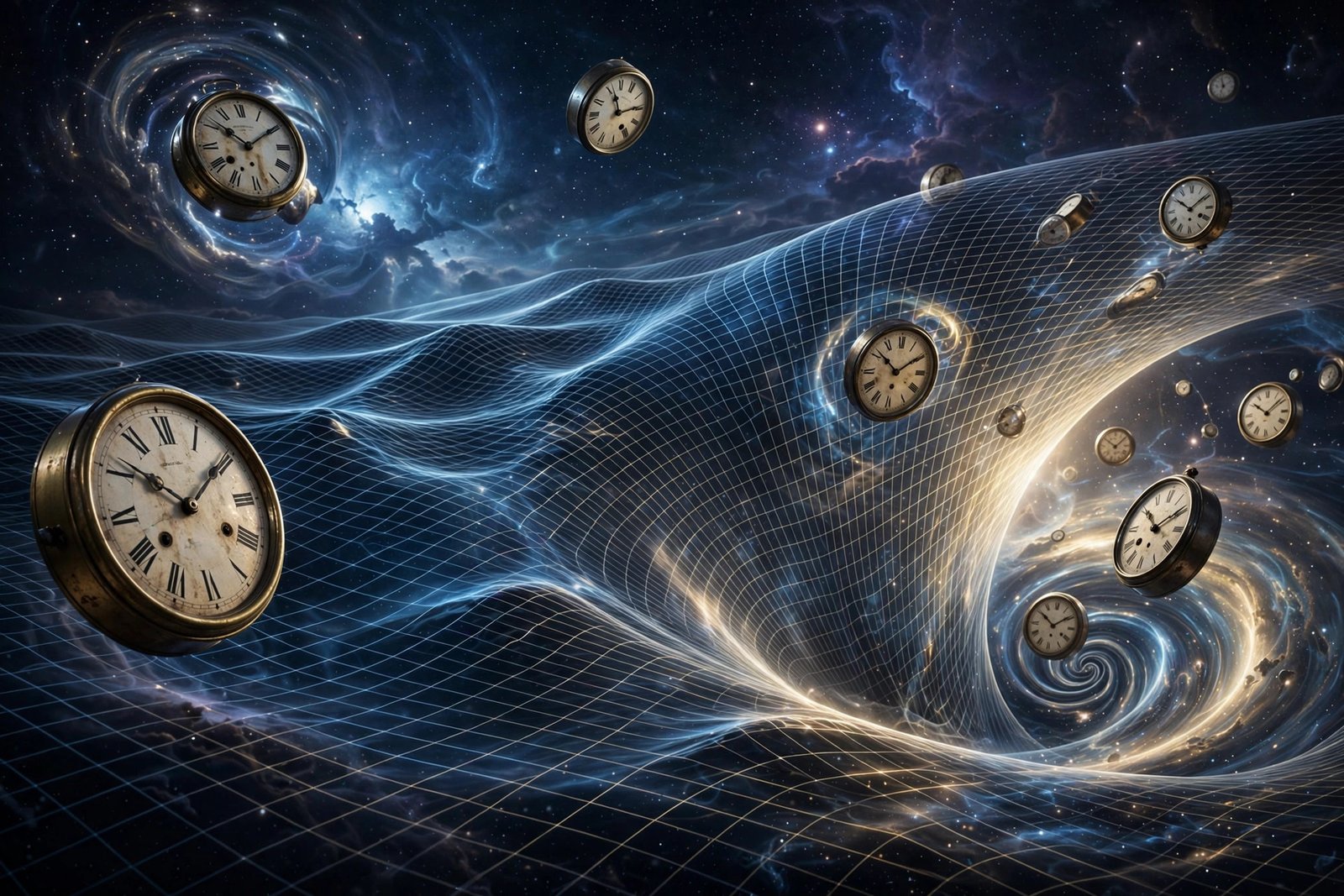
Time travel is science fiction’s favorite playground — DeLoreans, phone booths, and Avengers-style heists. But beneath the fiction sits a serious physics question: do the laws of nature actually permit it? The answer is more interesting than a simple yes or no. Einstein’s relativity doesn’t just allow a limited form of time travel — it requires it, and we’ve measured it. But the kind most people mean — going back to change the past — runs into paradoxes and physical barriers that may be fundamental. Here’s what physics actually says, where the line sits between confirmed and speculative, and why the distinction matters.
Forward Time Travel: Confirmed, Measured, Routine
Traveling into the future is real, and it happens constantly. Einstein’s special relativity shows that time passes more slowly for objects moving at high speed relative to a stationary observer — time dilation. The effect is tiny at everyday speeds but enormous near light speed. The classic illustration: the twin paradox, where one twin rockets away at near-light speed and returns to find their Earth-bound sibling aged decades while they’ve aged months. It’s called a paradox, but there’s no contradiction — it’s a confirmed prediction, measured with atomic clocks flown on airplanes and observed in muons (subatomic particles) that live longer when moving fast because their internal “clocks” run slow.
General relativity adds gravitational time dilation: time passes more slowly in stronger gravity. GPS satellites, orbiting in weaker gravity than Earth’s surface, have their clocks run fast relative to ground clocks — engineers correct for both special-relativistic slowing (from orbital speed) and general-relativistic speeding (from weaker gravity), a net ~38 microseconds per day. NASA’s explanations of relativity cover how these corrections keep the whole system honest — without them, GPS positions would drift by kilometers daily. You are, right now, time-traveling into the future at slightly different rates depending on your altitude and speed. The effect is real; it’s just small. To travel years into the future, you’d need a significant fraction of light speed — physically permitted, technologically distant.
The black hole method
The most extreme forward time travel would use a black hole: hovering near (not inside) the event horizon, where gravity is immense, your time would crawl relative to the distant universe — you could watch millennia pass outside while experiencing hours. It’s the Interstellar scenario, and the physics is legitimate. The engineering — surviving the radiation, tidal forces, and accretion disk inferno — is the problem. Forward time travel is allowed; it’s just brutally impractical.
Backward Time Travel: Where Physics Gets Uncomfortable
Going back is a different beast. General relativity’s equations do contain solutions that permit closed timelike curves — paths through spacetime that loop back to their own past. Kurt Gödel found one in 1949 (a rotating universe), and Kip Thorne showed in the 1980s that traversable wormholes could theoretically function as time machines if one mouth were accelerated to relativistic speeds. NASA’s science pages on black holes and wormholes explain which of these ideas have observational support and which remain pure mathematics. These are valid mathematics — the equations don’t forbid them.
But “mathematically permitted” and “physically possible” are different claims. Every backward-time-travel scheme requires something we have no evidence for: exotic matter with negative energy density to hold wormholes open (quantum effects permit tiny negative-energy blips via the Casimir effect, but scaling that to a macroscopic wormhole is speculative in the extreme), or cosmic strings of impossible density, or a rotating universe we don’t inhabit. It’s like noting that the equations of flight permit a human to fly if they had wings with the strength of titanium and the weight of paper — true, and useless.
The Paradoxes: Logic’s Objections
Even setting engineering aside, backward time travel creates logical problems. The grandfather paradox: go back and prevent your own birth, and you couldn’t have gone back — contradiction. Physicists have proposed resolutions. The Novikov self-consistency principle argues the universe simply won’t permit paradoxical actions — any attempt would fail through ordinary-seeming coincidence (your gun jams, you slip), because only self-consistent histories can exist. Quantum mechanics offers another out: the many-worlds interpretation suggests traveling back would branch you into a parallel timeline, so you’d change a different universe’s past, never your own — no paradox, but no true “return to your past” either.
Then there’s the chronology protection conjecture — Stephen Hawking’s proposal that the laws of physics conspire to prevent closed timelike curves from forming, perhaps via quantum effects that destabilize any would-be time machine. It’s a conjecture, not a theorem, but it captures the field’s skepticism: the universe seems to abhor backward time travel, even if no single law explicitly bans it. If backward time travel fascinates you, thought-provoking science documentaries explore these ideas with the depth they deserve.
What Would It Take? The Honest Assessment
Ranking by plausibility: forward time travel via velocity or gravity — certain, demonstrated, just impractical at human scales. Wormhole time machines — mathematically valid, requiring exotic matter we can’t produce and may not exist at scale. Cosmic string time machines — requiring hypothetical objects we’ve never observed. Changing the past — blocked by paradoxes unless many-worlds branching or Novikov consistency saves the logic, in which case it’s not really “your” past anyway.
The deepest reason for skepticism may be thermodynamic: the arrow of time — entropy always increasing — gives time its direction, and reversing it locally would require decreasing the universe’s entropy, which the second law of thermodynamics forbids. Time’s one-way flow might be the most fundamental feature of reality, not a technical limitation. For now, the scientific consensus is: forward yes (in principle), backward probably never — and “probably” is doing honest work, because physics has surprised us before. Fans of cosmic mysteries will find great films exploring time and space a fun way to keep wondering.
Frequently Asked Questions
Has time dilation been proven experimentally?
Yes, repeatedly. Atomic clocks on fast aircraft tick slower than ground clocks (Hafele-Keating experiment, 1971, confirmed many times since), muons from cosmic rays live longer due to their speed, and GPS systems must correct for relativistic effects daily or fail. Time dilation is engineering fact, not theory.
Could we build a time machine in the future?
A forward time machine (near-light-speed ship) is physically possible but far beyond foreseeable engineering — the energy requirements are astronomical. A backward time machine requires exotic matter or cosmic structures we have no evidence for. “Future technology” can’t bypass missing physics.
What about the many-worlds solution to paradoxes?
If the many-worlds interpretation of quantum mechanics is correct, backward time travel might branch reality rather than rewrite it — you’d visit a parallel past, and your original timeline would be unchanged. It resolves the logic but means you can never truly return to your own past.
Why can’t we go faster than light to go back in time?
Special relativity shows that accelerating mass to light speed requires infinite energy — it’s not an engineering limit but a structural one. Tachyons (hypothetical faster-than-light particles) would imply backward time travel, but they’ve never been observed and would violate causality as we understand it.
Does quantum entanglement allow sending messages back in time?
No — despite “spooky action at a distance,” entanglement can’t transmit usable information faster than light, let alone backward in time. The correlations are real but uncontrollable; no signal, no message, no time phone.
Physics says yes to forward time travel — it’s measured, routine, and built into GPS — and “probably never” to backward time travel, blocked by missing exotic physics, thermodynamic law, and logical paradoxes. The DeLorean remains fiction; the atomic clock is fact. And honestly, the real version — that time itself is flexible, that your head ages faster than your feet — is stranger than most fiction dares.