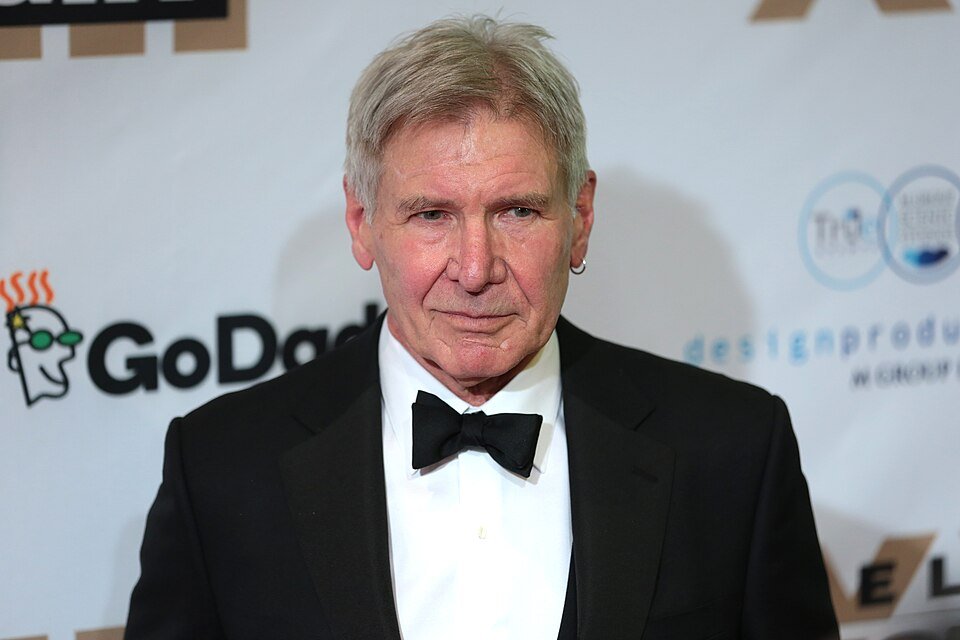
Harrison Ford at 84: What Five Decades of Blockbusters Built — a $350 Million Fortune
The Short Version
Harrison Ford spent a decade as a working carpenter who acted on the side, and then he played Han Solo, Indiana Jones and Rick Deckard inside six years and rewrote his life permanently. Celebrity Net Worth puts his fortune at $350 million, in a page the site updated in October 2026 and raised from its earlier $300 million figure. Many 2026 reports still cite the older $300 million, and this profile prints both numbers and dates them, because the disagreement itself tells readers how these estimates move. He is 84, he married actor Calista Flockhart in 2010, he counts five children, and he still works — a carpenter-turned-star who outlasted nearly every leading man of his generation.
No single salary built this fortune. Ford stacked franchise paydays across five decades, took points and profit shares when studios offered them, bought land early in Wyoming, and kept working long after most stars retire. The sections below follow that stack in order.
How They Got There
1966–1976: Bit Parts and a Tool Belt
Ford signed a studio contract in the mid-1960s and collected small, often uncredited roles while the studios underused him. He played a bellhop in Dead Heat on a Merry-Go-Round (1966) and drifted through television work for a decade. Frustrated, he taught himself carpentry and built cabinets and extensions for Hollywood households, a trade that paid better than acting and, famously, put him in front of director George Lucas as a workman rather than an applicant. Francis Ford Coppola cast him in The Conversation (1974) and later Apocalypse Now (1979). Lucas cast him in American Graffiti (1973) in a small role. The carpenter years matter to the money story: Ford entered stardom at thirty-four with a tradesman’s suspicion of luck and a habit of treating acting income as windfall rather than wage.
1977–1984: Solo, Jones and Deckard
Star Wars (1977) made him Han Solo and made him famous worldwide, though his salary on the first film stayed modest by later standards. The Empire Strikes Back (1980) and Return of the Jedi (1983) raised his price sharply. Steven Spielberg and Lucas then cast him as Indiana Jones in Raiders of the Lost Ark (1981), and the fedora became his second signature. Ridley Scott cast him as Rick Deckard in Blade Runner (1982), a film that underperformed on release and then grew into a classic that pays him in reputation to this day. Inside six years he fronted three franchises that still generate money and revivals half a century later. Very few actors in history hold three roles of that durability at once.
1985–1999: The Dramatic Peak and the $20 Million Years
Ford proved his dramatic range in Witness (1985), which earned him his only Academy Award nomination, and The Mosquito Coast (1986). He then settled into a run of adult thrillers that made him the defining leading man of the era: Working Girl (1988), Presumed Innocent (1990), Patriot Games (1992), The Fugitive (1993), Clear and Present Danger (1994), Sabrina (1995), Air Force One (1997) and Six Days, Seven Nights (1998). The Fugitive grossed more than $368 million worldwide and Air Force One more than $315 million, and Ford’s salary climbed into the $20 million-per-film bracket that only a handful of stars commanded. Celebrity Net Worth’s salary table for him totals roughly $300 million across his career — earnings, not wealth, and this profile labels the figure exactly that way.
2000–Today: The Elder Statesman Who Keeps Working
The 2000s mixed quieter dramas with franchise returns. He played Indiana Jones again in Kingdom of the Crystal Skull (2008) and The Dial of Destiny (2023), returned as Han Solo in The Force Awakens (2015), and revisited Deckard in Blade Runner 2049 (2017). He carried the adventure film The Call of the Wild (2020) and then, in his eighties, moved into television leads: the Yellowstone prequel 1923 and the comedy-drama Shrinking, which brought him some of the warmest reviews of his career. He also joined the Marvel universe in Captain America: Brave New World (2025). The work pattern explains the fortune’s late growth — Ford never took the long retirement that stops most actors’ income compounding.
Where It Began
Harrison Ford arrived on July 13, 1942, in Chicago, Illinois. His father, Christopher Ford, worked in advertising and had acted earlier in life. His mother, Dorothy Nidelman, had performed in radio drama. The family raised Harrison and his younger brother in the Chicago suburbs, and Ford attended Maine East High School in Park Ridge, where he took his first drama class in his final year, largely to overcome shyness. He studied philosophy at Ripon College in Wisconsin and left before graduating, signing his studio contract soon after. The biography’s hinge stays the carpentry decade: Ford built furniture for directors and musicians through the early 1970s, married his first wife Mary Marquardt in 1964, and kept auditioning between jobs until Lucas, who knew him as the man building his office doors, asked him to read Solo’s lines against other actors — and then cast the carpenter.
The Fortune in Full
Celebrity Net Worth raised its Ford estimate to $350 million in its October 2026 update. The site previously listed $300 million, and many 2026 reports continue to cite $300 million, so readers will meet both figures; the fresher count carries the later date and this profile headlines it while printing the older figure alongside. The composition differs from most fortunes in this series. Ford earned across an unusually long window — his first franchise payday arrived in 1977 and his television salaries continue in 2026 — and he converted earnings into land and long-held property rather than businesses. His Celebrity Net Worth salary table sums to roughly $300 million in career film earnings, a figure that excludes television, residuals and profit participations, and that this profile presents strictly as earnings history.
Two habits protected the pile. First, Ford worked in the profit-participation era and took backend shares on major hits, so The Fugitive and Air Force One paid him beyond their salaries. Second, he spent conservatively by superstar standards: aircraft, motorcycles and Wyoming land absorbed most of his visible indulgence, and none of those categories carries the burn rate of a yacht fleet or a gambling habit. The fortune grew the slow way, across fifty years of cheques that never really stopped.
The Houses
Ford’s signature property is his ranch near Jackson, Wyoming — roughly 800 acres of land he bought early in his fame and has held ever since, donating portions for conservation over the years. He keeps a base in Brentwood, Los Angeles, the city where his career and his wife’s career both run. No fuller current inventory has a reliable published record, and this profile claims none. The Wyoming purchase, made before the region’s land prices exploded, stands as the single smartest asset decision of his career, and characteristically, he made it as a home first and an investment second.
The Car Collection
Here the honest headline runs negative: no verified car inventory for Harrison Ford exists in any reliable published source, and this profile invents none. His documented mechanical passion points skyward instead. Ford holds pilot licences, flies fixed-wing aircraft and helicopters, and keeps a fleet at his Wyoming ranch that reporting over the years has described in detail; he also rides motorcycles and has flown rescue missions in Wyoming as a volunteer. Reporters who chase a car collection find a hangar instead. The bank’s car question gets its truthful answer in the table below: the collection readers imagine does not exist in any verifiable form, and the aircraft do.
The television chapter deserves its own line in the ledger, because it changed the fortune’s late shape. Ford resisted series television for fifty years, and streaming-era economics finally priced his resistance correctly: 1923 cast him as the patriarch of a prestige western, and Shrinking cast him against type as a gruff therapist, and both productions paid headline salaries to secure a film star of his rank for multi-season commitments. Industry reporting routinely places salaries for stars of his stature at the very top of the television scale, and while no reliable source publishes his exact per-episode figure — so this profile prints none — the direction of the money is unmistakable. An actor whose film salary peaked in the 1990s found, in his eighties, a second market willing to pay him like a franchise lead all over again. Longevity, in his case, literally compounds.
Life Away from the Job
Ford married Calista Flockhart, the actor who headlined Ally McBeal, on June 15, 2010, in Santa Fe, New Mexico, after a relationship that began in 2002. His earlier marriages, to Mary Marquardt and to screenwriter Melissa Mathison, ended in divorce. He counts five children: Benjamin, who arrived in 1966, and Willard, who arrived in 1969, from his first marriage; Malcolm, who arrived in 1987, and Georgia, who arrived in 1990, from his second; and Liam, whom Flockhart adopted in 2001 and whom Ford formally adopted after their marriage — adopted children count in this profile’s tally, and Liam stands as his fifth child in every sense the family itself uses. His parents, Christopher Ford and Dorothy Nidelman, both came from performance backgrounds, and Ford credits the household’s radio-drama years for his ease with dialogue. Readers tracing the franchise family tree can compare his fortune with Sean Connery’s net worth profile, since Connery played Indiana Jones’s father in The Last Crusade and the two men anchored that film together.
Ford guards his private life with a consistency his press officers describe as total. He gives interviews about work, aircraft and conservation, and he declines almost everything else. The Wyoming ranch anchors the family: he has flown volunteer rescue flights for Teton County, served on conservation boards, and kept the same low public profile for four decades. Flockhart likewise keeps her own career and privacy separate, and the couple appear together rarely and deliberately. That discipline also protects the fortune’s story — with no lifestyle spectacle to report, coverage of Ford defaults to the work and the numbers, which is precisely where he seems to want it.
And Finally
At 84, Ford holds a position no other actor of his era quite matches: three defining roles, a fortune Celebrity Net Worth counts at $350 million, and an active television career that reviewers treat as a late peak rather than a victory lap. Shrinking and 1923 introduced him to audiences who never saw a Star Wars film in a cinema, and he plays both parts with the same dry economy he brought to Solo.
The assessment the record supports is simple. Ford converted a late start and a tradesman’s caution into fifty years of top-bracket earnings, held his land, skipped the spectacle, and kept working. The $300 million figure still circulating in 2026 reports understates the fresher count by $50 million; either way, the carpenter built well.
The Scoop File
| The Scoop File | Details |
|---|---|
| Born | July 13, 1942, Chicago, Illinois |
| Age | 84 |
| Height | 6 ft 1 in |
| Net Worth | $350 million (Celebrity Net Worth, October 2026 update); many 2026 reports still cite $300 million |
| Weight | No reliable published figure exists |
| Wife | Calista Flockhart (married June 15, 2010) |
| Children | Benjamin (born 1966), Willard (born 1969), Malcolm (born 1987), Georgia (born 1990) and Liam (adopted) |
| Parents | Christopher Ford and Dorothy Nidelman |
| Car Collection | No source has ever published a verified car inventory; his documented collection is aircraft |
| No official Instagram account (neither Ford nor Flockhart runs one) |