Ask a soccer coach how to build stamina and you’ll hear “go run five miles” — advice that misunderstands the sport completely. Soccer stamina isn’t marathon stamina. A soccer player covers 6–8 miles per match, but almost none of it is steady jogging: it’s hundreds of short sprints, jogs, walks, and explosive direction changes, with the ball at your feet. Training like a distance runner builds the wrong engine. Here’s how to build genuine soccer stamina — match-fit endurance — without a single boring long run.
Understand the Engine You’re Building
Soccer is an intermittent sport: roughly 90 minutes of alternating intensities. Studies using GPS trackers show elite players perform 150–250 high-intensity actions per match — sprints, accelerations, decelerations — separated by lower-intensity recovery periods. Your aerobic system handles the overall workload and recovery between bursts; your anaerobic system powers the sprints themselves. Training must develop both, plus the ability to recover quickly while still moving.
This is why long slow runs underdeliver: they build pure aerobic base but never train the repeat-sprint ability or the deceleration/acceleration mechanics that define soccer fitness. You end up fit in a way that doesn’t transfer — the classic “marathon-fit but gassed by minute 60” player. The fix is training that mimics the match: intervals, small-sided games, and ball work at intensity.
The Core Method: High-Intensity Interval Training (HIIT), Soccer-Style
The 30-30 protocol: 30 seconds hard (85–95% effort) / 30 seconds easy jog or walk, repeated 10–15 times. Two sessions weekly. This directly trains repeat-sprint ability — the exact quality matches demand. Start with 8 reps and add one weekly.
Tabata-style finishers: 20 seconds all-out / 10 seconds rest × 8 rounds (4 minutes total). Brutal, time-efficient, and devastatingly effective for anaerobic capacity. Add after one training session weekly — not before, or the session is ruined.
Shuttle runs: 5-10-15 yard shuttles with direction changes train the deceleration-acceleration cycle that straight-line running ignores. Soccer is a change-of-direction sport; your conditioning should be too. Time them and track improvement — measurable progress keeps motivation alive. The Yo-Yo Intermittent Recovery Test (shuttles at increasing speeds with 10-second rests) is literally how professional clubs measure soccer fitness; doing a simplified version monthly gives you a pro-style benchmark.
Build your overall activity base sensibly alongside this: how much weekly exercise adults need frames where soccer training fits in a balanced routine, and proper recovery habits determine whether hard sessions build fitness or just fatigue — sleep and nutrition are where stamina is actually constructed.
Small-Sided Games: The Fun Way
Nothing builds soccer stamina like soccer. 4v4 or 5v5 games on a small pitch — 2–4 minute games with 1-minute rests, 6–8 rounds — produce heart rates matching real matches while developing touch, decisions, and fitness simultaneously. Research consistently shows small-sided games match or beat pure running intervals for soccer-specific fitness, with far better skill transfer. If you can organize one weekly small-sided session, it can replace an interval day entirely.
Ball-Work Conditioning: Fitness With a Purpose
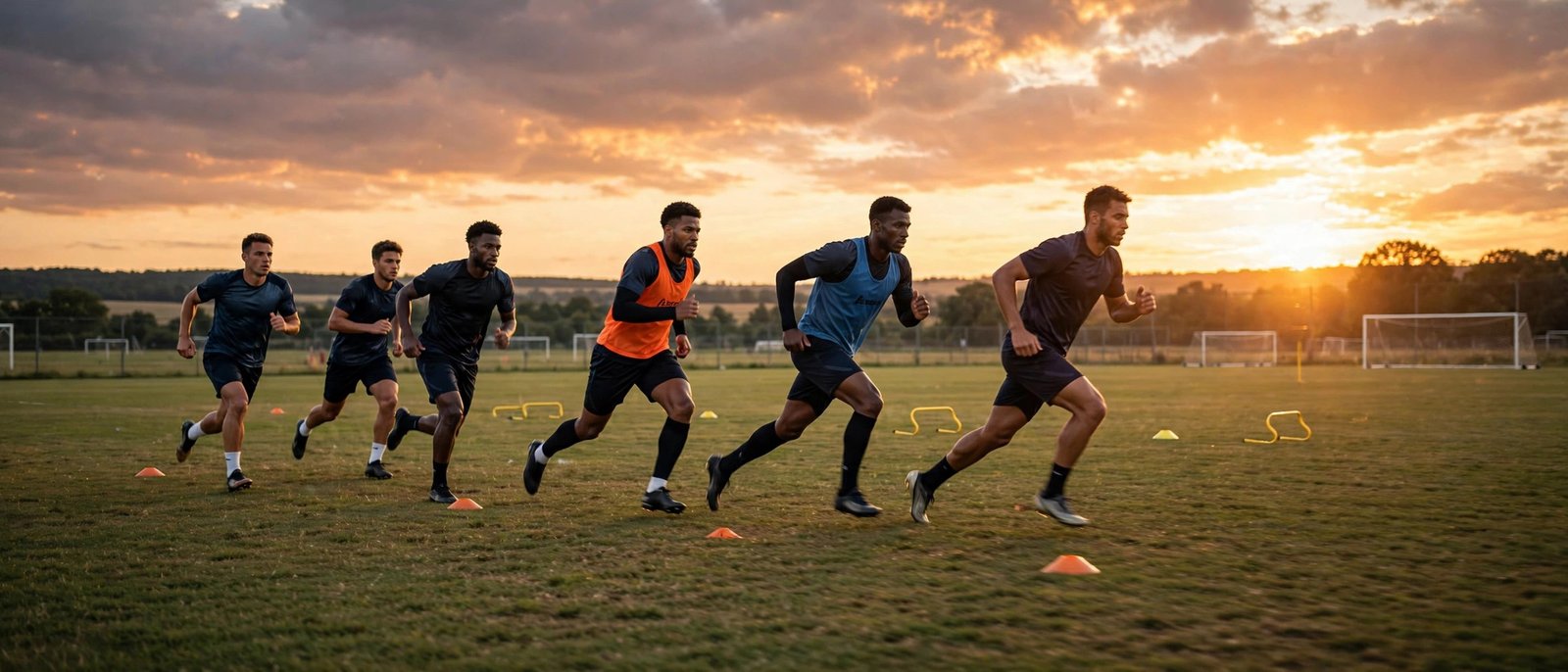
The best soccer conditioning hides fitness inside technique work. Dribbling circuits: set up cones and dribble through them at increasing intensity — 60 seconds on, 30 off, 10 rounds. Pass-and-move drills: wall passes or partner passing with sprints between stations. Rondo under fatigue: play keep-away in a circle after a sprint set — training technical quality when tired, which is exactly what the 80th minute demands.
This approach solves the motivation problem that kills running programs: you’re improving touch and fitness simultaneously, so every session feels like soccer, not punishment. Players who condition with the ball consistently outlast players who only run — because their fitness is wired to the movements they’ll actually perform. Even 20 minutes of high-intensity dribbling circuits delivers a conditioning stimulus that transfers directly to match play.
Strength, Mobility, and the Unsexy Foundations
Stamina isn’t just cardio. Lower-body strength (squats, lunges, single-leg work, calf raises — twice weekly) improves running economy: stronger legs use less energy per stride, which is free stamina. Core stability maintains posture when fatigued — the player whose form collapses at minute 70 wastes energy every step. Hip mobility and ankle mobility keep your stride efficient and injury-free; tight hips are an energy leak.
And the genuinely unsexy foundation: sleep and fueling. No training program overcomes 5-hour nights — sleep deprivation measurably reduces time-to-exhaustion and slows reaction time, both critical in soccer. Fuel with carbohydrates before sessions (your high-intensity system runs on glycogen), hydrate with electrolytes for sessions over an hour, and eat protein after for recovery. The fittest player on an empty stomach loses to the moderately fit player who’s fueled. A short daily stretching routine keeps the mobility side handled in minutes.
The 6-Week Match-Fitness Plan
Weeks 1–2: two interval sessions + one small-sided game weekly, easy base. Weeks 3–4: add Tabata finisher, increase interval reps, add one strength session. Weeks 5–6: peak — three high-intensity days, full small-sided games, strength maintained. Week 7: deload (halve volume) then test with a full match. Most players feel transformed by week 4 — the “I can still sprint in the 80th minute” moment is unmistakable.
U.S. Soccer’s coaching resources at ussoccer.com offer age-appropriate conditioning frameworks, and the CDC’s activity guidelines at cdc.gov provide the broader fitness context.
Conclusion
Building stamina for soccer without long runs means training the actual demands of the sport: HIIT intervals that mimic match intensity, small-sided games that build fitness through play, ball-work conditioning circuits, twice-weekly strength work, and the sleep and fueling that make it all stick. Six weeks of this builds more match fitness than six months of jogging — because you’re building a soccer engine, not a marathon engine. Start this week with two interval sessions, add the ball work next week, and notice the difference by week four. The 80th-minute sprint is earned in training, not wished for on match day.
Frequently Asked Questions
Do soccer players need to run long distances for stamina?
No — soccer stamina is intermittent (sprints mixed with recovery), not steady-state. Interval training, small-sided games, and ball-work circuits build match fitness far more effectively than long slow runs, which train the wrong energy systems.
How many times a week should I do soccer conditioning?
2–3 high-intensity sessions weekly (intervals, small-sided games, or ball circuits), plus 1–2 strength sessions and actual soccer practice/games. More than 4 intense days risks overtraining — recovery days are when fitness is built.
What is the best interval workout for soccer?
The 30-seconds-hard/30-seconds-easy protocol for 10–15 reps most closely mimics match demands. Add shuttle runs for change-of-direction fitness and occasional Tabata finishers for anaerobic capacity.
How long does it take to get match fit for soccer?
Most players see dramatic improvement in 4–6 weeks of structured interval and small-sided game training. Full match sharpness (90 minutes at intensity) typically takes 6–8 weeks from a moderate base. Returning after a long layoff takes longer — rebuild gradually to avoid injury.
Does strength training help soccer stamina?
Yes significantly — stronger legs improve running economy (less energy per stride), and core stability preserves efficient form when fatigued. Two short strength sessions weekly is one of the highest-ROI additions to a soccer fitness program, and it also reduces injury risk.