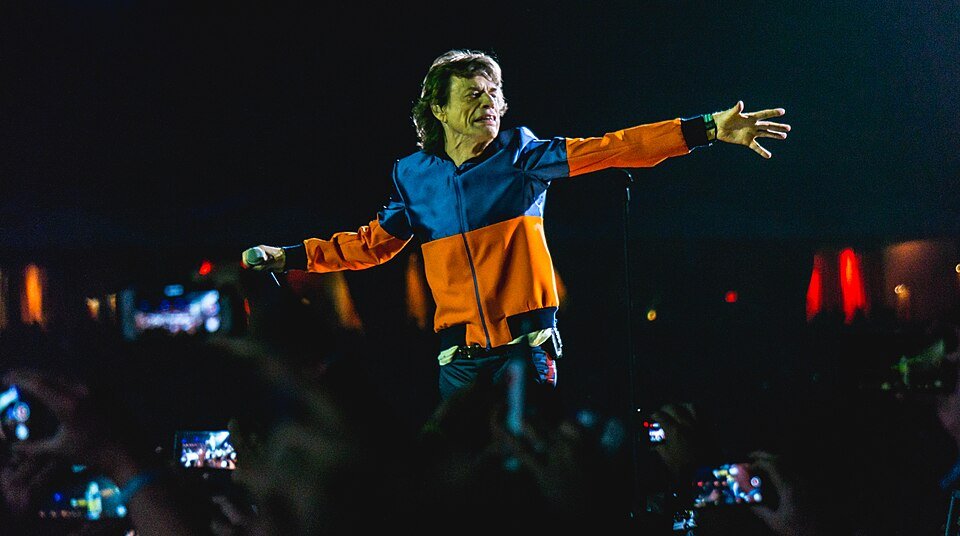
Mick Jagger’s Money: The $500–600 Million Range Behind the Strut
The Short Version
Mick Jagger, frontman of the Rolling Stones for over sixty years, is rock’s great survivor-businessman: the singer who also became the band’s de facto chief executive, steering the most lucrative live act in history through six decades of tours. This profile honestly presents his fortune as a range. Celebrity Net Worth updated its figure to $600 million in October 2026; $500 million remains the most commonly cited estimate elsewhere. This profile prints the range — $500 to $600 million — and attributes both ends. He is 83, still touring into his eighties following the Stones’ Hackney Diamonds album in 2023 and a North American stadium tour in 2024, engaged to Melanie Hamrick, and father of eight children with five partners.
How They Got There
1962–1971: The Stones Assemble and Conquer
Jagger and Keith Richards, childhood acquaintances reunited on a Dartford railway platform in 1961, formed the Rolling Stones in 1962 with Brian Jones. The early records were covers and then, under management pressure to write, Jagger-Richards originals: “(I Can’t Get No) Satisfaction” (1965) made them America’s anti-Beatles. The great run followed — Beggars Banquet (1968), Let It Bleed (1969), Sticky Fingers (1971) — albums whose songs, “Sympathy for the Devil,” “Gimme Shelter,” “Brown Sugar,” still open the shows and anchor the publishing catalog that underlies the fortune.
1972–1989: Exile, Arenas, and the Business Turn
Critics now routinely rank Exile on Main St. (1972), recorded in a French villa amid tax exile, among the greatest albums ever made. The seventies made the Stones the blueprint for the arena band; the eighties, with Some Girls (1978) behind them and Tattoo You (1981) carrying “Start Me Up,” made them an institution. Jagger’s solo career — She’s the Boss (1985), Primitive Cool (1987) — never rivaled the band, a fact the biography should state plainly. What did rival everything was the business turn: from Steel Wheels (1989) onward, corporate sponsors backed the Stones’ tours, and the band’s operation precisely routed and priced them like the premium product they were, with Jagger, who had studied at the London School of Economics before music took over, as the band’s financial mind.
1994–2026: The Highest-Grossing Habit in Rock
Voodoo Lounge (1994), Bridges to Babylon (1997), and A Bigger Bang (2005) each arrived with a world tour bigger than the last; the Bigger Bang tour set gross records. The band played free to a million people in Rio, opened Cuba in 2016, and — after drummer Charlie Watts died in 2021 — continued with Steve Jordan. Hackney Diamonds (2023), their first album of original material in eighteen years, won praise and produced the 2024 North American stadium tour, Jagger performing at 80 and 81 with the same choreography of strut and sprint. The live catalog is the fortune’s engine: no band has grossed more, for longer, than this one.
The solo and side record, honestly assessed, is a footnote that still paid. His solo albums sold respectably without ever threatening the band’s primacy; a 2001 album, Goddess in the Doorway, drew a famous critical drubbing and modest sales. SuperHeavy (2011), a one-off supergroup with Dave Stewart, Joss Stone, Damian Marley, and A. R. Rahman, showed the restlessness persisting into his late sixties. Through his Jagged Films company he produced films including Enigma (2001) and the James Brown documentary Mr. Dynamite (2014), and he was an executive producer of the television series Vinyl (2016). Queen Elizabeth II knighted him in 2003 — Sir Mick, to the visible amusement of his bandmate Richards. None of it rivals the Stones; all of it kept the name earning between tours.
Where It Began
Basil “Joe” Jagger and Eva Jagger, née Scutts, welcomed Michael Philip Jagger on July 26, 1943, in Dartford, Kent. His father, Basil “Joe” Jagger, was a physical education teacher and lecturer who lived to 2006; his mother, Eva Jagger, née Scutts, an Avon representative active in local politics, died in 2000. It was a comfortable, respectable, suburban upbringing — the famous irony of the Stones’ story being that its wild frontman was its most middle-class member, a grammar-school boy who won a place at the London School of Economics and left it for the band.
The Fortune in Full
The range is the fact: $500 million, the figure most commonly cited across reference sources, to $600 million, Celebrity Net Worth’s October 2026 update. The components are better documented than the total. Six decades of touring grosses in which the Stones have repeatedly held the all-time record. Songwriting royalties as half of the Jagger-Richards partnership on one of rock’s deepest catalogs. And property: Celebrity Net Worth has valued his worldwide property portfolio at about $250 million — hedged here as reported, since no public audit exists. He is, in the accurate phrase, a man whose band became a blue-chip company with himself as singer and chief executive in one.
The Houses
The main base on recent reporting is the Château de Fourchette in France’s Loire Valley, which he bought in the early 1980s during his years with Jerry Hall; it has its own studio, and the Stones recorded A Bigger Bang there. In London he holds Downe House on Richmond Hill, bought in the 1990s, a Grade II listed house reported at about £13 million, plus a Chelsea riverside property. On Mustique he built the Stargroves villa in the 1990s, let to others when he is away. In Florida, he bought in Lakewood Ranch in 2020 with Melanie Hamrick for about $1.98 million; agents listed it in 2023. Five properties, four countries, one pattern: bought decades ago, held ever since.
The Car Collection
No reliable modern inventory of his cars exists. The documented cars are period pieces — an Aston Martin DB6 and a Morgan Plus 8 from the early years of fame — and this profile leaves the collection there, in the era where the evidence is, rather than inventing a modern fleet.
Life Away from the Job
His partner is Melanie Hamrick, a former ballerina, his partner since 2014; in April 2025 reporting, Hamrick confirmed to Paris Match that the two had engaged two or three years earlier. Engagement is the status; this profile never describes them as married. He legally married only once, Bianca Pérez-Mora Macías, from 1971 to 1978; a court later ruled his Bali ceremony with Jerry Hall no valid marriage. His eight children, with five partners, are: Karis (born 1970, with Marsha Hunt); Jade (born 1971, with Bianca); Elizabeth (born 1984), James (born 1985), Georgia May (born 1992), and Gabriel (born 1997), with Hall; Lucas (born 1999, with Luciana Morad); and Deveraux Octavian Basil, born December 8, 2016, with Hamrick. The section above records his parents, Basil and Eva. His songwriting partnership is the other great relationship of the life, and it leads naturally to the band’s wider circle, represented here by David Bowie’s net worth profile, his collaborator on the 1985 hit “Dancing in the Street.”
One structural fact explains why the fortune, vast as it is, is not larger. The Rolling Stones do not own the master recordings of their 1960s catalog; the early records sit with ABKCO, the company of their former manager Allen Klein, after a settlement in the 1970s. The band controls its post-1971 masters and the group administers its publishing on terms it renegotiated over the decades. Jagger’s wealth therefore rests disproportionately on the two income streams the band never gave away: live performance, where the Stones have out-grossed every act in history across their career, and the songwriting share of the Jagger-Richards catalog. It is a fortune built on the road and the pen — the two assets a frontman can keep.
The Stones’ live economics, which Jagger more than anyone designed, repay one detailed look. From the 1989 Steel Wheels tour onward, the band treated each outing as a self-contained business: sponsorship sold at the tour level, ticket prices set at what the market’s top would bear rather than what custom suggested, merchandise and later VIP packages engineered as profit centers, and routing planned with an accountant’s eye. The result, across the Voodoo Lounge, Bridges to Babylon, Licks, Bigger Bang, and No Filter tours, was a sequence of grosses that repeatedly reset the all-time record — the Bigger Bang tour’s roughly $558 million stood as the benchmark for years. Critics periodically called the prices cynical; the audiences kept paying them, in Jagger’s own reported view because the show was worth it. An 83-year-old who can still deliver that show, in stadiums, is not merely a singer with a large fortune. He is the chief executive of the most successful live-entertainment business ever assembled, who happens to perform at the front of it.
His family geography mirrors the property portfolio, and he manages both with the same long view. Grandchildren and great-grandchildren extend the eight children across three generations and four continents; the Loire château hosts the clan the way Woodside hosts Elton John’s — as a working headquarters of a family that is also, inescapably, a business. The Stones’ corporate structure, with its Dutch and international arrangements refined over decades, exists precisely so that a band formed in 1962 can still split stadium grosses efficiently in 2026. Jagger, the LSE student who left before graduating, became the structure’s architect. Biographers sometimes treat the business as the betrayal of the music. The record assembled here suggests the opposite reading: the business is what allowed the music to keep happening, at full scale, into its seventh decade — and what turned a singer’s earnings into a $500–600 million fortune.
At eighty-three the touring has slowed to selected runs rather than annual marathons, but the machinery built across six decades — the catalog, the corporate structure, the property — no longer needs his knees to hold up for the fortune to hold its value.
Time, as his own most famous lyric admits, was always on his side.
And Finally
At 83, Jagger remains the industry’s proof that a frontman can also be the firm. He built the fortune — $500 to $600 million on the attributed range — by treating every tour since 1989 as a business launch and every song since 1965 as an asset.
The strut was never the opposite of the spreadsheet. It was the product the spreadsheet sold, for sixty years, at prices no competitor has matched.
The Scoop File
| The Scoop File | Details |
|---|---|
| Born | July 26, 1943, Dartford, Kent, England |
| Age | 83 |
| Height | 5 ft 10 in (178 cm) |
| Net Worth | $500–600 million ($500 million most commonly cited; $600 million, Celebrity Net Worth, updated October 2026) |
| Weight | No reliable published figure exists |
| Partner | Melanie Hamrick (since 2014; engagement confirmed in April 2025 reporting) |
| Children | Eight: Karis, Jade, Elizabeth, James, Georgia May, Gabriel, Lucas, and Deveraux |
| Parents | Basil “Joe” Jagger and Eva Jagger, née Scutts |
| @mickjagger |