
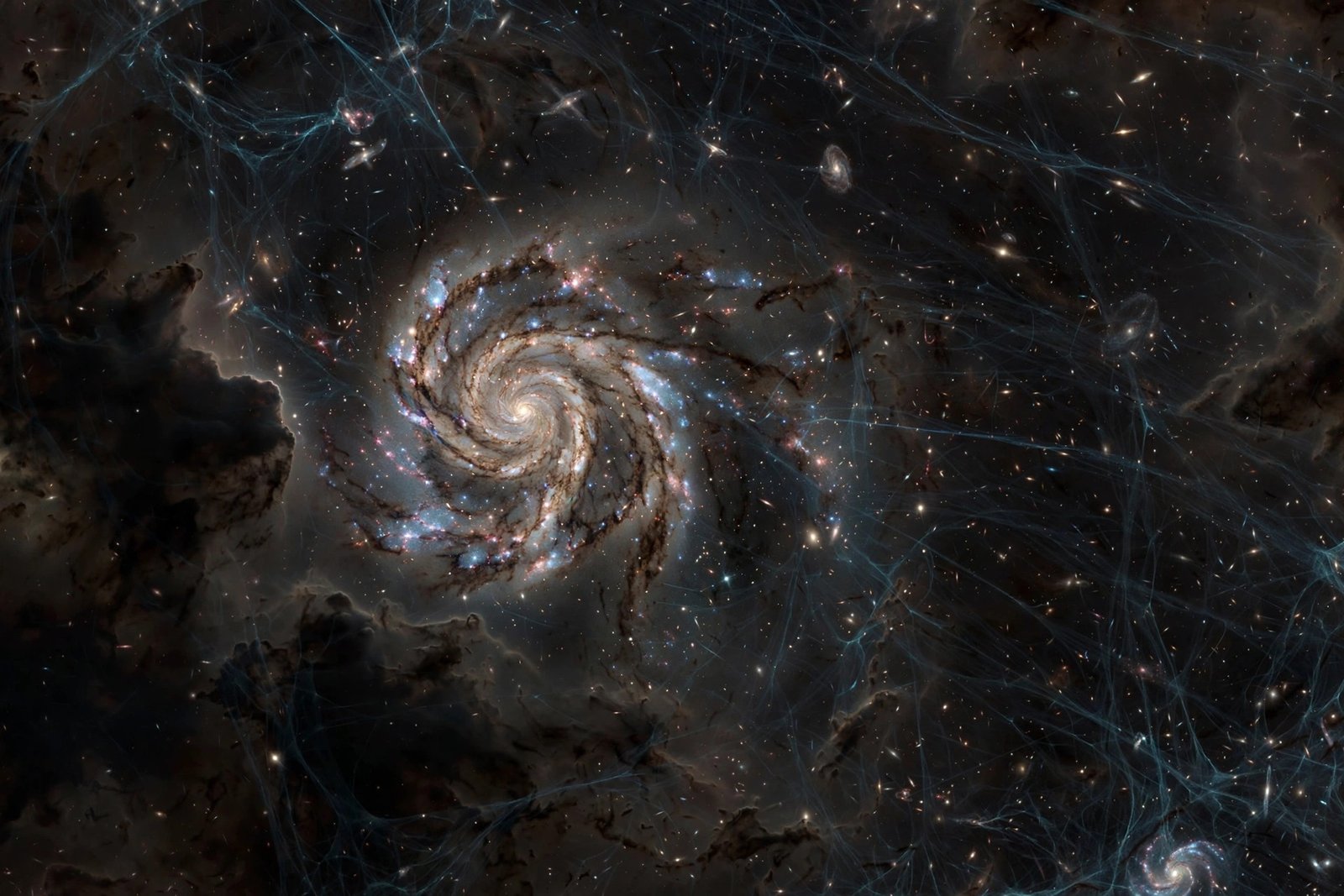
Everything you can see — stars, planets, galaxies, your own body — is made of ordinary matter: protons, neutrons, electrons. Here’s the problem: that familiar stuff accounts for only about 5% of the universe. Roughly 27% is something else entirely — dark matter — invisible, intangible, detectable only through its gravitational pull on the visible world. It’s the most abundant form of matter in existence, it shaped every galaxy including ours, and after nearly a century of study, nobody knows what it is. This is the biggest unsolved mystery in physics, hiding in plain sight.
How We Know It’s There: The Evidence
Dark matter wasn’t hypothesized on a whim — it was forced on physics by observations that refused to make sense otherwise. In the 1930s, Fritz Zwicky found that galaxies in the Coma Cluster were moving far too fast to be held together by their visible mass — something invisible was providing extra gravity. In the 1970s, Vera Rubin measured rotation curves of spiral galaxies and found stars at the edges orbiting just as fast as stars near the center — impossible unless galaxies are embedded in massive halos of unseen matter. Visible mass alone predicts outer stars should slow down; they don’t.
The evidence has only grown stronger. Gravitational lensing — massive objects bending light — reveals dark matter’s distribution directly: the Bullet Cluster shows lensing mass separated from visible gas after a galactic collision, exactly as dark matter predicts. The cosmic microwave background — the Big Bang’s afterglow, measured exquisitely by NASA’s WMAP mission and ESA’s Planck satellite — encodes the universe’s composition: ~5% ordinary matter, ~27% dark matter, ~68% dark energy. NASA’s dark matter science pages summarize how each line of evidence constrains what the mystery substance can be. And cosmic structure itself — the web of galaxies — only forms correctly in simulations that include dark matter’s gravitational scaffolding. Five independent lines of evidence converge on the same answer. Something is there.
What dark matter is not
It’s not antimatter (which annihilates on contact with matter and would be visible). It’s not black holes or dim stars — microlensing surveys ruled out enough compact objects to account for it (the MACHO hypothesis is dead). It’s not just “hard to see” ordinary matter — Big Bang nucleosynthesis precisely accounts for all ordinary matter, and there’s no room for more. Whatever dark matter is, it’s something fundamentally new.
What Could It Be? The Leading Candidates
The frontrunner for decades has been WIMPs — Weakly Interacting Massive Particles, hypothetical particles with mass (heavier than protons) that interact with ordinary matter only through gravity and the weak nuclear force. WIMPs were beloved because they emerged naturally from supersymmetry theories and had exactly the right properties — the “WIMP miracle.” But decades of increasingly sensitive direct-detection experiments (buried deep underground to shield from cosmic rays) have found nothing, progressively ruling out the expected parameter space. The WIMP miracle is looking less miraculous.
Attention has shifted to alternatives. Axions — hypothetical ultralight particles originally proposed to solve a puzzle in quantum chromodynamics — could fill the role if produced in sufficient numbers in the early universe; experiments like ADMX are hunting them now. Sterile neutrinos — heavier, non-interacting cousins of known neutrinos — are another candidate. Primordial black holes (formed in the Big Bang’s first moments, not from stars) could contribute, though constraints limit how much. Or the answer might be more radical: modified gravity theories (like MOND) propose that our understanding of gravity breaks down at galactic scales, and there’s no missing matter at all — though these struggle to explain the Bullet Cluster and cosmic microwave background as elegantly.
Why Can’t We See It? The Detection Challenge
“Dark” doesn’t mean black — it means non-interacting with light. Dark matter appears to ignore the electromagnetic force entirely: it doesn’t emit, absorb, or reflect light, which is why every telescope ever built is blind to it. It reveals itself only through gravity — the one interaction it definitely has. This makes detection extraordinarily hard: you’re hunting particles that pass through the entire Earth (and you) constantly, interacting almost never.
Three detection strategies run in parallel. Direct detection: ultra-sensitive detectors in deep mines waiting for a rare dark matter particle to bump an atomic nucleus — so far, silence, but each generation probes deeper. Indirect detection: space telescopes hunting gamma rays from dark matter particles annihilating each other in dense regions like the galactic center — intriguing hints, no confirmation. Production: particle colliders like the LHC trying to manufacture dark matter particles in high-energy collisions — nothing yet. The continued null results are themselves informative, steadily narrowing where the answer can hide. For fellow curious minds, the best science documentaries cover the dark matter hunt with the drama it deserves.
Why It Matters: The Architect of Everything
Dark matter isn’t just a curiosity — it’s the reason galaxies exist. In the early universe, dark matter’s gravity created the first dense regions, pulling in ordinary matter that then formed stars and galaxies. Without dark matter’s scaffolding, the universe would be a diffuse fog of hydrogen — no galaxies, no stars, no planets, no us. Our Milky Way sits inside a dark matter halo roughly ten times the mass of all its stars; the solar system is currently sweeping through it at 220 kilometers per second.
Solving dark matter likely means discovering new fundamental physics — a new particle would be the first confirmed physics beyond the Standard Model, opening a new frontier the way the electron opened the atomic age. Or, if modified gravity wins, we’d rewrite our understanding of gravity itself. Either way, the answer changes physics textbooks. And the hunt continues with new instruments: the Vera Rubin Observatory (named for the rotation-curve pioneer) will map dark matter’s distribution across the sky in unprecedented detail when its survey begins. Sometimes the most profound discoveries start with noticing that the numbers don’t add up — and wondering what’s really out there is a fine way to spend an evening.
Frequently Asked Questions
Is dark matter the same as dark energy?
No — they’re unrelated mysteries that share only the word “dark” (meaning unknown). Dark matter (27%) is invisible mass that clumps via gravity and holds galaxies together. Dark energy (68%) is a uniform repulsive effect driving the universe’s accelerating expansion. Different phenomena, different evidence, both unexplained.
Could dark matter just be a measurement error?
Five independent lines of evidence — galaxy rotation, cluster dynamics, gravitational lensing, the cosmic microwave background, and large-scale structure — all converge quantitatively on the same ~27% figure. A single error can’t explain that convergence; whatever the answer, it’s real physics.
How much dark matter is passing through me right now?
Estimates suggest hundreds of thousands of dark matter particles stream through every square centimeter of your body each second — completely unnoticed, because they essentially never interact. You’re swimming in it; you just can’t feel it.
What’s the difference between WIMPs and axions?
WIMPs are hypothetical heavy particles (heavier than protons) interacting via the weak force — the long-favored candidate now under pressure from null detections. Axions are hypothetical ultralight particles (billions of times lighter than electrons) from a different theoretical motivation, now a leading alternative. Different masses, different origins, different experiments hunting them.
Will we solve dark matter in our lifetime?
Possibly — the Vera Rubin Observatory, next-generation direct detectors, and upgraded colliders are all probing new territory this decade. But nature doesn’t owe us a timely answer; the mystery has already lasted 90 years. The hunt itself keeps producing valuable physics regardless.
Dark matter is the invisible majority of matter — 27% of the universe, detectable only by gravity, responsible for every galaxy’s existence, and utterly unknown after a century of investigation. We know it’s there from five converging lines of evidence; we don’t know what it is despite our best detectors. It’s the biggest open case in science — and the detective story is still unfolding.