DJing looks like an expensive hobby from the outside: the decks, the mixer, the headphones, the speakers — a starter hardware setup easily runs $500 to $1,500. But here’s what working DJs know: the equipment was never the skill. The skill is in your ears and your timing — beatmatching, phrasing, reading a crowd, building energy — and every bit of that can be learned for free or nearly free in 2026. The gear comes later, when you actually need it.
This guide shows you the zero-budget path: free software that professionals genuinely use, how to practice with just a laptop (or even a phone), where to find music legally without spending a fortune, the fundamental techniques in order, and how to get your first real gigs before you own a single piece of hardware. By the end, you’ll know whether DJing is for you — without having spent a dollar finding out.
Start With Free Software (It’s Better Than You Think)
The biggest myth in DJing is that you need Serato or Rekordbox hardware to begin. You don’t. Several fully capable DJ applications are free, and the skills transfer directly to any professional setup later.
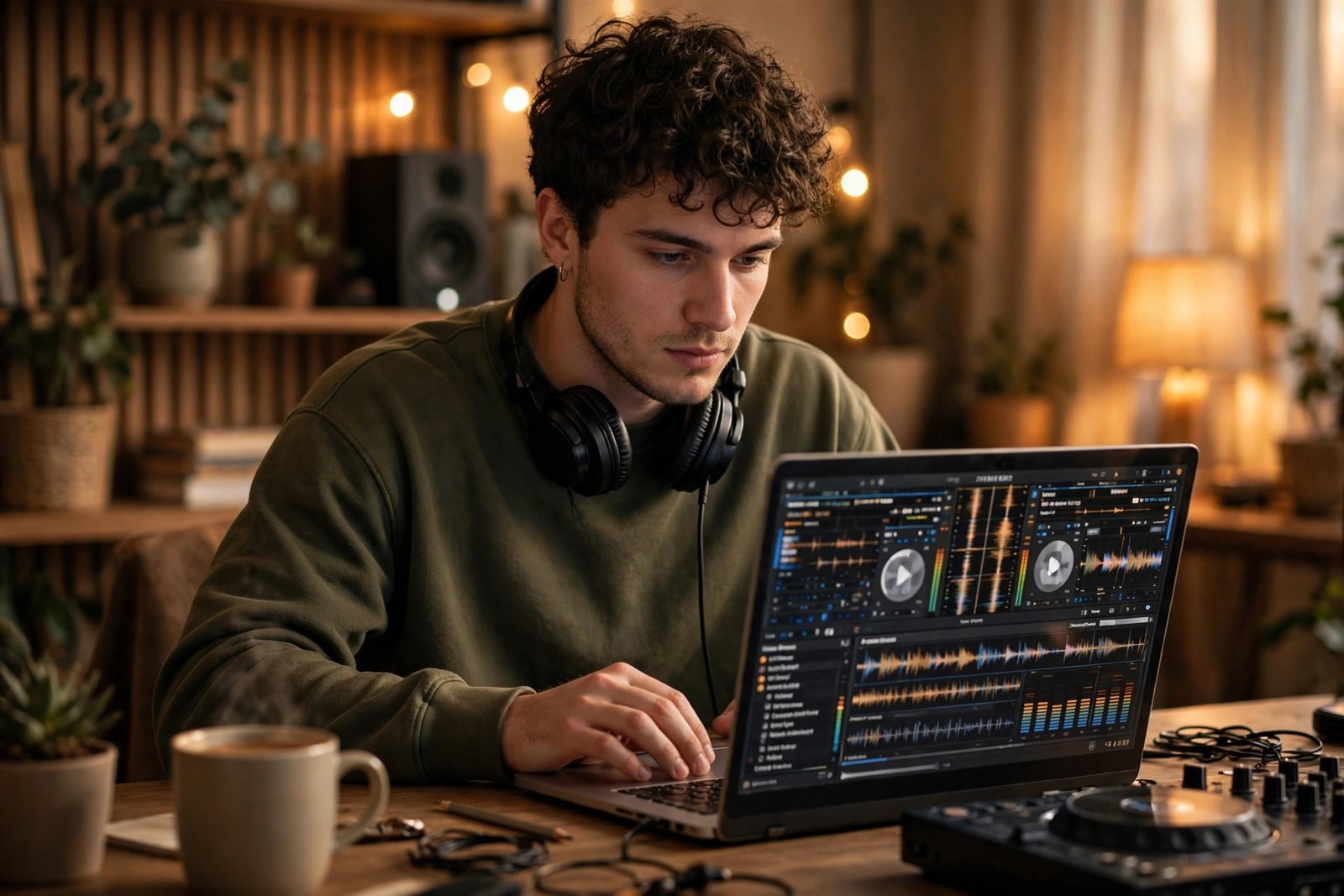
Serato DJ Lite is free and runs with just your laptop — no controller required. It gives you two decks, a mixer, EQ, and effects, controlled by keyboard and mouse. The workflow is identical to the full Serato that club DJs use, so everything you learn transfers. Rekordbox (Pioneer’s software) has a free tier with similar capabilities. Mixxx is completely free and open-source, surprisingly powerful, and runs on anything. Even YouDJ in a web browser works for absolute first steps.
Yes, mixing with a keyboard and trackpad feels awkward at first. That’s fine — awkward is where learning happens. The core skills (beatmatching by ear, phrase matching, EQ blending) are software-independent. When you eventually touch real decks, your brain already knows what to do; your hands just need to catch up. Digital DJ Tips maintains current comparisons of free DJ software and is the most trusted free resource in the DJ education world.
Your Laptop (or Phone) Is Enough Hardware
For learning, you need: a laptop made in the last decade, headphones (any decent earbuds work to start — you’ll want closed-back over-ears eventually, $50–80), and an internet connection. That’s the complete equipment list for months of learning.
The one genuinely useful early purchase is a cheap DJ controller — but “eventually,” not “first.” Controllers like the Pioneer DDJ-200 or Numark Party Mix ($100–150 new, often $60–80 used) give you physical jog wheels and faders, which make practice dramatically more intuitive. Buy one after a month of software practice, when you know you’re committed — not before. Check used markets; beginners constantly sell barely-used starter controllers.
Skip for now: expensive headphones (any closed-back pair works while learning), monitor speakers (your existing speakers or headphones are fine), and definitely skip the full CDJ-and-mixer setup — that’s a $2,000+ investment for skills you haven’t built yet. The gear ladder goes: software → cheap controller → better controller → pro setup, and most people never need to climb past step two or three.
Learn the Fundamentals in the Right Order
DJ technique has a natural learning sequence. Follow it instead of jumping to advanced tricks.
1. Beatmatching by Ear
The foundation of everything: getting two tracks to play at the same tempo, aligned beat-to-beat. Start with two copies of the same track (cheating, but instructive), then two tracks at similar BPMs. Use the pitch fader to match speeds, then nudge the jog wheel to align the beats. Practice until you can do it in under 30 seconds. This single skill takes most beginners 2–4 weeks of daily practice — it’s the rite of passage.
2. Phrasing
Music is built in phrases (typically 16 or 32 beats). Mixing a new track in at the start of its phrase, aligned with the outgoing track’s phrase, is what makes transitions sound natural instead of chaotic. Count beats: 1-2-3-4, 2-2-3-4… Learn to hear where phrases begin — it’s usually obvious once you listen for it (new element enters, energy shifts).
3. EQ Blending
Two full tracks playing simultaneously sounds muddy because their bass frequencies clash. The technique: as you bring the new track in, gradually cut the bass on the outgoing track while bringing the new track’s bass up — the “bass swap.” Practice with the EQ knobs until transitions sound clean. This is 80% of what makes a mix sound professional.
4. Track Selection and Energy Management
The advanced skill that actually books gigs: choosing the right track at the right moment and managing the room’s energy arc. This can’t be learned from gear — it comes from listening to lots of music, studying how DJs you admire structure sets, and practicing recorded mixes. Record every practice session and listen back critically; it’s the fastest feedback loop available.
Build Your Music Library Without Going Broke
You need music, and buying every track at $1–2 adds up fast. Legal budget strategies: DJ pools (like BPM Supreme or DJcity, ~$20/month for unlimited downloads — worth it once you’re practicing seriously), Bandcamp (support independent artists directly, frequent sales), SoundCloud (vast free downloads from artists, especially in electronic genres), and free promotional tracks from labels’ mailing lists.
Organize from day one: create crates/playlists by energy level and genre, tag your tracks, and build the habit of pre-listening. A DJ with 200 well-known tracks outperforms one with 2,000 strangers. And develop your taste actively — finding good new music without streaming algorithms (digging through blogs, mixes, radio shows, friends’ recommendations) is itself a core DJ skill. The DJs who stand out are the ones with distinctive taste, not the ones with the most expensive gear.
Respect the craft’s economics: once you’re playing gigs, buy your music. But while learning, free and legal sources are plentiful and legitimate.
Get Your First Gigs Before You Own Gear
Here’s the secret of the budget DJ path: you don’t need to own pro gear to play real gigs, because venues have gear. House parties, bars, and small events provide the setup; you bring a laptop, headphones, and your music library on a USB stick. Many working DJs played their first dozen gigs exactly this way.
Start with recorded mixes: a 30–60 minute demo mix posted on SoundCloud or Mixcloud is your resume. Share it with friends, local promoters, and bar managers. Offer to play opening slots (lower pressure, great practice) or house parties (forgiving crowds, real experience). Film a short video of yourself mixing — promoters book people, not just audio.
Network in the scene: go to local nights, introduce yourself to DJs, be genuinely interested. The DJ community is famously generous with advice and opportunities for earnest beginners. DJ Tech Tools has excellent guides on the business side — getting booked, promoting yourself, and transitioning from bedroom to booth.
And remember that DJ skills transfer to any social music setting. The playlist instincts you develop make you the hero of road trips too — making a road-trip playlist everyone will enjoy uses the same energy-management muscles as a club set, just at 65 mph.
The Bottom Line
Learning to DJ without expensive equipment isn’t a compromise — it’s the smart path. Free software (Serato DJ Lite, Mixxx) teaches the same fundamentals as pro setups; your laptop and headphones are enough hardware for months; beatmatching, phrasing, and EQ blending are ear skills, not gear skills; and your first gigs will use the venue’s equipment anyway. Spend your first dollars on music and maybe a used starter controller, not on a flagship setup. The DJs who last are the ones who fell in love with the music and the craft — and neither of those costs anything.
Frequently Asked Questions
Can I learn to DJ with just a laptop?
Yes. Free software like Serato DJ Lite or Mixxx gives you two decks and a mixer controlled by keyboard and mouse. All fundamental skills — beatmatching, phrasing, EQ mixing — are fully learnable this way. A cheap controller ($60–150 used) makes practice more intuitive later, but it’s not required to start.
How long does it take to learn to DJ?
Basic beatmatching typically takes 2–4 weeks of daily practice; competent mixing of a smooth 30-minute set takes 3–6 months. Gig-ready confidence usually comes around 6–12 months. Like any instrument, it’s a continuous journey — but the early progress is fast and motivating.
Do I need to know music theory to DJ?
No. Helpful concepts (like harmonic mixing with the Camelot wheel) come later and are optional enhancements. The core skills are rhythmic (beatmatching, phrasing) and curatorial (track selection). Many successful DJs know zero formal theory.