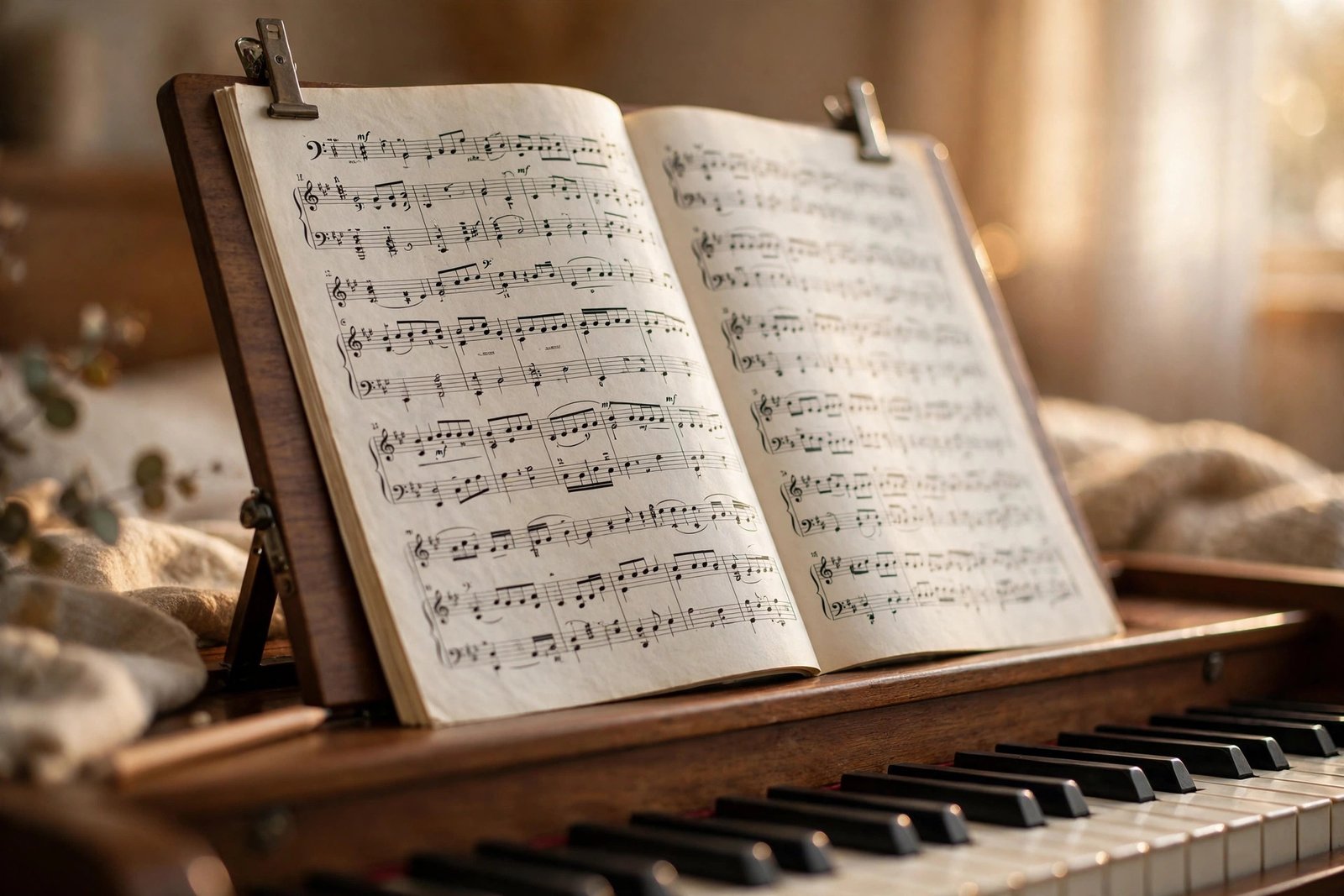
Sheet music looks like an alien language — dots, lines, and symbols that somehow tell musicians exactly what to play. But here’s what nobody tells beginners: reading music is easier than reading this sentence. You learned an alphabet of 26 arbitrary symbols as a child; music uses about a dozen, and they’re beautifully logical once someone explains them in the right order. This step-by-step guide takes you from “what are all these lines” to reading real melodies, with the practice method that actually works.
Step 1: Learn the Staff and Clefs (the Map)
The staff — five horizontal lines — is simply a map of pitch: higher on the staff means higher in pitch. That’s the entire concept. Notes sit either on lines or in the spaces between them, and their vertical position tells you how high or low to play.
The clef at the beginning tells you which notes the lines represent. The treble clef (the swirly one, used for higher instruments and the right hand on piano) centers on G — the second line from the bottom is G, and everything else follows alphabetically. The bass clef (used for lower instruments and the left hand) centers on F — the second line from the top is F. Learn one clef first (whichever your instrument uses); the other comes easily later since the pattern is identical, just shifted.
The Mnemonics That Actually Stick
For treble clef lines (bottom to top): E-G-B-D-F — “Every Good Boy Does Fine.” Spaces spell F-A-C-E — it literally spells “face.” Bass clef lines: G-B-D-F-A — “Good Boys Do Fine Always.” Spaces: A-C-E-G — “All Cows Eat Grass.” These century-old mnemonics survive because they work; drill them for five minutes daily and they’re permanent within two weeks.
Step 2: Note Values — How Long Each Note Lasts
Pitch is only half the language; rhythm is the other half. Note shapes tell you duration: a whole note (open oval) lasts 4 beats, a half note (open oval with stem) lasts 2, a quarter note (filled oval with stem) lasts 1, eighth notes (filled with stem and flag/beam) last half a beat, and sixteenth notes last a quarter beat. Each level halves the previous — simple fractions, that’s all.
The time signature (like 4/4) tells you the rhythmic framework: the top number is beats per measure, the bottom is which note gets one beat. 4/4 means four quarter-note beats per measure — the heartbeat of most popular music. 3/4 (waltz time) means three beats per measure. Start by clapping rhythms before playing them — if you can clap it, you can play it. Rhythm confusion causes more beginner reading failures than pitch confusion.
Step 3: Key Signatures, Accidentals, and Dynamics
Key signatures (the sharps or flats after the clef) tell you which notes are altered throughout the piece — they’re the “default settings.” A key signature with one sharp means every F is F# unless marked otherwise. Rather than memorizing all keys now, learn them as you encounter pieces; each new key signature is a small, manageable addition.
Accidentals (♯ sharp, ♭ flat, ♮ natural) alter individual notes temporarily — they apply for the rest of that measure. Dynamics (p = soft, f = loud, crescendos/hairpins) tell you how loudly to play — they’re the emotion of the piece, and beginners who ignore them play correctly but lifelessly. Tempo markings (Allegro = fast, Andante = walking pace) set the speed. Learn these symbols in context as they appear in your music rather than memorizing charts.
The 80/20 of Symbols
You need about 20 symbols to read 95% of beginner-to-intermediate music: the clefs, five note values, rests (silence symbols mirroring note values), sharps/flats/naturals, repeat signs, and basic dynamics. Everything else — trills, mordents, obscure Italian terms — you look up as encountered. Don’t let the symbol catalog intimidate you; working musicians use a small core constantly and reference the rest.
Step 4: The Practice Method That Builds Real Reading
Here’s where most self-teaching fails: people stare at notation hoping it clicks. Reading music is a skill built through structured reps, not osmosis. The method:
Daily 10-minute drills: Use flashcards or an app to name notes (pitch) and clap rhythms separately. Isolate the skills before combining them.
Sight-read below your level: Play through simple pieces you’ve never seen, slowly, without stopping for mistakes. The goal isn’t perfection — it’s training your eyes to keep moving forward. One new easy piece daily beats one hard piece weekly for reading development.
Connect to music you love: Find simplified sheet music for songs you know — recognizing the melody you hear in the dots you see is the moment reading “clicks.” Discovering new music to learn keeps practice motivated, and working toward playing at an open mic night gives your reading practice a real-world deadline.
Write music: Transcribing even simple melodies by ear into notation cements the symbol-to-sound connection faster than reading alone. The Recording Academy’s music education resources at grammy.com highlight how literacy opens doors across the industry, and NAMM’s education resources at namm.org support learners at every level.
Step 5: Common Beginner Traps
Reading note-by-note instead of in patterns: Advanced readers see chords, scales, and phrases as units — like reading words instead of letters. Train this by identifying familiar patterns (that’s a C major scale, that’s an arpeggio) rather than decoding each dot.
Ignoring rhythm: Beginners obsess over right notes and mangle timing. In ensemble playing, correct rhythm with a wrong note beats wrong rhythm with right notes every time.
Practicing only pieces you know: Comfortable pieces don’t build reading; unfamiliar easy pieces do. Deliberately uncomfortable, deliberately easy — that’s the growth zone.
Giving up at the plateau: Weeks 3–6 feel like no progress — then it suddenly clicks. The plateau is neurological consolidation happening invisibly. Push through; the click is real and every musician remembers theirs.
Conclusion
Reading sheet music step by step means: learn the staff and one clef with mnemonics, master note values and time signatures through clapping, pick up key signatures and dynamics in context, practice with daily drills and easy sight-reading, and avoid the traps of note-by-note decoding and rhythm neglect. It’s a 2–3 month project at 15 minutes a day — not the years people assume. The dots stop being alien and start being music, and that transformation never gets old.
Frequently Asked Questions
How long does it take to learn to read sheet music?
Basic reading (simple melodies in one clef) takes 2–3 months at 15 minutes of daily practice. Comfortable sight-reading of intermediate music typically takes 1–2 years of consistent playing. It’s far faster than most beginners expect.
What is the easiest way to remember music notes?
Use the classic mnemonics: treble clef lines are E-G-B-D-F (“Every Good Boy Does Fine”), spaces spell F-A-C-E. Drill with flashcards 5 minutes daily — the associations become automatic within two weeks.
Do I need to learn bass clef too?
Learn the clef your instrument uses first. Pianists need both eventually; most other instrumentalists need only one. The pattern is identical between clefs, so the second comes quickly once you know the first.
Can I learn to read music as an adult?
Absolutely — adults often learn faster than children because they understand the underlying logic (it’s just a coordinate system plus fractions). Consistent short daily practice beats occasional long sessions at any age.
What’s more important: pitch or rhythm when sight-reading?
Rhythm. In ensemble playing, correct timing with an occasional wrong note keeps the music alive; perfect pitches at wrong times destroys it. When sight-reading, prioritize keeping the beat over hitting every note.